
Professional Liability vs General Liability Insurance For Technology, Computer & IT Services
I’m working on an insurance policy renewal for a Technology, Computer & IT Services based small business. This is for their Professional Liability / Errors & Omissions insurance coverage.
The insured wants to know the advantages of keeping this E&O insurance policy and the coverage differences compared to General Liability insurance.
Here’s a nice two-minute explanation from The Hartford to address this exact question:
If you ask me, all Technology, Computer and/or IT Services based businesses should carry both professional liability (E&O) and General Liability to protect their risk exposures, without question.
Your clients can sue you for a wrongful act in providing professional services, which can be the result of an act, error or omission; very often, it is not the result of a mistake, but rather displeasure with the outcome, and even frivolous lawsuits will incur defense costs
The best part is that both coverages can often be packaged into a single policy together.
-JK
Uber and Lyft Passengers Can Now Buy Insurance Before Their Rides

Uber and Lyft passengers can now buy insurance before their rides to cover any accidents or even death. Chubb, one of the world’s biggest property-casualty insurers, is joining ranks with startup Sure to sell policies on an “on-demand, per-day basis,” to cover accidents or death. The initiative will be called RideSafe and will pay up to $10,000 in medical costs per accident and include a $100,000 death benefit. Eventually, RideSafe plans to offer insurance for autonomous vehicle rides.
Source: LinkedIn
California Commercial Auto Insurance – Losses & Costs Rising
Right now there are industry-wide challenges with increasing loss costs in commercial and personal auto insurance, particularly in California. If you have a commercial auto insurance policy for your business, you’re probably seeing your premiums increase. If not, you can expect to. I’ve been seeing it with pretty much all major insurance carriers on the market. We’ve been having to shop coverage for clients like crazy due to the steep premium increases.

California Commercial Auto – What’s Driving Losses?
More traffic: Total miles driven increased 50 percent faster in California than in the rest of the country since the start of 2015. More vehicles = higher frequency of accidents.
Distracted drivers: One-quarter of crashes involve drivers talking on phones or texting.
Escalating medical costs: Medical care costs are climbing more than 1.5 times faster than other costs.
More fatalities and other severe accidents: Accident rates per person and per mile
of driving are rising in California.
Inexperienced or undesirable drivers: A shortage of skilled commercial drivers with good driving records = greater odds for accidents.
Rising auto repair costs: Record U.S. auto sales mean garages are often servicing newer cars with more expensive parts. Even minor repairs can cost big bucks.
What you can do to help ease your commercial auto insurance loss costs?
- Implement a fleet safety program and follow proper fleet maintenance procedures.
- Enforce company policy for use of company vehicles (e.g., limitation on personal use, who can use company vehicles, hours of operation, etc.).
- Regularly check employees’ driving records and take appropriate action driving records are not acceptable.
- Use telematic devices to monitor employee driving habits and usage of company vehicles.
- Be aware of the risks involved with employees using their personal vehicles on the job.
- Provide Driver Safety Training for their employees. Important topics include, but are not limited to: Distracted Driving; Speeding; DUI; Need for Rest; What to do if your vehicle breaks down, etc.
Need help with these things? Contact me today. Buying a commercial auto policy is one thing, but implementing these risk management procedures along with the policy can help your business tremendously with costs.
-JK
Man Sues Krispy Kreme For Not Having Real Fruit In Its Doughnuts
Yes, you read that title correctly. A Los Angeles man is suing Krispy Kreme doughnuts claiming they misled the public by naming its doughnuts in a way that led people to believe they contained vitamin-rich fruits, despite them being completely fruit-free.
Read more HERE
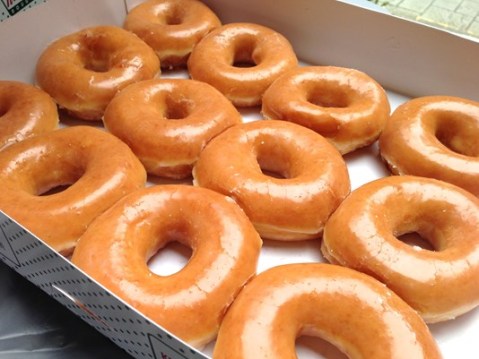
If you’re wondering what this has to do with anything, my point is that there are nut jobs all over the world like this who are sue happy and looking for a little extra money, even through a settlement. It’s imperative as a business that you carry commercial general liability insurance with product liability included. By carrying a policy for this, you have defense coverage under the policy to protect your business from even the frivolous claims.
Even though a judge could potentially throw this case out the window, there’s going to be legal fees that need to be paid no matter what. And the headache of dealing with this. Leave it to a commercial general liability policy to handle this for you so you can focus on the important things in running a business. Don’t think that only happens to the big guys like Krispy Kreme either. This can happen to ANY business, especially in litigious Southern California.
-JK
Insurance For Taco Bell Building
I post pictures of commercial buildings that I insure often here on my site. Of all the various commercial insurance risks I write, my favorite are commercial buildings, whether it be apartment complexes, retail strip malls, warehouses, or office buildings. I’d definitely consider it my main niche. I know all the best carriers for these and the appropriate coverage needed for building owners.
This is a building I insure in Lynwood, CA.
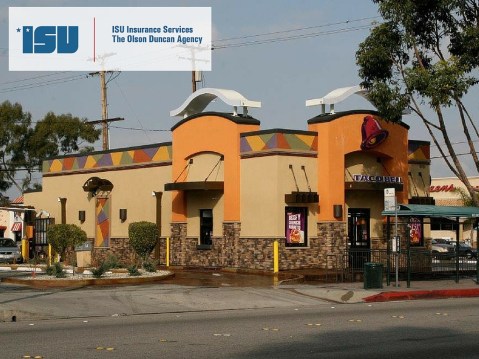
The owner was referred to me by a local banker in Palos Verdes a few years ago. They were in a rush to get the building insured practically on the spot to close a loan. As you can see, Taco Bell is the tenant of the building. The building is in beautiful shape and totally renovated. This allowed me to get coverage in place the same day.
It’s not a big flashy skyscraper, but it’s nice when you drive around town and see various businesses and properties that you insure.
The owner of this building and the banker who referred me couldn’t have been happier when we wrote this several years ago. We just renewed the property & general liability package policy in March. And hopefully we’ll be renewing for years to come representing the building owner.
-JK
Commercial Building Insurance in Compton, CA
This morning I finalized the Property & Liability insurance for this fine 55,048 square foot commercial warehouse building in Compton. Escrow set to close by Friday.
Commercial buildings are a specialty for me whether office, apartment, or manufacturing/warehouse facilities. They’re definitely my favorite niche to write.

-JK
Commercial Building Insurance – 2401 N. Palm Ave.
Congratulations to a client who closed escrow on this fine 8,250 square foot commercial building in Signal Hill on Wednesday. We wrapped up the Property, General Liability, and Commercial Umbrella insurance for the building so it’s time to move in now.

-JK
Premises Liability – Saloon Doors Episode
Whoops, sorry, kid!
-JK
Insurance For Condo Homeowners Association in Harbor City
Effective 8/9, I finalized insurance for this Condo Homeowners Association in Harbor City. This is an 18-unit, 25,850 total square feet dual building property. Coverage’s include Commercial Property insurance for the structures, General Liability, and Director’s & Officer’s Liability to help protect the association board. The expiring policy didn’t include the D&O. I was able to add this coverage and still save premium dollars compared to the renewal terms the association received from the incumbent broker.
 -JK
-JK
Insurance For Medical Office Towers In Torrance
Just wrapped up the insurance renewals for these two medical office towers in Torrance. 140,000 Square feet
- Property Insurance
- General Liability Insurance
- Umbrella / Excess Liability Insurance
- Earthquake Insurance
- Workers’ Compensation Insurance

-JK
About Me

I grew up in Fullerton, CA and graduated from Servite High School in Anaheim. I have my Bachelors degree from Loyola Marymount University in Los Angeles. I currently live in Tustin, CA.
Please contact me if you need help with any of the following lines of insurance for your business:
-Cyber / Data Breach
-Commercial Property
-Commercial General Liability
-Products Liability
-Workers Compensation
-Commercial Auto
-Umbrella/Excess Liability
-Errors & Omissions/ Professional Liability
-Employment Practices Liability
-Directors & Officers
-Life & Disability Insurance
 Jimmy Kinmartin, CPCU