
How Are Commercial Insurance Premiums Determined?
The way an insurance policy is rated determines how the policy premium is developed. Rating factors vary based on the line of insurance you are purchasing.
 If you are purchasing commercial property insurance, the building rating formula is based on factors including square footage, type of construction, sprinklered or non-sprinklered, the fire protection classification, etc.
If you are purchasing general liability insurance, the rating formula can be based on square footage, payroll, or gross sales depending on the general liability classification codes used. These are known as rating exposures.
Once the rating exposures are identified and the deductibles selected (usually from information you have provided on the application), the premium is calculated by a simple formula: rate x exposure = premium. The deductible amount you choose will be calculated in the rate. The higher the deductible (the amount you choose to self-insure) the lower the rate. By utilizing higher deductibles, you can bring your premium cost down; however, you do not want to jeopardize your company’s financial future by choosing overly large deductibles.
Speak with your broker-agent for the deductible options available to you when purchasing commercial insurance.
The basic rating equation most often utilizes other modification factors, which can include experience modifications, schedule rating, or judgment rating. Because rating formulas can range from simple to complex, depending on the line of insurance, it is important to discuss how your policy is rated and how the policy premium is calculated with your broker-agent.
Source: California Department of Insurance
-JK
Avoid the Jolt from a Lightning Bolt!
I came across this fierce 30 second video on Youtube today of a lightning bolt striking the shore of a beach about a hundred or so yards from a hotel balcony where some guy was filming. Check it out (some cursing included so beware)
The force and power are so crazy it knocked the guy back a little bit!
Living in Southern California, we don’t see a lot of intense thunder and lightning, but you should learn to identify the early signs of an oncoming thunder and lightning storm.
Typically you’ll see towering clouds in the shape of a cauliflower, dark sky, distant rumbles of thunder and flashes of lightning. When a storm is on the verge of striking your area, you need to take cover to get out of harm’s way.
Here’s how:
- Seek shelter in an enclosed building, if possible.
- If you are in a car, stay inside and keep the windows securely rolled up.
- Do not use a small shed, pavilion or lean-to as shelter; they do not provide enough protection.
- Stay several feet away from open windows, sinks, toilets, tubs, showers, electric boxes, outlets and appliances during a lightning storm. Lightning bolts can flow through these items, “jump” to you and give you a jolt.
- Do not use a landline telephone during a storm. Opt for a cellular or cordless phone, which is not connected to the building’s wiring.
If you are caught outside in a lightning storm:
- If your skin starts to tingle or your hair stands up, lightning may be about to strike. Crouch to the ground on the balls of your feet and place your feet close together. Then, place your hands on your knees and lower your head. Try to get as close to the ground as possible without placing your hands or knees on the ground.
- Avoid seeking shelter under trees, near metal fences, pipes or tall and long objects.
- If you are swimming, boating or fishing, seek shelter on land immediately.
- If you are boating and cannot get to shore before the storm hits, crouch your body down in the middle of the boat, as low as you can get.
Next time you’re in the path of a thunderstorm, you can stay cool knowing Jim Kinmartin taught you everything you need to know about dealing with it ;).
Planning is important when it comes to preparing for storms, and that includes having the proper home or business insurance. Contact your broker or me to learn more about insurance solutions for your home, business and life.
–JK
The Importance of Terrorism Insurance
In the wake of the recent Boston Marathon bombings, the issue of terrorism was brought to light again as a harsh reality we face this day in age in the United States and throughout the world.
Bob Hartwig of the Insurance Information Institute http://www.iii.org interviewed on FOX recently talking about terrorism insurance for businesses.
A standard business policy does not cover for damage or loss of business due to an act of terror. In an age where terrorism is becoming “the new normal”, having the proper coverage is important.
Contact me if I can help with questions on terrorism insurance, or the Terrorism Risk Insurance Act and how it relates to you business insurance.
-JK
What To Do In the Event of An Insurance Claim
When you deal with an incident that gives rise to an insurance claim, it’s usually a pretty crappy situation. It can be stressful, terrifying, frightening, and alarming in many cases. First things first, try not to panic. Hopefully it’s an incident you carry insurance for to be protected.
Your insurance contract requires that you report all claims promptly. Contact your insurance carrier or broker as possible after a property, liability, worker’s comp or automobile claim. An insurance company claims adjuster will be assigned to handle your claim. You should then be able to deal directly with the adjuster to settle your claim, but your broker can be there with you to assist you along the way.
Here’s step-by-step suggestions on how you should handle property, liability, workers compensation, and auto insurance claims.
Property Claims
In the event of damage to your building or contents:
- Protect the property from further damage:
- Call the proper authorities and utilities (gas, electric, telephone).
- Take photos of the damage before having emergency repairs made, such as boarding up windows or covering holes in the roof.
- Call your insurance broker or carrier to report the loss.
- Call a contractor to estimate the building damages.
- Separate damaged contents from undamaged contents. Do not discard any items until the claims adjuster gives you the authority to do so.
- Keep records of expenses if you are forced to temporarily relocate your business.
- Do not authorize repairs until the claims adjuster has given you the authority to do so.
After the claim is reported to the insurance company, the claims adjuster will:
- Contact you by phone or mail to discuss the loss
- Arrange for an appraiser to inspect extensively damaged property
- Assist you with your choice of contractors to make the repairs
- Contact you for a settlement
Liability Claims
In the event of injuries or damage to property of others which you allegedly caused:
- Call your insurance broker or carrier to report the claim.
- Forward any correspondence, including a summons from an attorney representing the other party.
- Do not discuss the claim with the other party or their attorney. Refer them to your insurance company’s claims adjuster or to us.
After the claim is reported to the insurance company, the claims adjuster will:
- Contact you to discuss the incident that allegedly caused the injury or damage to the property
- Deal directly with the other party and/or attorney to handle the claim
Workers’ Compensation Claims
In the event an employee is injured on the job:
- Complete the Employer’s First Report of Injury or Disease form for all claims. Either use the “call in” reporting system or fax the original form to the insurance company.
- Forward a copy of the First Report to your broker in the event of a disabling injury or death claim. They should follow-up with the insurance company for their prompt handling of the claim.
- Contact the insurance company to question the status of a claim. If you experience delays or have questions, contact your broker for assistance.
After you report the claim to the insurance company, the claims adjuster will:
- Contact the injured employee to discuss the accident
- Request copies of bills and doctors’ reports for medical treatment administered
- Contact you, the employer, if there is any lost time from work as a result of the injury
Auto Insurance Claims
In the event of an automobile accident:
- Report the accident to the police.
- Obtain information about the other people involved in the accident such as:
- Names, addresses and phone numbers
- Insurance company
- Type of vehicle
- Auto and driver’s license numbers.
- Have your vehicle towed to the nearest repair shop if the vehicle is not drivable. Do not authorize repairs until the claims adjuster gives you the authority to do so.
- Call your insurance broker or carrier to report the accident.
In the event of a windshield, vandalism or theft loss:
- Report the vandalism loss or theft to the police.
- Call us to report a loss.
After the claim is reported to the insurance company, the claims adjuster will:
- Contact you to request details of the accident and repair estimates
- Arrange for an appraiser to inspect the damages of vehicles that are not drivable or extensively damaged
- Contact you for a settlement
- Deal directly with the others involved in the accident
You should not talk to others involved in the accident, but refer them to your claims adjuster.
-JK
Source: Zywave, Inc.
Preventing Copper Theft
Have you ever noticed how many stories there are in the local news about stolen copper? From construction sites to vacant buildings, theft of copper has become a major problem for many communities throughout the country. Skyrocketing metal prices, especially copper, have made what was once a minor issue into a major problem costing over $1 billion/year according to the US Dept of Energy. Copper is recyclable and does not have any identifying marks making it difficult to determine if the metal is actually stolen property.
From pipes to wires to cables to rain gutters, copper components like these are being torn from walls and buildings. Thieves target copper in vacant buildings or difficult to secure areas including:
- Construction Sites – theft of copper plumbing, wiring, generators and materials.
- Vacant Buildings – theft of copper plumbing, wiring, air conditioners.
- Communications Towers – theft of copper wiring and cables.
- Electrical Sub-stations – theft of copper grounding bars and cables.
- Foreclosed Properties – theft of copper plumbing, wires, sprinkler systems, and cooling systems.
In addition, the collateral damage done from ripping pipes and wires out of walls far exceeds the actual cost of the copper stolen.
Copper Theft Crime Tips
Here are a few tips we recommend to help prevent copper theft:
- If you see something suspicious, say something
- Tour your property – take away the opportunity to steal
- Inventory your equipment and take photographs
- Lock copper materials inside buildings and utilize security cameras whenever possible
-
Remove the exterior of your exterior air conditioning units and spray paint the copper tubing with a fluorescent orange or green paint. Then replace the exterior
Here’s some more useful information on preventing copper theft from Church Mutual Insurance Company
-JK
Source: Long Beach Police Department
Solar Panel Fire Insurance
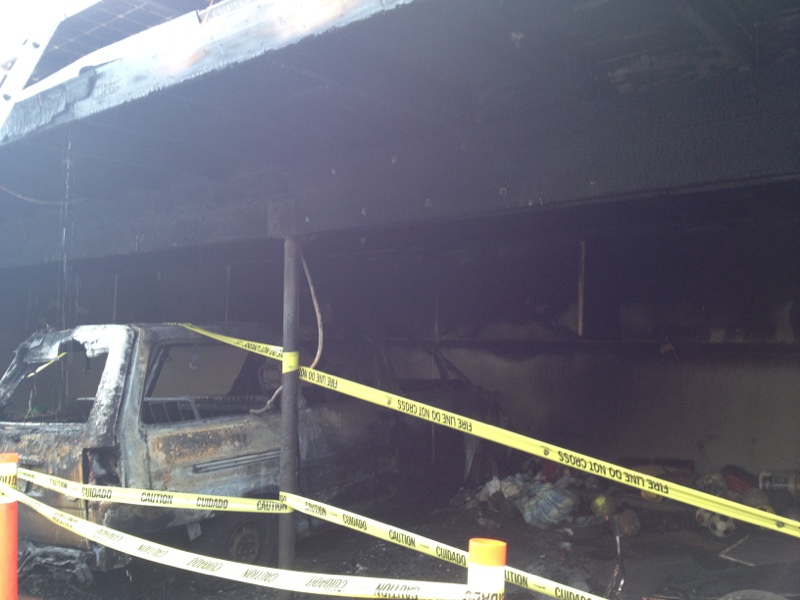
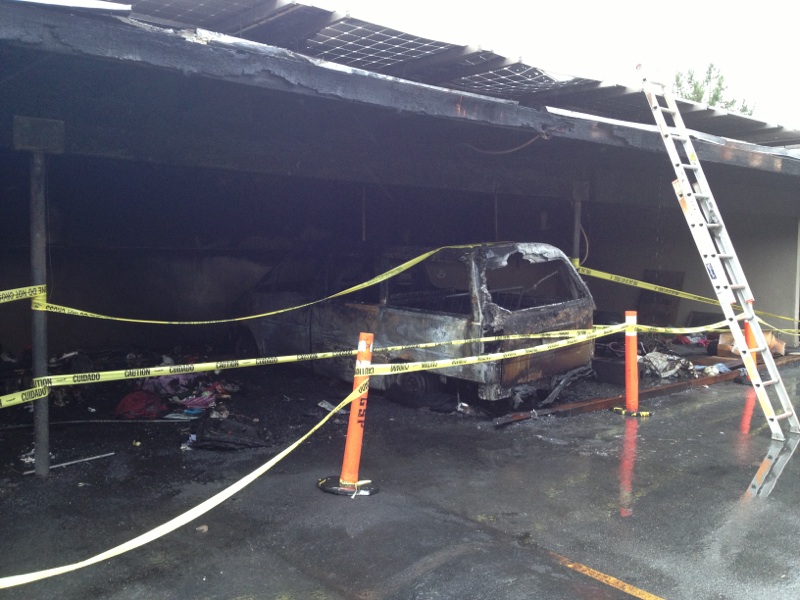
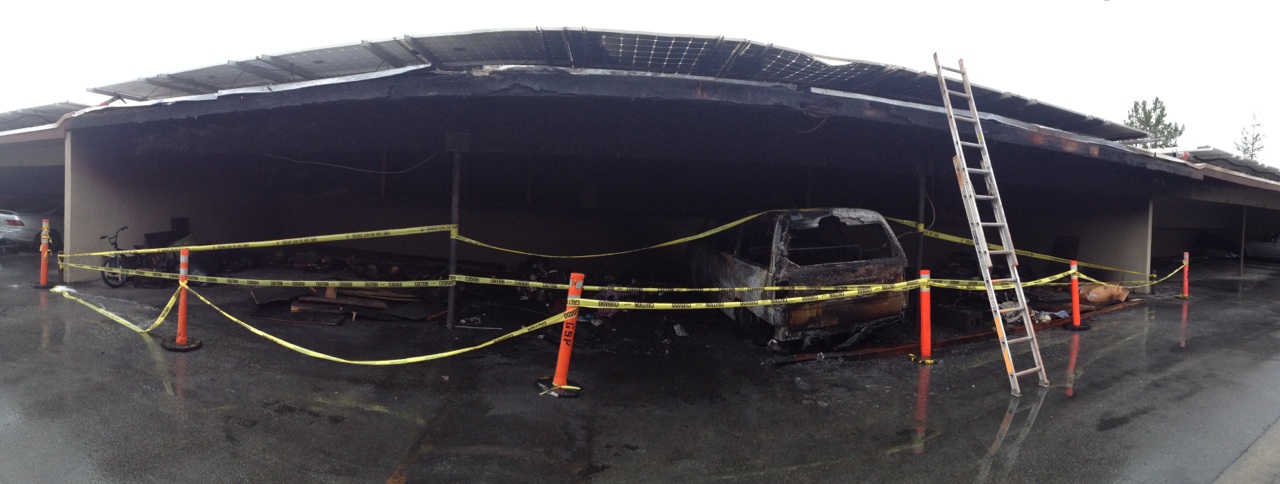
Check out these pictures showing fire damage from a car fire which spread throughout the car port it was parked under. The fire damaged solar panels affixed to the roof which are operated by an insured of mine. Good thing for property insurance. The claim has been submitted with the carrier and we’re working on getting these fixed and back in order. Not only does the property need to be replaced, but the insured will need to be compensated for lost income due to the business interruption.

-JK
Office Waterfall
I can across this picture on Reddit today of an office getting pounded by water from a pipe burst in the ceiling:

Looking at this picture, I’ll guarantee you this business didn’t expect Niagara Falls to be suddenly pouring through their ceiling on this day.
Which leads me to the topic of insurance.
Insurance is intended to cover sudden and unexpected losses like burst pipes and fires among other things.
I talk to all different types of businesses on a weekly basis about their insurance. From offices to stores, manufacturers to distributors, and everything in between. A common sentiment I get when discussing coverage’s is, “I don’t need that, it’ll never happen to me.”
Let’s hope this business didn’t skimp out on insurance to save money thinking this would never happen to them. Not only is there a major property loss, but what about the downtime and all the intangibles you don’t even think about that result from a loss. What if you’re the business located downstairs?
The point is, a loss can happen to anyone, anytime. Be prepared. Be proactive, not reactive. A loss to this magnitude can put you out of business for good if your don’t have the proper risk management tools in place. Don’t wait to learn the hard way.
-JK
Business Income Insurance – Coverage to Help Keep a Business Running
When disaster happens, a business may need to close temporarily. And when closed, that means loss of income.
 Loss of income is one of the main reasons most businesses don’t reopen after a serious loss. Expenses don’t suddenly go away. In fact, they may spike significantly. Without revenue, it can be difficult for a business to survive.
Business Income insurance helps keep the capital flowing when a businesses doors are shut temporarily and indefinitely after a loss.
With business income insurance, you are reimbursed for revenues lost during downtime when your property is damaged by fire, theft, vandalism or a natural disaster. Business income will also reimburse for expenses incurred to minimize the suspension of business operations, such as rent paid for a temporary office while the damaged property is being repaired.
What’s more, options might include coverage for business interruption resulting from:
- Loss of off-premises utility services, including water, communication or power
- Loss to a dependent property, such as a major supplier or customer
- Electronic vandalism for business conducted over the Internet
- Food contamination in restaurants and food service businesses
Business income coverage is usually included under a property insurance policy, but you should double-check that you have this and understand what the terms of the policy form are. If you have a Businessowners insurance policy, business income insurance will most definitely be included under the policy.
Source: The Hartford
Water Damage Exclusions On A Property Insurance Policy
In my last blog post, I shared information on the water damage loss a client of mine suffered the week of the 4th of July.
Water damage claims can be tricky. Here’s what you need to understand about water damage when it comes to insurance coverage.
When your building and/or its contents have suffered water damage, it’s never a good situation. It’s more prone to happen if you have not been properly maintaining your building. Probably the two biggest characteristics of the building that apply to water damage claims are the roof and plumbing. If you have ever purchased property insurance for a building you own, or a space you lease, you are asked what year the building was built. If it’s over 25 years in age, insurance carriers typically want to know when the last renovation or update was made on the roof and plumbing, as it can affect your contents and the likelihood of water damage.
The property insurance policy defines water damage as “accidental discharge or leakage of water or steam as the direct result of the breaking or cracking of any part of a system or appliance containing water or steam.”
What could this mean for you? Assume for a minute that the gutters on your building are rusty and water is not being properly diverted off your roof. A rainstorm pushes water through the weakened area into your roof. Water leaks under the eaves, into your walls and starts to pool. And because it was over a weekend, your desk is now an island in a small lake. This damage is not covered by your insurance because it is due to improper maintenance, not a sudden and unforeseen event.
You should also know that flood, including the “accumulation of surface water, waves, tides, tidal waves, overflow of streams or any other bodies of water, or their spray, all whether driven by wind or not” are NOT covered under a property insurance policy. You must have a separate flood insurance policy in place to protect your business from these perils.
A general rule of thumb is water rising from the ground up is generally not covered by property insurance, unless you have your policy endorsed to include sewer or drain backup.
If in doubt about whether you’re covered or not for certain aspects of water damage, contact your agent or broker to discuss.
-JK
Nasty Water Damage Loss; Insurance Claim
Upon returning to my office last Thursday morning after the July 4th “holiday”, we received a call from a client who returned to their office after the day off, only to find every square inch of their floor covered by 2-3 inches of water.
At first glance, they weren’t overly concerned about what they saw, but as they entered the building, they realized this was a severe loss for them. It turned out the sink in the break room had been building up pressure which caused the faucet head to shoot like a rocket across the room knocking a 5-inch wide hole through a wall and sprayed water like a fountain throughout the office for over a day.
The phones had been knocked out, employees couldn’t enter the building, and the entire office was under water. They needed help, fast.
We immediately called the claim in to the carrier and contacted a damage restoration company to get in there to begin cleaning up the mess. The restoration service company ended up spending the entire day Thursday sucking up the thousands of gallons of water.
On Friday morning, I visited my client’s premises to check it out and meet with the carrier claims adjuster, plumbers, contractors, and my client.
Here are some pictures of the damage:
The good news is insurance coverage is in place to help with this loss. Not only are the repairs being made, but there is business interruption coverage and the carrier found a temporary office to relocate our insured while their office is being repaired. In a conversation I had with our client, they told me they see the value of their insurance more now than they ever had. Unfortunately, there are many businesses out there who don’t see the value of carrying insurance, thinking issues like this will never happen to them. And when it does, they learn the hard way. With a six-figure loss like this, would your business survive without insurance?
About Me

I grew up in Fullerton, CA and graduated from Servite High School in Anaheim. I have my Bachelors degree from Loyola Marymount University in Los Angeles. I currently live in Tustin, CA.
Please contact me if you need help with any of the following lines of insurance for your business:
-Cyber / Data Breach
-Commercial Property
-Commercial General Liability
-Products Liability
-Workers Compensation
-Commercial Auto
-Umbrella/Excess Liability
-Errors & Omissions/ Professional Liability
-Employment Practices Liability
-Directors & Officers
-Life & Disability Insurance
 Jimmy Kinmartin, CPCU