
Hail Damage Photo – McAllen, TX
Take a look at this incredible shot of some hail damage at a Starbucks store that occurred in McAllen Texas last night. This picture came from the National Weather Association.
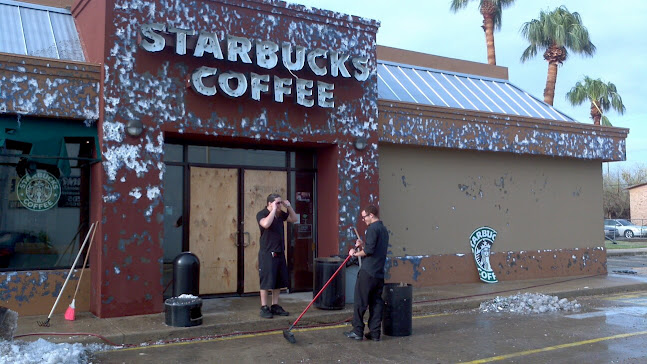
Windstorm or hail damage is a covered cause of loss on a property insurance policy. Here in California, I can’t imagine ever seeing hail as severe as this, but the picture was incredible enough to share.
–JK
My Business Will Be Closed For Termite Fumigation. Am I Covered By My Insurance?
I received an interesting call this week from a client with a really unique question, definitely the first I had ever been asked this one: “My business will be closed for three days for termite fumigation, am I covered by my business insurance?”
 Not a bad question actually.
This insured is a local hair salon which is located in a four-story building where the ground floor consists of retail shops and the upper floors are all residential condominiums. The building needs to undergo termite tenting and the business on the ground floor will be forced to close their doors for three days. There are three businesses total, but one of them is a restaurant and the homeowners association can only afford to pay one days worth of income for the restaurant, and the restaurant only.
What about the other two days and the other two business tenants??
This is when my client called to ask if his policy would provide such coverage.
The answer to this question is unfortunately, no. There is no business income/interruption coverage provided by a property insurance policy. The tenting of the building for termite fumigation purposes is not a covered cause of loss. Not to say that there are no carriers out there who offer some kind of special endorsement for something like this, but it’s very unlikely. I am not aware of any myself and even ran it by the carrier underwriter to be certain.
However this homeowners association decides to handle it has yet to be determined, but insurance isn’t the solution to the business closures in this scenario.
–JK
Massive Overnight Fire Destroys Businesses in Cerritos
This morning I woke up and was having my morning coffee and catching up on the news when I read on Twitter that a major fire broke out locally overnight and destroyed a retail strip mall about four miles from my home. I decided to jump in the car to check out the scene of the fire. Here’s a short video I took:
According to the Cerritos-Artesia Patch, flames burned for more than three hours at Cerritos’ Fountain Plaza, destroying businesses in the two-story strip mall. Estimates are the fire caused about $5.5 million in damages.
The blaze broke out at 2 a.m. Sunday, Oct. 23 and burned for more than three hours, according to the Los Angeles County Fire

Cerritos on the map
Department. About 75 firefighters were on scene to battle the massive blaze.
The fire reportedly began at a Chinese restaurant in the building along the back-end of the shopping plaza — then spread to adjoining businesses. The roof of the restaurant eventually caved in as firefighters tried to tame the flames, according to reports from the scene.
Aside from the restaurant, the commercial building also housed at least 10 other businesses, including an ultrasound clinic, a dental practice, and an escrow firm.
Damage to the structure was estimated at $4 million, and roughly $1.5 million worth of contents were also destroyed, a county fire inspector said. The cause of the fire was not yet known.
Lesson Learned
When’s the last time you reviewed your property insurance coverage? Do you have adequate coverage to protect your assets? What about business interruption coverage? Whether you own a commercial building or a business, don’t think that a catastrophic fire won’t ever happen to you! This single fire completely destroyed ten different businesses. Not only are all the contents destroyed from fire and water, but all the businesses will need to be re-built and relocated. It will be quite some time before operations are restored, but the bills won’t stop coming. The salaries, loans, mortgage, and overhead still need to be paid. Don’t get burned before it’s too late.
–JK
Know Your Deductible
Picture this scenario- You own a pizza parlor. It’s late Tuesday evening and business is closed as you are getting your premises fumigated. You have the pest control company at your premises to “bug bomb” the joint. As a passerby walks by your front window, he thinks he sees smoke and frantically calls the fire department. The fire department arrives and see’s “smoke” so they break down your front door and hammer through your front window to access the interior only to find out that the white stuff wasn’t smoke. Rather, a routine pest control measure you’re trying to take to maintain your restaurant.
 The end result? You get called to come down to the scene. You have to temporarily board up the front door and windows to keep things safe until the morning; and when the morning arrives, you have a contractor come out to fix everything so that you’re back in order for business.
When it’s all said and done, the contractor gives you an invoice for $2,800. You call your insurance carrier to put a claim in on the loss. In the process, your claims adjuster advises that you carry a $2,500 deductible. “Ahhh man! That means it’s coming out of my pocket!”
Have you ever experienced a similar situation where you find yourself paying out a loss entirely because your deductible was high? Was it burdensome for you to have to pay, or do you wish you had a lower deductible to save some cash?
The reality is people’s preferences are different when it comes to insurance and their deductibles. Some businesses like higher deductibles to save some money on their insurance premium. They may feel anything under their deductible amount wouldn’t be an issue to cover out-of-pocket. Or, they don’t anticipate many losses, so it’s not a big deal. For others, an unexpected loss like this might put them in a financial bind, but they never knew what their deductible was in the first place.
Solution
The story above is a true story. It happened to a client of mine last week. Since he carried a $2,500 deductible on a $2,800 insured loss, we didn’t move forward with the claim. Yes, it was a burden to have to fork out $2,800, but luckily it wasn’t too much for him to handle. However, we did make some changes on the deductible, and it really didn’t impact the premium much at all looking at the big picture:
- Changing the deductible from $2,500 to $1,000 = Additional annual premium of $114
- Changing the deductible from $2,500 to $500 = Additional annual premium of $194
So what’s the moral of this story? For one, know what property insurance deductible you carry, and two, picture yourself in a loss. Can you handle the deductible, or will it put a dent into your savings? Why not play with the different deductible options to see what difference in annual premium you’re looking at. Really, it’s not much in the grand scheme of things. You never know when the fire department might be banging down your front door.
–JK
Can Your Business Survive a Natural Disaster?
I am happy to share this article from Inc. Magazine which I was interviewed for and quoted on. The basis of the article is – Don’t let a natural disaster spell ruin for your business. Make sure you’re protected against natural disasters such as earthquakes, flood, hurricanes, tornadoes and recoup on your financial loss.
Read the article HERE

Thanks!
–JK
Property Insurance Coverage Exclusion – Water
This post isn’t terribly exciting, but true. So I must share.
A client called me on Monday, a pizza parlor, about some troubles they have been dealing with over the past two months. A foul sewage-like odor had been permeating throughout the kitchen area of the restaurant and sometimes even the seating area. Nobody had an idea of where it was coming from. There had been no sewage back-ups or signs of plumbing problems or anything. The “porta-potty” like odor started to become a significant problem for the restaurant as it grew stronger and started pushing customers away. Finally, our client called the building owner to come check it out (this is another story).
 It turns out there was a small pipe underground in the kitchen slowly dripping over the course of a month that was saturating the ground and walls and pushing through the vents which affected the entire two-story building with a foul odor. Plumbers had to jack-hammer the concrete floor in the kitchen to get to the leaky pipe and patch it. Then put it all back together. The cost was paid out-of-pocket by our client who is NOT the building owner, nor responsible for this loss in his lease. Now he’s dealing with the building owner on trying to collect on the loss. I visited last night and it still smells like crap in there which is not good for business. In fact, business has dropped a bit which has our client stressing!
From an insurance standpoint, it should be noted that a loss like this is NOT typically covered on a property insurance policy. If you review a property insurance special policy form, you’ll find the following language under the list of exclusions:
Water:
- Flood, surface water, waves, tides, tidal waves, overflow of any body of water, or their spray, all whether driven by wind or not
- Mudslide or mudflow
- Water that backs up or overflows from a sewer, drain, or sump; or
- Water under the ground surface pressing on, or flowing or seeping through (a) foundations, walls, floors or paved surfaces; (b) basements, whether paved or not; (c) doors, windows, or other openings
*If water results in fire, explosion, or sprinkler leakage, carriers will typically pay for the loss or damage caused by that fire, explosion, or sprinkler leakage.
It remains to be seen how this whole ordeal will be play out between our client and his landlord, but a good rule of thumb to understand about water damage claims is: if water rises from the ground up and causes property damage, it’s generally excluded from coverage. However there are endorsements such as “sewer drain and backup” that can be added on Businessowners policies to give coverage back in some scenarios. Be sure to clarify with your agent/broker about your property insurance policy.
–JK
Clean Up Your Mess!
I wrote insurance coverage for a commercial building earlier this year, property and general liability, only to receive a phone call a couple of months later from the carrier telling me that an inspection was done on the building and for lack of a better term, the premises was an absolute mess. It needed a fix quickly, or coverage was going to be cancelled short-term. The call took me by surprise so I decided to visit the property myself. Here’s what I discovered:
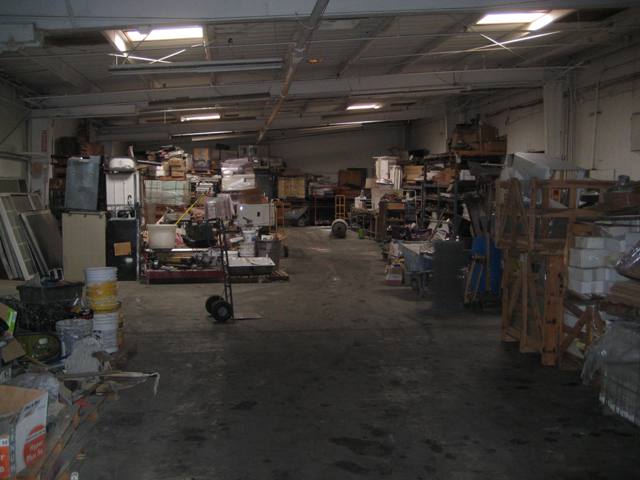


This was borderline hoarding. Storage was disorganized, with random articles stacked in solid piles up to the ceiling in some areas. There were no aisles and inadequate means of getting out from the storage area in the event of an emergency. Combustible material was stacked near an electrical switch, box, and panels, etc.
The loss control recommendation from the carrier: housekeeping. “There is excessive storage of combustible inventory and miscellaneous material throughout parts of the warehouse. Such arrangement of material (with 1 small walking path) could impede safe egress from the structure; The volume of closely packed material increases exposure to a rapidly spreading fire. The material also obstructs access to fire extinguishers and is stacked adjacent to electrical boxes and panels; The heavy fire load may not be controlled by the existing sprinkler system.”
The recommended solutions to this mess?
- The inventory should be rearranged so all electrical boxes/panels have a 3′ radius free of combustible material.
- The inventory should be rearranged to allow access to fire extinguishers.
- The inventory density should be reduced to allow better access to storage areas and improved water distribution for the sprinklers.
- Housekeeping should be improved and then maintained on a regular basis.
This is one of the most extreme examples of a disorderly premises that I have encountered. It doesn’t take an insurance professional to know that this is a severe property and general liability insurance hazard. There is absolutely no way of writing insurance with any carrier if you have a premises in this kind of shape. The risks are just too extreme. I’m not an obsessive compulsive neat freak by any means, but I ask myself if this insured has any bit of concern for protecting their assets? The point here is about risk management and risk reduction, not about making things look pretty at your home or business.
What type of housekeeping do you maintain at your home or business?
–JK
Sunset Beach, CA $10M House Fires
So, yes, this is a blog devoted to business insurance topics, but sometimes events happen close to home that stir interest and are worth writing about. One such event is a major fire that occurred Thursday in Sunset Beach, only a few miles from home down the road on Pacific Coast Highway.
At least three different million dollar beach-front homes were severely damaged or destroyed by an intense fire. More than 80 firefighters responded to the four-alarm blaze shortly before 5 p.m. Thursday afternoon. One of the homes involved actually collapsed from fire damage and two others sustained major damage.
Here’s some raw footage from YouTube user medxproductions:
Firefighters from Newport Beach, Huntington Beach, Fountain Valley and the county fire authority fought the blaze. The cause of the initial fire might have been an overturned barbecue grill, officials said.
The Orange County Fire Authority advised that damage to the four buildings could reach $10 million . That includes damage and contents to the four homes torched by the fire, three of which have been red-tagged and deemed uninhabitable.
One neighbor said “I always imagined that we would have an earthquake or tsunami, but never a fire. It‘s one of those things that you actually don‘t prepare for.” As an insurance agent, these are infamous last words often heard after a major loss. Sadly, many don’t feel like an event of this magnitude will ever happen to them. As a result, they might pass on insurance, or under-insure their belongings and possessions in order to “save money” on premiums.
Regardless, summer is approaching and barbecue season has arrived. Now that the season is here, it’s essential that you’re barbecuing safely. Here are some recommendations provided by the U.S. Fire Administration:
Use Barbecue Grills Safely
- Position the grill well away from siding, deck railings, and out from under eaves and overhanging branches.
- Place the grill a safe distance from lawn games, play areas, and foot traffic.
- Keep children and pets away from the grill area by declaring a 3-foot “kid-free zone” around the grill.
- Put out several long-handled grilling tools to give the chef plenty of clearance from heat and flames when cooking food.
- Periodically remove grease or fat buildup in trays below grill so it cannot be ignited by a hot grill.
- Use only outdoors! If used indoors, or in any enclosed spaces, such as tents, barbecue grills pose both a fire hazard and the risk of exposing occupants to carbon monoxide.
Charcoal Grills
- Purchase the proper starter fluid and store out of reach of children and away from heat sources.
- Never add charcoal starter fluid when coals or kindling have already been ignited, and never use any flammable or combustible liquid other than charcoal starter fluid to get the fire going.
Propane Grills
- Check the propane cylinder hose for leaks before using it for the first time each year. A light soap and water solution applied to the hose will reveal escaping propane quickly by releasing bubbles.
- If you determined your grill has a gas leak by smell or the soapy bubble test and there is no flame:
- Turn off the propane tank and grill.
- If the leak stops, get the grill serviced by a professional before using it again.
- If the leak does not stop, call the fire department.
- If you smell gas while cooking, immediately get away from the grill and call the fire department. Do not attempt to move the grill.
- All propane cylinders manufactured after April 2002 must have overfill protection devices (OPD). OPDs shut off the flow of propane before capacity is reached, limiting the potential for release of propane gas if the cylinder heats up. OPDs are easily identified by their triangular-shaped hand wheel.
- Use only equipment bearing the mark of an independent testing laboratory. Follow the manufacturers’ instructions on how to set up the grill and maintain it.
- Never store propane cylinders in buildings or garages. If you store a gas grill inside during the winter, disconnect the cylinder and leave it outside.
Commercial Insurance or personal insurance, fires are a reality for all and should not be taken lightly. They don’t discriminate on who they target. Learn from events like these that this can happen to anyone. Be certain your property insurance policies are up to date with the coverages you need to protect your livelihood.
–JK
What is Inland Marine Insurance?
Without prior knowledge of ‘Inland Marine’ insurance, you might think this is some kind of boating insurance or something. Ironically, it’s not. Marine insurance is a type of property coverage that has a long history behind it.
Marine insurance came into existence in the early days of shipping when merchants relied on bodies of water such as oceans, rivers, and canals as their main routes of transportation.

Source: Cunnington & Associates Inc
Then the twentieth century came along, and with it, a whole new system of transportation: planes, trains, and automobiles. With this, the demand for insurance to protect goods in transit over land came into existence. This is where inland marine insurance was born.
Inland marine is one of the most varied types of Property & Casualty insurance with many unique and unusual exposures. It is a form of property insurance, but the distinction between property and marine coverage can be very confusing. As a general rule, property coverage is designed to cover stationary property, property that predominately remains at a “scheduled” premises, and property not considered “unique.” Inland marine coverage is intended for property that may be moving from location to location, property off premises at new locations, temporary locations, or work locations, and/or subject to “unique” causes of loss that traditional property policies do not cover.
The four major types of inland marine coverages written today are:
- Property being transported
- Buildings under construction (builders risk)
- Computer equipment and data
- Contractors equipment
There are numerous other inland marine policy coverages written to handle expensive and unique property situations. They include:
- Accounts Receivable
- Bailee’s Coverage (for property of others accepted for cleaning, repairing, etc)
- Camera and Musical Instruments
- Exhibition Floater
- Equipment Dealers
- Fine Arts
- Furriers Block
- Jewelers Block
Does your business need Inland Marine Insurance?
Depending on the type of small business you own, this coverage can be essential to protecting business property. Consider any items you place in your car or truck daily to get your work done or the valuables, including data, you own or are responsible for. Most property policies limit or exclude coverage for these items.
Or maybe you are in the construction trade or are building an addition to your office. Inland Marine Insurance can protect the building materials—and a contractor’s tools and equipment.
If you clean, repair, service or perform work on property of others, Inland Marine Insurance can work for you. It can cover losses to goods that occur at your premises, while being transported to or from your premises or in storage.
These are just a few examples.
As you can see, marine insurance means a lot more than what it sounds like from the surface. Don’t let the term “Marine” fool you. It’s not just some kind of boating insurance. Rather, inland marine insurance is one of the most varied types of Property & Casualty insurance on the market that shouldn’t be overlooked.
–JK
Flood Damage Vs. Water Damage – There Is A Difference
It has been raining a lot this week in Southern California and I just wrote a flood insurance policy for the first time since 2007, so this is a post about floods. Got it?
Anywhere it rains, it can flood. What defines a flood you ask? A flood is “a general and temporary condition where two or more acres of normally dry land or two or more properties are inundated by water or mud-flow.” Many conditions can result in a flood including: hurricanes, broken levees, outdated or clogged drainage systems and rapid accumulation of rainfall.

IMAGE SOURCE PAGE: http://thegazette.com
Just because you haven’t experienced a flood in the past, doesn’t mean you won’t in the future. Flood risk isn’t just based on history, it’s also based on a number of factors: rainfall, river-flow and tidal-surge data, topography, flood-control measures, and changes due to building and development.
Flood is not a covered peril on your property insurance policy. However, that doesn’t mean water damage is not covered at all. There’s a difference between flood damage and water damage and it’s important that you know the difference when it comes to insurance coverage.
FLOOD INSURANCE
As the name implies, a standard flood insurance policy, which is written by the National Flood Insurance Program, provides coverage up to the policy limit for damage caused by flood. The dictionary defines “flood” as a rising and overflowing of a body of water onto normally dry land. For insurance purposes, the word “rising” in this definition is the key to distinguishing flood damage from water damage. Generally, damage caused by water that has been on the ground at some point before damaging your home is considered to be flood damage. A handful of examples of flood damage include:
- A nearby river overflows its banks and washes into your home.
- A heavy rain seeps into your basement because the soil can’t absorb the water quickly enough
- A heavy rain or flash flood causes the hill behind your house to collapse into a mud slide that oozes into your home.
Flood damage to your home or business can be insured only with a flood insurance policy — no other insurance will cover flood damage. Flood insurance is available through your insurance agent, insurance company or local Federal Emergency Management Office (FEMA). An excellent resource for flood insurance is Floodsmart.gov, the official site of the NFIP.
HOMEOWNERS/ COMMERCIAL PROPERTY INSURANCE
Homeowners insurance and commercial property insurance policies do not provide coverage for flood damage, but they do provide coverage for many types of water damage to your property. Just the opposite from flood damage, for insurance purposes, water damage is considered to occur when water damages your home before the water comes in contact with the ground. A few examples of water damage include:
- A hailstorm smashes your window, permitting hail and rain free access into your home.
- A heavy rain soaks through the roof, allowing water to drip through your attic or ceiling.
- A broken water pipe spews water into your home.
It’s important to note that flood insurance and homeowners insurance do not duplicate coverage for water damage. Instead, they complement each other.
It is up to you to talk to your insurance agent or insurance company about flood insurance and homeowners insurance, and then decide which insurance coverage you need to protect your home, its contents and your family.
Source: Insurance Information Network of California
–JK
About Me

I grew up in Fullerton, CA and graduated from Servite High School in Anaheim. I have my Bachelors degree from Loyola Marymount University in Los Angeles. I currently live in Tustin, CA.
Please contact me if you need help with any of the following lines of insurance for your business:
-Cyber / Data Breach
-Commercial Property
-Commercial General Liability
-Products Liability
-Workers Compensation
-Commercial Auto
-Umbrella/Excess Liability
-Errors & Omissions/ Professional Liability
-Employment Practices Liability
-Directors & Officers
-Life & Disability Insurance
 Jimmy Kinmartin, CPCU