
10 Good Questions To Ask About Business Auto Insurance
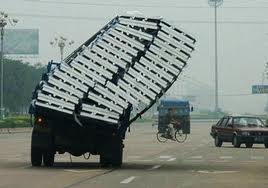 On any given workday, you may have employees on the road operating a variety of vehicles. Whether you provide company vehicles or your employees use their own vehicles, commercial auto insurance is a must.
Commercial/ business auto insurance provides coverage for cars, trucks and vans used by you or your employees for business purposes. Your business vehicles are not covered by your businessowners policy or personal auto insurance, so you must buy a separate policy.
When shopping for the right coverage for your business, here are ten good questions to ask about business auto insurance:
1. Is coverage mandatory for a business that uses vehicles?
Yes. Just like with personal auto insurance, it’s against the law to drive a vehicle without insurance to cover injuries or damage to others that an employee causes as a result of a car accident.
2. Is Business Auto Insurance better than Personal Insurance?
Business Auto coverage is similar to the coverage you may carry on your personal auto policy; however, business auto exposures can be more complex requiring specialty coverages to be considered based on individual business needs.
3. How do I find out about what’s out there?
The most effective way to compare rates and coverage available to you is through an independent agent or broker. They should be able to point you to the right type of policy based on the type of business you have and how you use your vehicles.
4. What can I do to influence the premium I pay?
The best ways to keep rates down is to make sure that you’re a safe driver, hire and employ safe drivers and use less expensive vehicles for your business.
5. What factors impact the premium I pay for Business Auto Insurance?
Insurance premiums can be affected by everything from the type of business you operate, to the type of vehicles you own; to the radius you operate your business in, and the driving records of yourself and your employees.
6. What is the reputation of the insurance company?
Make sure you do the research before moving forward with a Business Auto policy. Ask your insurance representative or go online to answer questions like — Do they have a long history? Are they reputable? Do they know your business?
7. What extra benefits are added onto the policy without additional cost?
Every insurance company is different. So make sure to ask about extra benefits when shopping around, because they could prove useful when an accident happens and save you money in the long run.
8. Does coverage vary state to state?
It definitely can. Each state has its own rules and regulations that can affect rates and types of coverage that an insurance carrier can make available to your business.
9. Are all my employees covered by my Business Insurance policy?
They should be, but there are exceptions. This is a very important question to ask when you’re shopping around for the best Business Auto policy.
10. How does the claims process work?
The process usually includes reporting an accident to both the police and your insurance company, assessing the damage, and working with a claims handler. When selecting an insurance carrier, be sure to ask about any benefits they offer in the event of an accident, like a network of repair shops where the work is guaranteed as long as the vehicle is leased or owned.
Source: The Hartford
Long Beach Grand Prix (and 10 Safe Driving Tips)
This past weekend was the Long Beach Grand Prix, probably the biggest weekend annually in Long Beach and by far one of my favorites. We went on Saturday and enjoyed a perfect day of sun, fast cars, thundering loud sound and jam-packed bars. I’m not necessarily a race fan, but if you ever get a chance to check out a live race and get up front in the action, you won’t be disappointed. The speed and noise of these IndyCars give me the chills every time I see them.
Check out this short clip I filmed track-side. This was Saturday’s IndyCar qualifying for the main race on Sunday. Cars are flying by at 160-170 mph at this point on the track:
With the theme of fast cars and driving, take a moment to browse over these 10 safe driving tips:
Top 10 Safe Driving Tips
- Don’t Drive Drunk – More than 30 percent of all auto accident fatalities in the United States involve drivers impaired by alcohol. It’s easy to avoid driving drunk. If you’ve been drinking, ask a sober friend for a ride or call a cab. If you’re planning to drink, make sure you have a designated driver. The mild inconvenience of taking a cab home is nothing compared to the disastrous consequences of driving drunk.
- Don’t Speed – Research has shown that for every mile per hour you drive, the likelihood of your being in an accident increases by four to five percent
- Avoid Distractions – One researcher compared the reaction time of a 20-year-old driver talking on a cell phone to that of a 70-year-old driver. What’s more, working a cell phone behind the wheel can delay reaction times by as much as 20 percent.
- Don’t Drive Drowsy – A study conducted by researchers at Virginia Tech reported that 20 percent of all accidents have sleepiness as a contributing factor
- Wear Your Seat Belt– NHTSA statistics reveal that more than half of all accident fatalities were people who weren’t using seat belts
- Be Extra Careful in Bad Weather
- Don’t Follow Too Closely – The three-second rule is simple. Find a stationary object on the side of the road. When the car ahead of you passes it, start counting seconds. At least three seconds should pass before your car passes the same object
- Watch Out for the Other Guy – One good rule of thumb to use is, “Assume everyone else on the road is an idiot.”
- Practice Defensive Driving – Defensive driving is not only safer, it can save you money. Many insurance companies offer discounts to drivers who complete defensive driving courses.
- Keep Your Vehicle Safe– One of the most common maintenance problems that can lead to a crash is improper tire pressure. Uneven tire pressure, or pressure that is too high or low, can impact performance or lead to a blowout — especially in high-performance cars or heavy vehicles like SUVs
For these tips and more, visit www.howstuffworks.com
Commercial Auto Fleets – Vehicle Safety Tips
Does your business own a fleet of automobiles? Fleets are generally defined as a group of motor vehicles owned or leased by a business, rather than by an individual or family. Many businesses purchase or lease fleet vehicles to deliver goods to customers, or for sales representatives to travel to see clients, etc.

Overseeing multiple vehicles requires hefty organizational skills and responsibility. Not only do you need to keep tabs on the vehicles themselves, but you need to take into account the employees driving them. When managing your businesses fleet of automobiles, consider three main points:
- Safety
- Maintenance
- Your insurance program
How can you improve fleet safety?
- All fleet insurance programs should start with driver selection and having suitable standards for the drivers hired. As a business, make sure that all the drivers you hire meet your standards. Review your driver list to make sure that you are keeping the very best drivers. Insurance carriers make it a priority to look at the driving records of the people you put on the road.
- Once you hire a new driver, provide adequate training programs, both on and off the road. Make sure your drivers are familiar with their routes and with the customers’ operations so they know where they’re going and what they are supposed to do.
- Once your drivers are on the road, be sure to measure what’s going on. Be aware of when your drivers have violations, accidents or incidents. Technology these days can help you do that. Systems such as on-board recorders can give you details like hard braking, speeding, etc. Some vehicle systems have parameters that will alert you if the driver has gone off-route. These systems alert the dispatcher that your driver has left the route, then you can contact the driver to see what’s going on.
What can be done to improve maintenance?
- Be sure that your vehicles are well-maintained and that you are keeping adequate records to document that maintenance. Train drivers to do inspections. Consider having a checklist that they need to complete before and after every trip to prove that they have done those inspections.
- At the very least, perform the regularly scheduled preventive maintenance, whether you’re using your own mechanics or outside mechanics, and document it all. That way, you can prove what you have and haven’t done if there ever was an issue with that vehicle or an accident. Some businesses resort to technology that will alert them when the vehicle is due for maintenance, and the dispatcher will be notified not to dispatch that vehicle until that maintenance has been completed.
How do you determine what type of insurance coverage you need?
- Concerning your insurance program, be sure your insurance broker has a complete understanding of all details of your fleet and that it is clearly relayed to your insurance carrier because it will affect your premium. Premium is rated according to whatever you’re transporting, your radius of operations, whether you are operating in an urban or rural area, whether you are a short-haul or long-haul.
- Once a loss occurs, stay very involved because in the end, those losses will determine what your insurance premiums are going to be.
It is very important to have an insurance partner who can represent your best interests. Monitoring the claims process is as important as preventing the claim in the first place.
–JK
Do I Need A Commercial Auto Insurance Policy For My Work Vehicle?
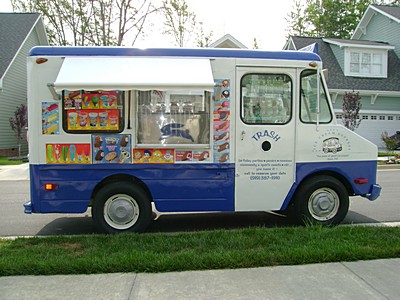 I was asked a question last week about commercial auto insurance for a home based business. “Do I need a commercial auto insurance policy for a delivery van which will be used to deliver my product?” This particular business is a new venture. It’s a baked goods catering business which prepares all product at a third-party commercial kitchen.
It can be confusing trying to determine when a commercial auto insurance policy is necessary, especially for home based businesses. If you’re trying to figure out if you need commercial auto insurance, or if you can just get by with your personal auto insurance policy, here are some scenarios that will hopefully help you decide.
When Might I Need Commercial Auto Insurance?
- If a vehicle is used in tasks related to the operator’s job, profession or business (other than commuting).
- If you are using your vehicle to transport goods or people for a fee or if you use your vehicle to conduct a service
- If you need higher limits of liability because of the nature of your work.
- If you are hauling a considerable weight in tools or equipment or towing a trailer used to conduct your business.
- If employees operate the vehicle or if ownership is in the name of a corporation or partnership.
If you as an individual are the titled owner of your vehicle, and use it for business purposes, contact your insurance agent to discuss your policy. Be certain you’re covered adequately for business use and appropriate estimated annual mileage. Many business uses and vehicle types may be excluded from personal auto insurance policies, so you want to be sure you have the right coverage.
–JK
All Businesses Are Vulnerable to Catastrophic Auto Liability Claims
Last month, on August 9th, a tour bus carrying Japanese sightseers from Las Vegas, NV to a national park in Utah, crashed on Interstate 15 north of Cedar City, Utah. Three were killed in the crash and 11 injured.
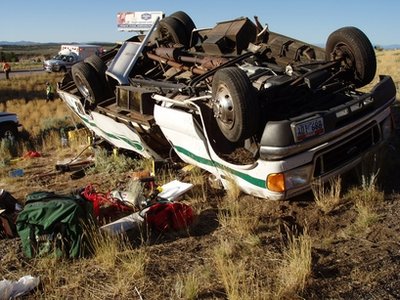
This photo released by the Utah Highway Patrol shows the bus at the scene of a crash north of Cedar City, Utah
The 26 year-old driver of the bus was reported to have smoked marijuana heavily for several days before falling asleep at the wheel of the tour bus when it crashed. He was charged yesterday with 10 felony counts of negligent driving under the influence, and one misdemeanor charge of having marijuana residue in his system.
To date, no charges have been filed against the bus company he was driving for. That company supplied the shuttle bus and driver to other tour operators who organized the trip.
What if this happened to your business?
You might not be in the tour bus industry, but this doesn’t mean an accident of this magnitude can’t happen to your business. Do you own commercial autos titled under your business? Have a commercial auto insurance policy in force? Or, do you simply have employees run errands to the post office, store, or to pick up your lunch? What if your employee was distracted at the wheel and veered off the road killing or injuring others? Are you certain your business is covered for these circumstances? You may want to inquire with your insurance agent NOW to confirm.
Aside from having the proper insurance coverage in force to protect your business from auto liability claims, here are some basic risk management measures you can take as a business owner to help mitigate the situation. Although, following these measures is no guarantee accidents will NOT happen.
If you have additional stories, advice, or recommendations to share, please comment!
–JK
Not So Fun Business Injury Facts
 Businesses deal with risk everyday. Whether it be liability risks such as injuries to employees or customers, or property loss risks such as fire or theft, businesses must implement risk control and risk management procedures to protect their operations. Of course, accidents happen and this is why insurance is necessary. Here are six (not so fun) injury facts courtesy of Travelers Insurance:
- 25,000 slip and fall accidents occur daily in the U.S., accounting for 15 percent of all workplace accidents. It is also the leading injury to people on company premises.
- Back injuries account for more lost work time than any other workplace injury. Often, the source is improper lifting.
- Fires in commercial buildings cost more than $2 billion in annual property damage and loss. Lack of, or improper maintenance of sprinkler systems plays a significant role.
- Musculoskeletal disorders results in over $45 billion in loss wages and productivity costs. Organized office workstations and poor ergonomic practices are contributors.
- Adverse weather is the leading cause of vehicle accidents and fatalities. Many company drivers don’t understand the risk or how to adjust their driving behaviors.
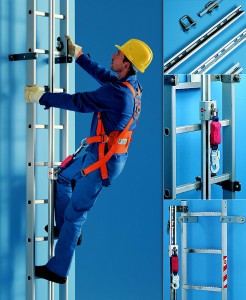
- Falls from ladders injure over 20,000 American workers annually. Some injuries result in permanent disabilities and even fatalities. Safety starts before the ladder is even mounted.
Why Your Business Should Consider A Cell Phone Usage Policy
Did you know that more than 1.5 million collisions a year, or 4,300 crashes daily are caused by driver distractions or inattentive driving? This comes from the National Highway Traffic Safety Administration. Probably the most obvious reason for driver distraction comes from cell phones and PDA’s. Whether it be text messaging, emailing, or straight talking, people on the road seem to make it their priority, putting driving secondary. Even here in California where it’s against the law to use hand-held devices while operating a vehicle, most don’t seem to care from what we see first-hand on the road every day. If it isn’t the cell phone, then it might be laptops, GPS systems, food, drinks, reading, writing, grooming and other crazy things.
 A 2009 study from the Virginia Tech Transportation Institute reflects the severity of cell phone distraction while driving. From dialing and talking to reaching and texting, cell phone usage while driving can be over 23 times riskier than non-distracted driving. Text messaging is by far the riskiest as the study results show.
The important message here is if you’re an employer, you may be held liable if one of your employees causes an accident, catastrophic or not, from distracted driving. As long as that employee is driving in the course of employment, then beware. It’s highly recommended to establish a cell phone usage policy for your business and to educate your employees on the potential severity of their actions. If employees must use their phone to conduct business, they should at least pull over to the side of the road or into a parking lot. Or, get out of the car completely.
1.5 million accidents a year is substantial number. However, it might only take one employee accident to affect your business substantially. Know your risks!
-JK
Photo Courtesy of TPS Report; Additional Resource: Insurance Information Institute
Auto Liability Insurance You Must Have
For all you business owners out there, do you ever send your employees on errands to the store or to the post office? To pick up food for the office? Do you have sales reps driving their own autos to meet clients or potential clients? Ever go on business trips and rent cars? If you have a business of any kind, I’d be shocked if none of these scenarios apply to your daily/weekly/yearly operations.
 Have you ever thought about what would happen if that employee you sent to pick up lunch hit a pedestrian and seriously injured or even killed them? Or if your sales rep was involved in an accident causing serious bodily injury or property damage to others involved? Unfortunately, accidents are not uncommon and when an employee causes an accident, the injured party will more than likely look to YOUR company to pay damages.
This is why you need to be certain ‘Hired & Non-Owned Auto’ liability is added as an endorsement to your commercial general liability insurance policy. Your business doesn’t need to own vehicles for this to apply.
Hired & Non-owned auto is a small endorsement which can have a huge impact on your general liability insurance coverage. It protects your business from bodily injury and property damage claims caused by a vehicle you rent or borrow; or caused by vehicles owned by others, such as your employees. It usually does not pay for physical damage to the vehicle itself; that’s covered by the owner’s insurance (although this option is sometimes available).
What’s great is that it’s incredibly inexpensive to add this coverage to your existing general liability insurance policy. Usually no more than $100-$200 annually for $1,000,000 in coverage! To be blunt, you would be dumb not to carry this endorsement if it is an option on your GL policy.
Be sure to check your current policy to see if this endorsement has been included. If it’s not, or if you’re uncertain, call your agent today to discuss! Accidents are not uncommon, so tomorrow may be too late!
-JK
About Me

I grew up in Fullerton, CA and graduated from Servite High School in Anaheim. I have my Bachelors degree from Loyola Marymount University in Los Angeles. I currently live in Tustin, CA.
Please contact me if you need help with any of the following lines of insurance for your business:
-Cyber / Data Breach
-Commercial Property
-Commercial General Liability
-Products Liability
-Workers Compensation
-Commercial Auto
-Umbrella/Excess Liability
-Errors & Omissions/ Professional Liability
-Employment Practices Liability
-Directors & Officers
-Life & Disability Insurance
 Jimmy Kinmartin, CPCU