
Commercial Umbrella Insurance Defined
 Commercial umbrella insurance, also referred to as excess liability, provides coverage when a liability claim goes above the aggregate limit of liability and the basic policy limits are exhausted. By purchasing a commercial umbrella, you can protect your business from being liable for this excess liability in a judgement. For instance, if you have $1 million in general liability coverage and a covered claim is settled for $1.5 million, your small business’s umbrella liability insurance policy would pick up the additional amount.
Commercial automobile, commercial general liability, workers compensation, or any other liability policies can be covered by a commercial umbrella.
Not only does an umbrella cover underlying insurance policies, but they may also provide coverage if a basic liability policy is not in force or when there are gaps in coverage under basic liability policies. When a commercial umbrella needs to step up and provide coverage for basic liability loss, it does not pay the loss from the first dollar. It’s common to have a Self-Insured Retention (SIR) amount of at least $10,000. SIR is the equivalent to a deductible. That means if there is a liability claim or loss and no corresponding underlying policy in force, you must pay the first $10,000 of the loss before the umbrella policy responds.
Commercial umbrella policies are typically purchased in $1M increments. The premiums vary depending on your business classification and underlying policies. Policies are often inexpensive considering the added coverage a business gains. For everyday businesses with average risk exposures, umbrella premiums are usually in the ballpark of $400-$600 annually for each $1M purchased.
You can never go wrong purchasing a commercial umbrella policy for your small business. A single umbrella provides broadened protection over all your small business liability exposures. Having the added protection of a liability umbrella policy is coverage no small business should go without.
-JK
General Liability Insurance: What Does “Additional Insured” Mean?
As a business owner, it’s likely you’ve been asked at some point or another to add a client, landlord, or similar entity onto your general liability insurance policy as an “additional insured.” You might ask, why do I need to put them on my business insurance policy?? What about their insurance policy? Well, here’s a little background on what it means and why it is requested so often in doing business.
 Adding another entity as an additional insured on your general liability insurance policy serves to protect that additional party in the event of negligence on your part as the primary policyholder, or “named insured.” It is not the intent of your policy to pick up the liability of another party when you had nothing to do with a claim or occurrence.
Here are some loss examples to give you a better understanding:
• You are a sub-contractor and have added a general contractor on your policy as an additional insured by request. An individual walking the grounds of your job site sustains a serious injury from a fall caused by a pothole in a parking lot. The parking lot is being built by you. This individual brings a suit against the general contractor who is covered as an additional insured on your policy.
• You are a tenant of a commercial building and have added the landlord of your building as an additional insured per the terms of your lease. A customer visits your premises and slips on a wet spot on the vinyl floor. The customer cracks their head open and brings a suit against the landlord who is covered under your policy.
Typically, a larger and more powerful business will require that smaller entities (desiring to do business) have the larger business named as an additional insured. This reduces the loss exposure of the additional insured and keep its premiums manageable.
-JK
Why Your Business Should Consider A Cell Phone Usage Policy
Did you know that more than 1.5 million collisions a year, or 4,300 crashes daily are caused by driver distractions or inattentive driving? This comes from the National Highway Traffic Safety Administration. Probably the most obvious reason for driver distraction comes from cell phones and PDA’s. Whether it be text messaging, emailing, or straight talking, people on the road seem to make it their priority, putting driving secondary. Even here in California where it’s against the law to use hand-held devices while operating a vehicle, most don’t seem to care from what we see first-hand on the road every day. If it isn’t the cell phone, then it might be laptops, GPS systems, food, drinks, reading, writing, grooming and other crazy things.
 A 2009 study from the Virginia Tech Transportation Institute reflects the severity of cell phone distraction while driving. From dialing and talking to reaching and texting, cell phone usage while driving can be over 23 times riskier than non-distracted driving. Text messaging is by far the riskiest as the study results show.
The important message here is if you’re an employer, you may be held liable if one of your employees causes an accident, catastrophic or not, from distracted driving. As long as that employee is driving in the course of employment, then beware. It’s highly recommended to establish a cell phone usage policy for your business and to educate your employees on the potential severity of their actions. If employees must use their phone to conduct business, they should at least pull over to the side of the road or into a parking lot. Or, get out of the car completely.
1.5 million accidents a year is substantial number. However, it might only take one employee accident to affect your business substantially. Know your risks!
-JK
Photo Courtesy of TPS Report; Additional Resource: Insurance Information Institute
Auto Liability Insurance You Must Have
For all you business owners out there, do you ever send your employees on errands to the store or to the post office? To pick up food for the office? Do you have sales reps driving their own autos to meet clients or potential clients? Ever go on business trips and rent cars? If you have a business of any kind, I’d be shocked if none of these scenarios apply to your daily/weekly/yearly operations.
 Have you ever thought about what would happen if that employee you sent to pick up lunch hit a pedestrian and seriously injured or even killed them? Or if your sales rep was involved in an accident causing serious bodily injury or property damage to others involved? Unfortunately, accidents are not uncommon and when an employee causes an accident, the injured party will more than likely look to YOUR company to pay damages.
This is why you need to be certain ‘Hired & Non-Owned Auto’ liability is added as an endorsement to your commercial general liability insurance policy. Your business doesn’t need to own vehicles for this to apply.
Hired & Non-owned auto is a small endorsement which can have a huge impact on your general liability insurance coverage. It protects your business from bodily injury and property damage claims caused by a vehicle you rent or borrow; or caused by vehicles owned by others, such as your employees. It usually does not pay for physical damage to the vehicle itself; that’s covered by the owner’s insurance (although this option is sometimes available).
What’s great is that it’s incredibly inexpensive to add this coverage to your existing general liability insurance policy. Usually no more than $100-$200 annually for $1,000,000 in coverage! To be blunt, you would be dumb not to carry this endorsement if it is an option on your GL policy.
Be sure to check your current policy to see if this endorsement has been included. If it’s not, or if you’re uncertain, call your agent today to discuss! Accidents are not uncommon, so tomorrow may be too late!
-JK
Is My Employee Covered On An International Business Trip?
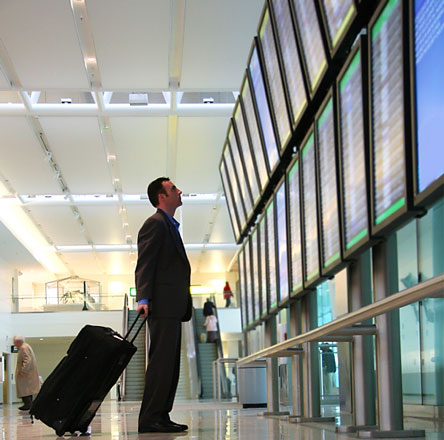
I had a client call last week to ask if his business would be covered by his general liability insurance policy if his employee was traveling internationally and caused bodily injury or property damage to a client of theirs. Truthfully, I didn’t know the sure answer to his question. This was the first time anyone had ever asked it. If this was in the United States, the answer would be easy….yes. However, would coverage apply internationally?
 I reviewed the Coverage Territory on the standard commercial general liability policy form and found “Coverage Territory” means:
a. The United States of America (including its territories and possessions), Puerto Rico and Canada;
b. International waters or airspace, but only if the injury or damage occurs in the course of travel or transportation between any places included in a. above;
c. All other parts of the world if the injury or damage arises out of:
(1) Goods or products made or sold by you in the territory described in a. above;
(2) The activities of a person whose home is in the territory described in a. above, but is away for a short time on your business; or
(3) “Personal and advertising injury” offenses that take place through the Internet or similar electronic means of communication
provided the insured’s responsibility to pay damages is determined in the United States of America (including its territories and possessions), Puerto Rico or Canada, in a “suit” on the merits according to the substantive law in such territory, or in a settlement we agree to.
Unless you’re a lawyer or an insurance agent or something, this might look like a foreign language to you. Let me translate. Under, c.(2) above, my client would have coverage in a general liability claim since his home is in the United States he and is away for a short time on business. Note, however, that my client’s responsibility to pay damages would have to be determined by a U.S. Court, not an international court.
And you thought that all insurance agents do all day is run quotes and punch numbers, didn’t you?
About Me

I grew up in Fullerton, CA and graduated from Servite High School in Anaheim. I have my Bachelors degree from Loyola Marymount University in Los Angeles. I currently live in Tustin, CA.
Please contact me if you need help with any of the following lines of insurance for your business:
-Cyber / Data Breach
-Commercial Property
-Commercial General Liability
-Products Liability
-Workers Compensation
-Commercial Auto
-Umbrella/Excess Liability
-Errors & Omissions/ Professional Liability
-Employment Practices Liability
-Directors & Officers
-Life & Disability Insurance
 Jimmy Kinmartin, CPCU