
Business Income Insurance – Coverage to Help Keep a Business Running
When disaster happens, a business may need to close temporarily. And when closed, that means loss of income.
 Loss of income is one of the main reasons most businesses don’t reopen after a serious loss. Expenses don’t suddenly go away. In fact, they may spike significantly. Without revenue, it can be difficult for a business to survive.
Business Income insurance helps keep the capital flowing when a businesses doors are shut temporarily and indefinitely after a loss.
With business income insurance, you are reimbursed for revenues lost during downtime when your property is damaged by fire, theft, vandalism or a natural disaster. Business income will also reimburse for expenses incurred to minimize the suspension of business operations, such as rent paid for a temporary office while the damaged property is being repaired.
What’s more, options might include coverage for business interruption resulting from:
- Loss of off-premises utility services, including water, communication or power
- Loss to a dependent property, such as a major supplier or customer
- Electronic vandalism for business conducted over the Internet
- Food contamination in restaurants and food service businesses
Business income coverage is usually included under a property insurance policy, but you should double-check that you have this and understand what the terms of the policy form are. If you have a Businessowners insurance policy, business income insurance will most definitely be included under the policy.
Source: The Hartford
Firefighter Helmet Camera
Check out this video which shows a first-hand point-of-view of a firefighter fighting an interior fire of 2 story residential structure. Pretty cool perspective.
-JK
Water Damage Exclusions On A Property Insurance Policy
In my last blog post, I shared information on the water damage loss a client of mine suffered the week of the 4th of July.
Water damage claims can be tricky. Here’s what you need to understand about water damage when it comes to insurance coverage.
When your building and/or its contents have suffered water damage, it’s never a good situation. It’s more prone to happen if you have not been properly maintaining your building. Probably the two biggest characteristics of the building that apply to water damage claims are the roof and plumbing. If you have ever purchased property insurance for a building you own, or a space you lease, you are asked what year the building was built. If it’s over 25 years in age, insurance carriers typically want to know when the last renovation or update was made on the roof and plumbing, as it can affect your contents and the likelihood of water damage.
The property insurance policy defines water damage as “accidental discharge or leakage of water or steam as the direct result of the breaking or cracking of any part of a system or appliance containing water or steam.”
What could this mean for you? Assume for a minute that the gutters on your building are rusty and water is not being properly diverted off your roof. A rainstorm pushes water through the weakened area into your roof. Water leaks under the eaves, into your walls and starts to pool. And because it was over a weekend, your desk is now an island in a small lake. This damage is not covered by your insurance because it is due to improper maintenance, not a sudden and unforeseen event.
You should also know that flood, including the “accumulation of surface water, waves, tides, tidal waves, overflow of streams or any other bodies of water, or their spray, all whether driven by wind or not” are NOT covered under a property insurance policy. You must have a separate flood insurance policy in place to protect your business from these perils.
A general rule of thumb is water rising from the ground up is generally not covered by property insurance, unless you have your policy endorsed to include sewer or drain backup.
If in doubt about whether you’re covered or not for certain aspects of water damage, contact your agent or broker to discuss.
-JK
Nasty Water Damage Loss; Insurance Claim
Upon returning to my office last Thursday morning after the July 4th “holiday”, we received a call from a client who returned to their office after the day off, only to find every square inch of their floor covered by 2-3 inches of water.
At first glance, they weren’t overly concerned about what they saw, but as they entered the building, they realized this was a severe loss for them. It turned out the sink in the break room had been building up pressure which caused the faucet head to shoot like a rocket across the room knocking a 5-inch wide hole through a wall and sprayed water like a fountain throughout the office for over a day.
The phones had been knocked out, employees couldn’t enter the building, and the entire office was under water. They needed help, fast.
We immediately called the claim in to the carrier and contacted a damage restoration company to get in there to begin cleaning up the mess. The restoration service company ended up spending the entire day Thursday sucking up the thousands of gallons of water.
On Friday morning, I visited my client’s premises to check it out and meet with the carrier claims adjuster, plumbers, contractors, and my client.
Here are some pictures of the damage:
The good news is insurance coverage is in place to help with this loss. Not only are the repairs being made, but there is business interruption coverage and the carrier found a temporary office to relocate our insured while their office is being repaired. In a conversation I had with our client, they told me they see the value of their insurance more now than they ever had. Unfortunately, there are many businesses out there who don’t see the value of carrying insurance, thinking issues like this will never happen to them. And when it does, they learn the hard way. With a six-figure loss like this, would your business survive without insurance?
Hail Damage Photo – McAllen, TX
Take a look at this incredible shot of some hail damage at a Starbucks store that occurred in McAllen Texas last night. This picture came from the National Weather Association.
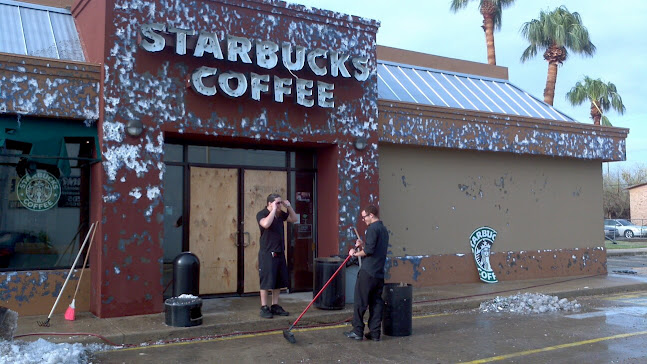
Windstorm or hail damage is a covered cause of loss on a property insurance policy. Here in California, I can’t imagine ever seeing hail as severe as this, but the picture was incredible enough to share.
–JK
My Business Will Be Closed For Termite Fumigation. Am I Covered By My Insurance?
I received an interesting call this week from a client with a really unique question, definitely the first I had ever been asked this one: “My business will be closed for three days for termite fumigation, am I covered by my business insurance?”
 Not a bad question actually.
This insured is a local hair salon which is located in a four-story building where the ground floor consists of retail shops and the upper floors are all residential condominiums. The building needs to undergo termite tenting and the business on the ground floor will be forced to close their doors for three days. There are three businesses total, but one of them is a restaurant and the homeowners association can only afford to pay one days worth of income for the restaurant, and the restaurant only.
What about the other two days and the other two business tenants??
This is when my client called to ask if his policy would provide such coverage.
The answer to this question is unfortunately, no. There is no business income/interruption coverage provided by a property insurance policy. The tenting of the building for termite fumigation purposes is not a covered cause of loss. Not to say that there are no carriers out there who offer some kind of special endorsement for something like this, but it’s very unlikely. I am not aware of any myself and even ran it by the carrier underwriter to be certain.
However this homeowners association decides to handle it has yet to be determined, but insurance isn’t the solution to the business closures in this scenario.
–JK
Know Your Deductible
Picture this scenario- You own a pizza parlor. It’s late Tuesday evening and business is closed as you are getting your premises fumigated. You have the pest control company at your premises to “bug bomb” the joint. As a passerby walks by your front window, he thinks he sees smoke and frantically calls the fire department. The fire department arrives and see’s “smoke” so they break down your front door and hammer through your front window to access the interior only to find out that the white stuff wasn’t smoke. Rather, a routine pest control measure you’re trying to take to maintain your restaurant.
 The end result? You get called to come down to the scene. You have to temporarily board up the front door and windows to keep things safe until the morning; and when the morning arrives, you have a contractor come out to fix everything so that you’re back in order for business.
When it’s all said and done, the contractor gives you an invoice for $2,800. You call your insurance carrier to put a claim in on the loss. In the process, your claims adjuster advises that you carry a $2,500 deductible. “Ahhh man! That means it’s coming out of my pocket!”
Have you ever experienced a similar situation where you find yourself paying out a loss entirely because your deductible was high? Was it burdensome for you to have to pay, or do you wish you had a lower deductible to save some cash?
The reality is people’s preferences are different when it comes to insurance and their deductibles. Some businesses like higher deductibles to save some money on their insurance premium. They may feel anything under their deductible amount wouldn’t be an issue to cover out-of-pocket. Or, they don’t anticipate many losses, so it’s not a big deal. For others, an unexpected loss like this might put them in a financial bind, but they never knew what their deductible was in the first place.
Solution
The story above is a true story. It happened to a client of mine last week. Since he carried a $2,500 deductible on a $2,800 insured loss, we didn’t move forward with the claim. Yes, it was a burden to have to fork out $2,800, but luckily it wasn’t too much for him to handle. However, we did make some changes on the deductible, and it really didn’t impact the premium much at all looking at the big picture:
- Changing the deductible from $2,500 to $1,000 = Additional annual premium of $114
- Changing the deductible from $2,500 to $500 = Additional annual premium of $194
So what’s the moral of this story? For one, know what property insurance deductible you carry, and two, picture yourself in a loss. Can you handle the deductible, or will it put a dent into your savings? Why not play with the different deductible options to see what difference in annual premium you’re looking at. Really, it’s not much in the grand scheme of things. You never know when the fire department might be banging down your front door.
–JK
Can Your Business Survive a Natural Disaster?
I am happy to share this article from Inc. Magazine which I was interviewed for and quoted on. The basis of the article is – Don’t let a natural disaster spell ruin for your business. Make sure you’re protected against natural disasters such as earthquakes, flood, hurricanes, tornadoes and recoup on your financial loss.
Read the article HERE

Thanks!
–JK
Property Insurance Coverage Exclusion – Water
This post isn’t terribly exciting, but true. So I must share.
A client called me on Monday, a pizza parlor, about some troubles they have been dealing with over the past two months. A foul sewage-like odor had been permeating throughout the kitchen area of the restaurant and sometimes even the seating area. Nobody had an idea of where it was coming from. There had been no sewage back-ups or signs of plumbing problems or anything. The “porta-potty” like odor started to become a significant problem for the restaurant as it grew stronger and started pushing customers away. Finally, our client called the building owner to come check it out (this is another story).
 It turns out there was a small pipe underground in the kitchen slowly dripping over the course of a month that was saturating the ground and walls and pushing through the vents which affected the entire two-story building with a foul odor. Plumbers had to jack-hammer the concrete floor in the kitchen to get to the leaky pipe and patch it. Then put it all back together. The cost was paid out-of-pocket by our client who is NOT the building owner, nor responsible for this loss in his lease. Now he’s dealing with the building owner on trying to collect on the loss. I visited last night and it still smells like crap in there which is not good for business. In fact, business has dropped a bit which has our client stressing!
From an insurance standpoint, it should be noted that a loss like this is NOT typically covered on a property insurance policy. If you review a property insurance special policy form, you’ll find the following language under the list of exclusions:
Water:
- Flood, surface water, waves, tides, tidal waves, overflow of any body of water, or their spray, all whether driven by wind or not
- Mudslide or mudflow
- Water that backs up or overflows from a sewer, drain, or sump; or
- Water under the ground surface pressing on, or flowing or seeping through (a) foundations, walls, floors or paved surfaces; (b) basements, whether paved or not; (c) doors, windows, or other openings
*If water results in fire, explosion, or sprinkler leakage, carriers will typically pay for the loss or damage caused by that fire, explosion, or sprinkler leakage.
It remains to be seen how this whole ordeal will be play out between our client and his landlord, but a good rule of thumb to understand about water damage claims is: if water rises from the ground up and causes property damage, it’s generally excluded from coverage. However there are endorsements such as “sewer drain and backup” that can be added on Businessowners policies to give coverage back in some scenarios. Be sure to clarify with your agent/broker about your property insurance policy.
–JK
Car Flies Off Ramp Into A Local Nail Salon
I was in the office Friday just before the lunch hour when I saw a Twitter news feed, “#BREAKINGNEWS: Car crashed into nail salon in Rolling Hills Estates along Deep Valley Drive – 5 minor injuries reported.” Seeing this was no more than a couple of miles from the office, I took a drive up the hill to check out what was going on, and I brought the camera with me. Here’s what I found:
It turns out an elderly woman driving up a ramp in the Rolling Hills Estates parking lot, crashed through a guard rail and went airborne before plunging into this nail salon. The 2001 Infiniti landed completely inside the Peninsula Center business. Somehow, the woman’s gray Infiniti missed hitting four other people as it embedded itself inside the building. .
From seeing the premises first-hand, it’s remarkable that nobody was seriously injured or even killed!
The crash crushed furniture and demolished tables inside. City building inspectors were expected to check the salon for structural damage. Here are a few still photos:


Looking at this video and pictures, it’s evident that this salon will be out of commission for some time. However, if the business is adequately insured, the business owner shouldn’t have to worry much. The following coverages should keep the business alive:
- Building and Business Personal Property: Coverage to help pay for the cost to repair or replace property, including inventory, office furniture or fixtures damaged by the accident. Not only is the business covering their own contents, but think about the building owner carrying a policy to cover the building itself.
- Business Income and Extra Expense Insurance (AKA – Business Interruption Insurance): Coverage that reimburses a business owner for lost profits and continuing fixed expenses during the time that a business must stay closed while the premises are being restored because of physical damage from a covered peril, such as a fire. It also may cover financial losses that may occur if civil authorities limit access to an area after a disaster and their actions prevent customers from reaching the business premises.
On the flip side of the coin, let’s hope the driver of the car carried an appropriate amount of liability insurance as you can bet the insurance company for the nail salon and the building owner will be looking to subrogate their losses as a result of the drivers negligence (The legal process by which an insurance company, after paying a loss, seeks to recover the amount of the loss from another party who is legally liable for it).
As with any other insured, do you think this business owner ever thought this would happen to them? If you own a business, don’t think it can’t happen to you. Don’t wait to carry business insurance coverage. Cover your business now and always expect the unexpected.
–JK
About Me

I grew up in Fullerton, CA and graduated from Servite High School in Anaheim. I have my Bachelors degree from Loyola Marymount University in Los Angeles. I currently live in Tustin, CA.
Please contact me if you need help with any of the following lines of insurance for your business:
-Cyber / Data Breach
-Commercial Property
-Commercial General Liability
-Products Liability
-Workers Compensation
-Commercial Auto
-Umbrella/Excess Liability
-Errors & Omissions/ Professional Liability
-Employment Practices Liability
-Directors & Officers
-Life & Disability Insurance
 Jimmy Kinmartin, CPCU