
OSHA Form 300A Posting Begins February 1
Employers that had 11 or more employees in the company at any point in 2024 must post the Occupational Safety and Health Administration (OSHA) Form 300A.
This form is a Summary of Work-Related Injury and Illnesses. The posting period is from February 1 through April 30.
This requirement applies even if the company didn’t have any recordable incidents in 2024. A company executive must certify OSHA Form 300A. The form should be posted in each establishment. It must be in a conspicuous location where notices to employees are customarily posted.
Certain establishments are partially exempt from OSHA’s routine recordkeeping requirements. This includes establishments with 10 or fewer employees. It also includes those whose primary business activity is classified as low hazard according to OSHA’s guidelines.
A full list of exempt low-hazard industries, ordered by North American Industry Classification System (NAICS) codes, can be found here.
The exemption is “partial” because all employers must notify OSHA when an employee is killed on the job or suffers a work-related hospitalization, amputation, or loss of an eye.
Need help with this stuff? Give me a call or shoot me a message and we can talk.
-JK
First Year Workers Account for 40% of Workers Compensation Claims
Workers who have been employed for less than a year are responsible for almost 40 percent of all workers’ compensation claims – according to the Workers’ Compensation Insurance Rating Bureau of California (WCIRB). This is staggering if you ask me. 40%?!!
There are many reasons that can lead to this statistic. Employee inexperience, unfamiliarity with workplace hazards and insufficient training to name a few.
The good news is, there was ways to help you ensure the safety of your new employees, preparing them properly for the workplace, preventing incidents and lowering claims.
Here are 7 proactive steps you can take to ensure the safety of your new employees. Actually, for ALL employees, but the emphasis here is the new employees who statistically show to be at higher risk:
1 – Comprehensive Onboarding and Training
Implement thorough onboarding programs that include detailed safety training. Make sure new employees are well-versed in workplace hazards, proper equipment use, and emergency procedures.
2 – Mentorship Programs
Create a supportive environment by pairing new employees with experienced mentors. These mentors can guide them through the job’s safety aspects and offer ongoing support, making them feel less isolated and more confident in their roles.
3 – Safety Culture Promotion
Foster a strong safety culture where employees feel comfortable reporting hazards and unsafe conditions without fear of retaliation
4 – Regular Safety Audits
Conduct regular safety audits and risk assessments to find and address potential hazards that affect new workers.
5 – Ergonomic Assessments
Make sure workstations and tasks are ergonomically designed to reduce strain and prevent injuries, particularly in industries like construction and restaurants where physical strain is common.
6 – Clear Communication
Keep open lines of communication about safety expectations and procedures. Encourage employees to ask questions and seek clarification on safety matters.
7- Adjust Workloads
Gradually increase the complexity and intensity of tasks assigned to new employees to allow them to build experience and confidence without overwhelming them
Proactively implementing these strategies significantly contributes to a safer work environment, reducing injuries among first-year employees and showing your commitment to their well-being.
But I want to emphasize, make sure you’re focusing on the safety and wellbeing of ALL employees. This creates a safe, positive work environment that can save a ton on operational costs by keeping your Experience Modification Rating DOWN.
I’m here to help!
if you have any questions or concerns, please contact me at jkinmartin@olsonduncan.com
Thanks for reading
-JK
California Requires Workplace Violence Prevention Plans
Starting on July 1, 2024, employers of all sizes will be required to have a written workplace violence prevention plan, maintain a violent incident log, and provide workplace violence prevention training to employees. These requirements will apply to nearly all California employers and employees. Exceptions include healthcare employers covered by the state’s workplace violence prevention plan standard, remote employees working at a location not controlled by the employer, and worksites with fewer than 10 employees that are not open to the public.
Below are some highlights of the law. You can find more complete information on the requirements in our platform and on Cal/OSHA’s Workplace Violence Prevention Guidance and Resources page, which includes helpful FAQs and a Fact Sheet.
For questions and free technical assistance, employers should contact the Cal/OSHA Consultation Services Branch at (800) 963-9424 or by email at InfoCons@dir.ca.gov.
Workplace Violence Prevention Plan
Employers must develop and maintain a written workplace violence prevention plan that all employees can access and that is tailored to address the hazards and corrective measures in each work area and operation. The plan must include mechanisms for involving employees, including in the implementation of the plan, identification and correction of hazards, ongoing improvement of the plan, reporting of incidents, and the design of training.
The plan can either be incorporated into the employer’s existing written injury and illness prevention program (as a stand-alone section) or maintained as its own document. Employers are required to review the plan regularly and conduct periodic inspections to identify workplace violence hazards.
Cal/OSHA has created a model workplace violence prevention plan for employers to use.
Violent Incident Log
Employers must keep a violent incident log with specific information about each workplace violence incident. The information in the log must come from employees who experienced the incident, witness statements, and investigational findings. Personal identifying information (such as names and addresses) that would allow someone to identify those involved in the incident should be excluded from the log. The log must be reviewed annually, when a violent incident occurs, and when a deficiency arises.
Training
Employers are required to provide employees with training on the workplace violence plan when it’s first established and annually thereafter. Additional training has to be provided when a new workplace violence hazard is identified or when changes are made to the plan, but this training can be limited to covering those specific topics. Any training materials the employer uses must be appropriate for the employees’ language, literacy, and educational level.
Action Items
Create a written workplace violence prevention plan, make it available to all employees, and provide training on the plan.
As usual, if you’re feeling overwhelmed about this and other regulations, contact me if you can use a hand and I will facilitate my resources and relationships to help you out.
-JK
Heightened Action in Cal/OSHA’s Task Force Enforcement
Southern California businesses have recently experienced a noticeable escalation of inspections and enforcement by Cal/OSHA’s Labor Enforcement Task Force Unit based in Santa Ana.
Unprecedented Hotel and Motel Labor Enforcement Task Force inspections are diligently being processed to verify whether these companies have a current:
- Housekeeper Ergonomic Written Plan (MIPP)
- Illness & Injury Prevention Plan (IIPP)
- Hazard Communication Plan/Checkup (Dealing with Chemicals & Toxic Materials)
Many small and mid-sized Southern California employers have overlooked these compliance requirements during the past several years but now must consider the strong possibility that their company will be visited soon.
So, Here’s The Big Question: ARE YOU READY?
A safety review and compliance check can save thousands of dollars in fines and citations.
If you would like help with this, contact me. I have trusted partners that provide large or small companies with comprehensive inspections – efficiently, quickly, and with total expertise. They can assist you in reviewing existing practices and then help you design policies and training that are compliant with 2022 new and evolving laws.
-JK
OSHA 300A Summary Posting Reminder
It’s that time of year when employers are required to tally the number of entries on their “Log of Work-related Injuries and Illnesses” (OSHA Form 300), and post the “Summary of Work-related Injuries and Illnesses” (OSHA Form 300A) in a prominent location.
The OSHA Summary Form 300A is required to be posted in the workplace beginning Feb. 1, 2018, and must remain posted for the entire three months of February, March, and April. It should be in an easily visible location so that employees are aware of the injuries and illnesses occurring in their workplace.
Employers that had 11 or more employees the previous year — except those in certain low-hazard establishments in the retail, professional services, finance and real estate sectors — are required to maintain records of all work-related injuries and illnesses, and post the summary of their records for the 2017 calendar year.
Many employers under Federal OSHA are required to electronically submit the summary of injuries and illnesses to OSHA. To ensure your entire management team is aware of these changes, I suggest making OSHA’s Recordkeeping Rule one of your first training sessions of the new year.
3 Key Elements of A Safety Culture
According to OSHA, “Safety cultures consist of shared beliefs, practices, and attitudes that exist at an establishment. Culture is the atmosphere created by those beliefs, attitudes, etc., which shape our behavior.”
Safety culture is the overall organizational attitude, belief, and values associated with safety in the workplace.
See the three key elements of a safety culture from Employers Compensation Insurance Company:
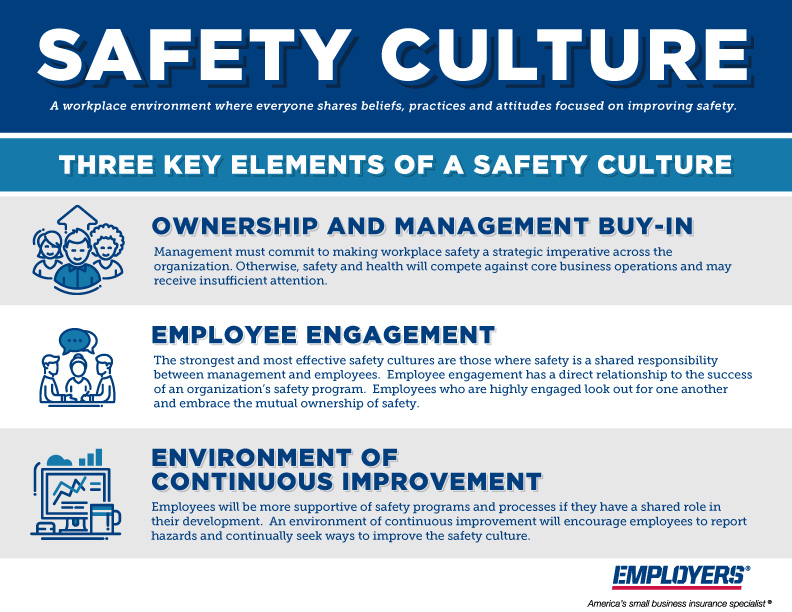
Many small and medium-sized businesses fail to invest in safety, when they’re the ones that can benefit the most from it. They have the most to lose in the face of a costly workplace accident. Creating a climate of safety doesn’t have to break the bank and it doesn’t require a large investment of time or a committed safety officer. Contact me today if you need help for your business.
Research is showing that, for every dollar a business invests in preventative measures, they’re seeing a four dollar return on that investment.
-JK
OSHA On-site Consultation Program
The Occupational Safety and Health Administration (OSHA) wants to assist small- and medium-sized businesses with their compliance and safety initiatives through their On-Site Consultation Service. This program offers confidential advice in all states across the country, with priority given to high-hazard work-sites. Consultation services are totally separate from enforcement and do not result in penalties or citations.
Using a free consultation service largely funded by OSHA, employers can find out about potential hazards at their work-sites, improve their occupational safety and health management systems and even qualify for a one-year exemption from routine OSHA inspections. The service is delivered by state governments using well-trained professional staff. Most consultations take place on-site, though limited services away from the work-site are also available. This safety and health consultation program is completely separate from the OSHA inspection effort presently in place. No citations are issued or penalties proposed during the consultation appointment.
Your name, your firm’s name and any information that you provide about your workplace, plus any unsafe or unhealthful working conditions that the consultant uncovers, will not be reported routinely to the OSHA inspection staff. Your only obligation will be to commit the organization to correcting serious job safety and health hazards; a commitment which you are expected to make prior to the actual visit, and carry out in a timely manner.
Getting Started
Since consultation is a voluntary activity, your organization must contact OSHA to request it. The consultant will discuss your specific needs with you and set up a visit date based on the priority assigned to your request, your work schedule and the time needed for the consultant to adequately prepare to serve you. OSHA encourages a complete review of your firm’s safety and health situation; however, you may limit the visit to one or more specific problems.
For more information on the OSHA On-Site Consultation Program, visit HERE
Benefits of On-Site Consultation
Knowledge of your workplace hazards and ways to eliminate them can only improve your own operations and the management of your firm. Your organization will get professional advice and assistance on the correction of workplace hazards and benefit from on-site training and assistance provided by the consultant to you and your employees. The consultant can help you establish or strengthen an employee safety and health program, making safety and health activities routine considerations rather than crisis-oriented responses. This program provides incentives and support to smaller, high-hazard employers to develop, implement and continuously improve effective safety and health programs at their worksite(s). The program recognizes employers who have demonstrated exemplary achievements in workplace safety and health by receiving a comprehensive safety and health consultation visit, correcting all workplace safety and health hazards, adopting and implementing effective safety and health management systems and agreeing to request further consultative visits if major changes in working conditions or processes occur that may introduce new hazards.
-JK
8 Key Components of a Business Safety Program
A safe work environment does not happen by accident. A company’s management team must be fully engaged in creating, planning, implementing, communicating and making sure safety programs work and are designed to fit the business. Most importantly, employees have to understand their role in making their workplace safer.
Your company’s safety program should incorporate the following 8 key components:
- Demonstrate management involvement – Management must lead by example. A visible demonstration that you embrace a safety culture is imperative to its success. Provide the essential time, budget and resources to create and support a safety program.
- Communicate your safety plan clearly – Your safety plan must be published and available to all employees. Reminders and updates should be timely and effective. Allow employees to contribute their suggestions to making the workplace safer.
- Get everyone involved – A safety program is likely to be more effective when employees at all levels are involved. Standardized policies should outline responsibilities and accountability for all employees. Safety goals can become part of job descriptions and employee reviews. Safety committees can help ensure that safety practices are understood and reinforced throughout the company. Positive reinforcement of safe behaviors can be an effective way to help build the desired culture.
- Train your employees to work safely – Safety training should begin from the moment an employee is hired. Ongoing training is also essential to creating a safety culture.
- Review, revise, improve – A safety program should be dynamic, especially since most business environments continue to evolve. An effective safety program should be flexible enough to adjust to changes. Regularly review, evaluate and identify risks that could affect safety, and make the changes necessary to keep your workplace safe.
- Create safety standards – Each department should set safety standards through a Job Safety Analysis (JSA) to make sure every task is done correctly and safely. Recognize good safety performance, and cite and correct unsafe practices.
- Investigate every incident and accident thoroughly – Properly trained staff with experience in investigation, analysis and evidence collection should conduct an accident analysis as soon as possible after an incident. Report the claim within 24 hours to help ensure prompt response and injury management.
- Manage every injury – Even with the best safety program, an employee injury can still occur. Planning helps you to react immediately when an employee is injured on the job. Learn about five strategies that can help you put employees on the road back to productivity.
Initiating a comprehensive program can seem daunting, but I can help businesses like yours take the necessary steps to begin creating a safety culture. Insurance is only one piece of the puzzle. Effective risk management and loss prevention efforts go a long way to keeping insurance premiums down and other costs of doing business.
-JK
Source: Travelers Insurance
Top 5 Workers’ Compensation Injury Types
 Data recently collected from the Bureau of Labor Statistics and the National Academy of Social Insurance shows that 65% of workers’ compensation costs can be traced to five common workplace injury types. By knowing the top five Workers’ Compensation injury types, employers can target those injuries and take action to prevent them.
According to the data, the following are the top five injury types:
- Overexertion injuries which are caused by pushing, pulling, carrying, holding or throwing.
- Falls on the same level that may happen for a variety of reasons, such as a wet floor or a tripping hazard.
- Being struck by equipment or an object, or even a vehicle. These injuries are common in the construction industry.
- Falls to a lower level, which can be prevented by using proper fall protection, ladder safety or scaffolding.
- Other exertions or bodily reactions, which can cause strains and sprains.
A safe workplace and injury prevention are vital to keeping your workers’ compensation costs down. If your company has an increased number of claims compared to previous years, this can directly affect your experience modification factor (also known as your mod factor) and increase your workers’ compensation premium. On the other hand, decreasing your number of claims can lower your mod factor and your premium.
For more information on workplace safety, including implementing or updating a safety program in your workplace, contact me at (310) 373-6441. We have the tools to help you take control of your workers’ compensation costs.
-JK
Workplace Safety in the Restaurant
Last night I found the most horrifying commercial/ad ever on Youtube. It shows very graphically that Commercial Kitchens can be extremely dangerous places to work. It’s only an advertisement, but it’s a heavy message but I guess it served it’s purpose as it’s now scarred in my brain. See for yourself:
The pressure of service and working in a restaurant with dangerous equipment and products can have a serious impact on one’s livelihood. As a restaurant owner, it’s critical to maintain a safe workplace for your kitchen staff. Good communication between co-workers as well as understanding and following all workplace safety procedures are essential in preventing burn injuries in restaurants. To reduce your risk of suffering a scald burn injury or causing a co-worker to be burned, consider the following precautions:
- When you are manually transferring hot liquids, make sure the container is no more than half full, and use a lid or splash guard.
- When using a rolling cart to transfer hot liquids, check to be sure the container is secure on the cart so it will not tip or fall from sudden stops or jarring.
- Use extreme care when handling foods or liquids that have been microwaved, as they can reach temperatures greater than boiling without bubbling.
- Keep floors clear of liquids and debris. Slips, trips and falls are responsible for many restaurant scald burns, and often these injuries can result in more time lost at work than other scald injuries.
- When appropriate, use hot pads, pot-holders or proper gloves/mittens.
- Always wear protective shoes with slip-resistant soles – never open-toed shoes, sandals or boots.
- Follow all safety procedures when working with deep fryers.
*This information is for informational purposes only . It’s not intended as medical or legal advice
Source: Zywave, Inc.
-JK
About Me

I grew up in Fullerton, CA and graduated from Servite High School in Anaheim. I have my Bachelors degree from Loyola Marymount University in Los Angeles. I currently live in Tustin, CA.
Please contact me if you need help with any of the following lines of insurance for your business:
-Cyber / Data Breach
-Commercial Property
-Commercial General Liability
-Products Liability
-Workers Compensation
-Commercial Auto
-Umbrella/Excess Liability
-Errors & Omissions/ Professional Liability
-Employment Practices Liability
-Directors & Officers
-Life & Disability Insurance
 Jimmy Kinmartin, CPCU