
Solar Panel Fire Insurance
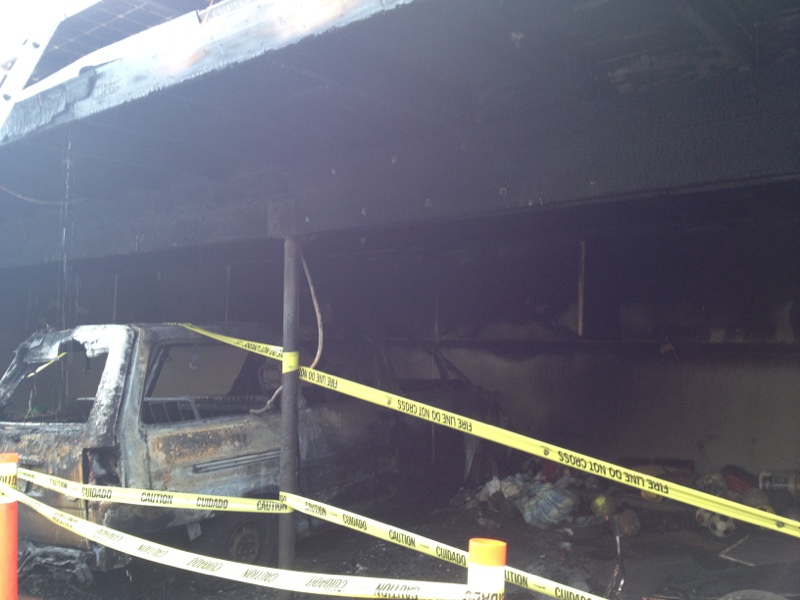
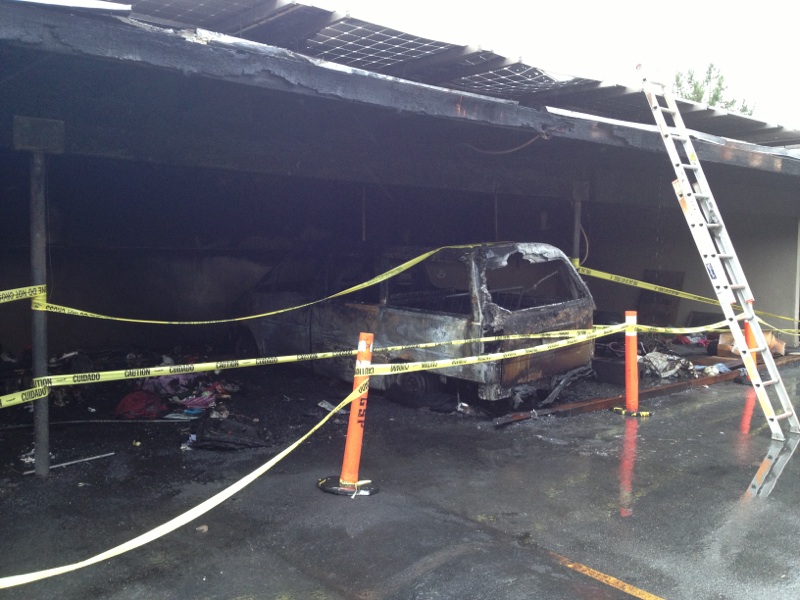
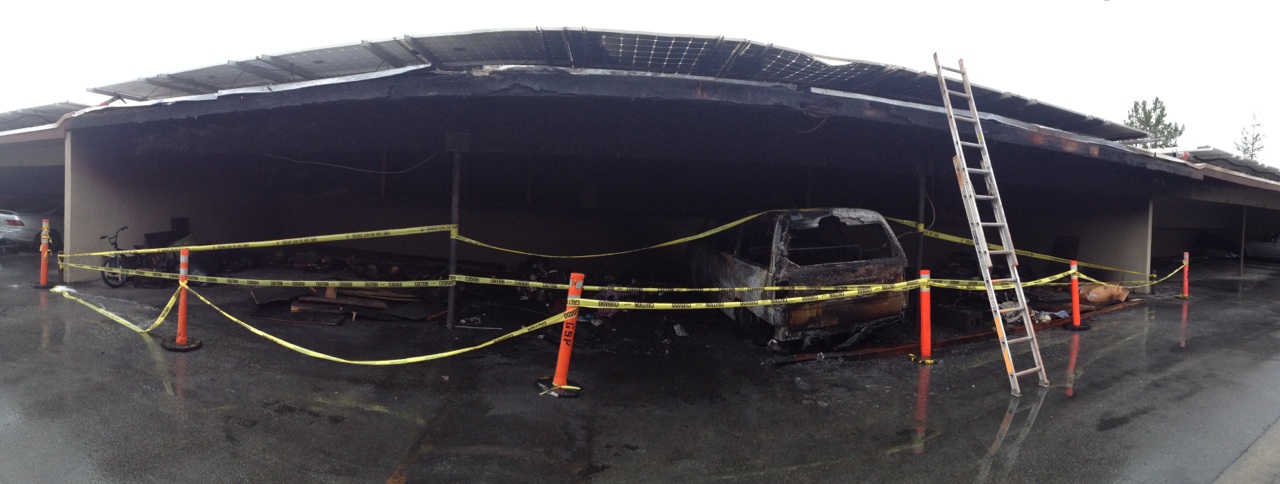
Check out these pictures showing fire damage from a car fire which spread throughout the car port it was parked under. The fire damaged solar panels affixed to the roof which are operated by an insured of mine. Good thing for property insurance. The claim has been submitted with the carrier and we’re working on getting these fixed and back in order. Not only does the property need to be replaced, but the insured will need to be compensated for lost income due to the business interruption.

-JK
Workplace Safety in the Restaurant
Last night I found the most horrifying commercial/ad ever on Youtube. It shows very graphically that Commercial Kitchens can be extremely dangerous places to work. It’s only an advertisement, but it’s a heavy message but I guess it served it’s purpose as it’s now scarred in my brain. See for yourself:
The pressure of service and working in a restaurant with dangerous equipment and products can have a serious impact on one’s livelihood. As a restaurant owner, it’s critical to maintain a safe workplace for your kitchen staff. Good communication between co-workers as well as understanding and following all workplace safety procedures are essential in preventing burn injuries in restaurants. To reduce your risk of suffering a scald burn injury or causing a co-worker to be burned, consider the following precautions:
- When you are manually transferring hot liquids, make sure the container is no more than half full, and use a lid or splash guard.
- When using a rolling cart to transfer hot liquids, check to be sure the container is secure on the cart so it will not tip or fall from sudden stops or jarring.
- Use extreme care when handling foods or liquids that have been microwaved, as they can reach temperatures greater than boiling without bubbling.
- Keep floors clear of liquids and debris. Slips, trips and falls are responsible for many restaurant scald burns, and often these injuries can result in more time lost at work than other scald injuries.
- When appropriate, use hot pads, pot-holders or proper gloves/mittens.
- Always wear protective shoes with slip-resistant soles – never open-toed shoes, sandals or boots.
- Follow all safety procedures when working with deep fryers.
*This information is for informational purposes only . It’s not intended as medical or legal advice
Source: Zywave, Inc.
-JK
Hurricane Sandy Horse
Hurricane’s aren’t funny, but this video shot during a live news broadcast of Hurricane Sandy is hilarious.
-JK
Office Waterfall
I can across this picture on Reddit today of an office getting pounded by water from a pipe burst in the ceiling:

Looking at this picture, I’ll guarantee you this business didn’t expect Niagara Falls to be suddenly pouring through their ceiling on this day.
Which leads me to the topic of insurance.
Insurance is intended to cover sudden and unexpected losses like burst pipes and fires among other things.
I talk to all different types of businesses on a weekly basis about their insurance. From offices to stores, manufacturers to distributors, and everything in between. A common sentiment I get when discussing coverage’s is, “I don’t need that, it’ll never happen to me.”
Let’s hope this business didn’t skimp out on insurance to save money thinking this would never happen to them. Not only is there a major property loss, but what about the downtime and all the intangibles you don’t even think about that result from a loss. What if you’re the business located downstairs?
The point is, a loss can happen to anyone, anytime. Be prepared. Be proactive, not reactive. A loss to this magnitude can put you out of business for good if your don’t have the proper risk management tools in place. Don’t wait to learn the hard way.
-JK
Labor Day Trip To Santa Fe, New Mexico
I’m almost a week late on this one, but this past Labor Day weekend, Joanelle and I visited Santa Fe, NM for a nice little weekend getaway. To be honest, Santa Fe is not a place I would have thought about visiting for a vacation. However, we went for a friend’s wedding and very happy we did! Santa Fe was GREAT!
We were able to get a direct flight out of LAX which was nice. The flight out there is about two hours. Very easy. We flew in to Albuquerque and caught a shuttle to Santa Fe which took another hour. However, Santa Fe has its own airport and it is great since it’s so small and easy to get in and out of (I know this because we flew back home from Santa Fe). I thought Long Beach Airport was easy. You should see Santa Fe! It’s tiny! American Airlines flies there which is what we flew from LA.
Back to the trip, the town of Santa Fe is a charming place, as Joanelle explains it. There’s just something about it that puts you in a relaxed frame of mind. The highlight of our trip was the Santa Fe Plaza which is the central part of town. It’s filled with restaurants, stores, and museums among other things. The food was excellent everywhere we ate. Our hotel, Hotel Chimayo, was in the center of all the action so we didn’t need a car. We walked everywhere. To make a long story short, I haven’t been on a trip in a long time where I felt I was able to get away and relax and feel recharged again. Santa Fe, NM did it for us and I hope to make it back there again soon. Here are a few pictures from our trip:

Cathedral Basilica of St. Francis

New Mexico Museum of Art

Joanelle and I on the front steps of the Cathedral Basilica of St. Francis

Santa Fe Plaza from the Thunderbird Bar & Grill

Picture I took from the plane when landing at LAX. This is the Williams Fire in the San Gabriel Mountains when it just started burning.
-JK
15 Signs of Workers’ Compensation Insurance Fraud
Workers’ compensation fraud costs the insurance industry roughly $5 billion each year, according to estimates by the National Insurance Crime Bureau. And depending on whom you ask, fraud accounts for as much as 10% of the costs of all workers’ comp claims.
With the tougher economic times, particularly as lay-offs mount, we’ve definitely seen a trend in our agency of work-related injuries for a variety of manufactured reasons, such as for an injury that occurred on personal time.
Look for these tell-tale signs of potentially fraudulent claims. Usually one of these items alone is not enough to point to fraud, but if you have two or more of these signs, it could suggest a problem.
1. Late reporting. If you have an employee who suffers a legitimate on-the-job injury, they will generally report it right away. This may not always be indicative of a fraudulent claim, though, because sometimes the true effects of an injury may not be known until the following day.
2. The Monday morning claim. If the injury allegedly occurred on Friday, usually late in the day, but did not get reported until Monday, there is reason to suspect there might be a little more going on than meets the eye. The logic is that the employee likely suffered an injury over the weekend and does not want to pay for it themselves if they lack health coverage, or if they don’t want to foot the bill even for their health coverage deductible.
3. Lack of witnesses. Often your employees won’t be working in a solitary environment and there ought to be somebody on your staff who witnessed the accident. Still, not every claim has a witness and this should not be used solely to determine fraud.
4. Sketchy details or conflicting descriptions. Most claimants can recall the details of their injury. If the claimant seems to be fuzzy on the details and gives vague responses to questions, it could be a warning sign. Also, if the employee’s description of the accident conflicts with the medical history or First Report of Injury, there may be a problem. This could arise if, upon further investigation, the employee keeps changing the story and adding or removing pertinent information – a good reason to suspect it to be a fraudulent workers’ compensation claim.
5. Disgruntled employee. A disgruntled employee is more likely to place fraudulent claims than an employee with high job satisfaction.
6. Financial hardship at home. Workers’ compensation benefits are sometimes seen as a way out of a tight financial situation at home. Although temporary disability benefits are lower than normal working wages, the worker could use the time to “double dip,” that is, take on extra work when they are supposed to be at home recovering from the alleged injury.
7. Hard to reach. This ties in with number six. If this occurs every time the claimant is called, there is a possibility of fraud.
8. Misses medical appointments. If an employee is truly injured, they want to get better and will make sure to go to all medical appointments. Missing appointments is another reason to suspect fraud.
9. Employee is engaged in activities at home that are not consistent with the injury. If your employee reported a back injury and other employees find that he is playing softball on the weekends or renovating his yard, there is a good reason to suspect fraud.
10. Employment change. The employee reports the injury right before or after being laid off, near the end of a contract job or near the end of seasonal work.
11. Post-termination claims. If an employee files a claim after being laid off or fired, red flags should pop up.
12. Frequent moves and changes. The claimant has a history of frequently changing physicians, addresses and places of employment.
13. History of claims. If the claimant has filed suspicious or litigated claims in the past, they could be a person who feeds off the system.
14. Employee refuses treatment. There should be no reason that a legitimately injured worker refuses a diagnostic procedure to confirm the nature or extent of an injury.
15. Rigorous hobby. If the injured worker has a pastime that could cause an injury similar to the alleged work injury, the claim could warrant further investigation.
Remember, if you suspect fraud, you should talk to your broker or the insurance company claims representative to alert them. All insurance companies are required to have special investigations units that look into claims fraud. It benefits both you the employer and the insurer if the insurance company investigates and uncovers a fraudulent claim.
If the insurer suspects fraud, they can reject the claim and report their suspicions to the local district attorney’s office and the Department of Insurance.
Credit: Atlas General Insurance Services
Business Income Insurance – Coverage to Help Keep a Business Running
When disaster happens, a business may need to close temporarily. And when closed, that means loss of income.
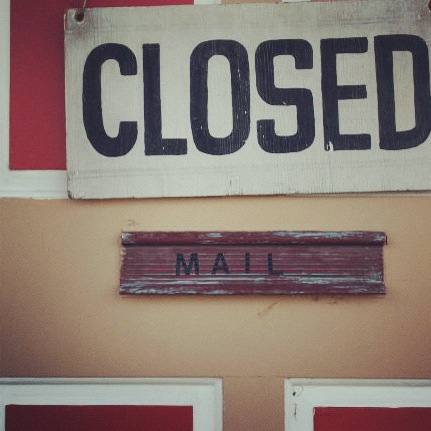 Loss of income is one of the main reasons most businesses don’t reopen after a serious loss. Expenses don’t suddenly go away. In fact, they may spike significantly. Without revenue, it can be difficult for a business to survive.
Business Income insurance helps keep the capital flowing when a businesses doors are shut temporarily and indefinitely after a loss.
With business income insurance, you are reimbursed for revenues lost during downtime when your property is damaged by fire, theft, vandalism or a natural disaster. Business income will also reimburse for expenses incurred to minimize the suspension of business operations, such as rent paid for a temporary office while the damaged property is being repaired.
What’s more, options might include coverage for business interruption resulting from:
- Loss of off-premises utility services, including water, communication or power
- Loss to a dependent property, such as a major supplier or customer
- Electronic vandalism for business conducted over the Internet
- Food contamination in restaurants and food service businesses
Business income coverage is usually included under a property insurance policy, but you should double-check that you have this and understand what the terms of the policy form are. If you have a Businessowners insurance policy, business income insurance will most definitely be included under the policy.
Source: The Hartford
Firefighter Helmet Camera
Check out this video which shows a first-hand point-of-view of a firefighter fighting an interior fire of 2 story residential structure. Pretty cool perspective.
-JK
CA Carbon Monoxide Poisoning Prevention Act (Senate Bill 183)
Pay close attention if you own an apartment building or dwelling.
 Effective January 1, 2013 building owners of dwellings will be required to install and maintain carbon monoxide detectors, in addition to smoke detectors.
The law is called the “Carbon Monoxide Poisoning Prevention Act”, California Senate Bill 183. It requires building owners to install and maintain carbon monoxide (“CO”) detectors in all dwelling units before January 1, 2013. Such devices must be designed to detect carbon monoxide and to sound an alarm. They must be installed outside each sleeping area or bedroom and each level of every unit and would require that the devices be operable at the time the tenant takes possession of the unit.
Senate Bill 183 requires a tenant to notify the landlord if the tenant becomes aware that the device is inoperable or deficient and would require the landlord to correct the reported inoperability or deficiency. A landlord is not in violation if he/she has not received the notification from the tenant.
The new law does not eliminate the requirement for smoke detectors; that is, both smoke detection and carbon monoxide detection devices are required.
Information is available on the internet regarding the new law, and you can see the actual law HERE.
If you haven’t already done so, it is suggested that you install carbon monoxide detectors as soon as possible to your building if you own one. These detectors are readily available at many local retail outlets and internet sellers.
-JK
Water Damage Exclusions On A Property Insurance Policy
In my last blog post, I shared information on the water damage loss a client of mine suffered the week of the 4th of July.
Water damage claims can be tricky. Here’s what you need to understand about water damage when it comes to insurance coverage.
When your building and/or its contents have suffered water damage, it’s never a good situation. It’s more prone to happen if you have not been properly maintaining your building. Probably the two biggest characteristics of the building that apply to water damage claims are the roof and plumbing. If you have ever purchased property insurance for a building you own, or a space you lease, you are asked what year the building was built. If it’s over 25 years in age, insurance carriers typically want to know when the last renovation or update was made on the roof and plumbing, as it can affect your contents and the likelihood of water damage.
The property insurance policy defines water damage as “accidental discharge or leakage of water or steam as the direct result of the breaking or cracking of any part of a system or appliance containing water or steam.”
What could this mean for you? Assume for a minute that the gutters on your building are rusty and water is not being properly diverted off your roof. A rainstorm pushes water through the weakened area into your roof. Water leaks under the eaves, into your walls and starts to pool. And because it was over a weekend, your desk is now an island in a small lake. This damage is not covered by your insurance because it is due to improper maintenance, not a sudden and unforeseen event.
You should also know that flood, including the “accumulation of surface water, waves, tides, tidal waves, overflow of streams or any other bodies of water, or their spray, all whether driven by wind or not” are NOT covered under a property insurance policy. You must have a separate flood insurance policy in place to protect your business from these perils.
A general rule of thumb is water rising from the ground up is generally not covered by property insurance, unless you have your policy endorsed to include sewer or drain backup.
If in doubt about whether you’re covered or not for certain aspects of water damage, contact your agent or broker to discuss.
-JK
About Me

I grew up in Fullerton, CA and graduated from Servite High School in Anaheim. I have my Bachelors degree from Loyola Marymount University in Los Angeles. I currently live in Tustin, CA.
Please contact me if you need help with any of the following lines of insurance for your business:
-Cyber / Data Breach
-Commercial Property
-Commercial General Liability
-Products Liability
-Workers Compensation
-Commercial Auto
-Umbrella/Excess Liability
-Errors & Omissions/ Professional Liability
-Employment Practices Liability
-Directors & Officers
-Life & Disability Insurance
 Jimmy Kinmartin, CPCU