
Workers Compensation – Employee or an Independent Contractor?
One of the biggest dilemma’s concerning workers compensation insurance coverage is whether a given individual is an employee or an independent contractor. It applies to pretty much any industry. Recently, I had a discussion with a janitorial services business which uses a specialist to do  floor waxing when needed. The owner told me this individual is an independent contractor. I explained to the owner that individual might be considered an employee in the eyes of an insurance carrier.
The reality is there is no definitive test to determine Employee or an Independent Contractor! It’s not a black and white issue. In many cases, it is the court of law who decides. California Workers Compensation laws are construed liberally; in other words, in favor of the claimant. There is a presumption of employment unless the employer can prove otherwise.
There are certain basic questions which might help determine the status, however. The following circumstances can help determine the relationship between and employee versus an independent contractor:
| Employee | Independent Contractor |
| Has the right to control the manner and means of accomplishing the result desired | Responsible only for the result of the work performed |
| Has a specific title and/or position | Engaged in a distinct occupation or business |
| Works under the direction of a boss | Is a specialist, does actual work without supervision |
| Uses company tools and/or equipment | Supplies their own |
| Working hours are set by the company | Has no set hours, may come and go at will |
| Is paid salary or by the hour | Paid on a per-job basis |
| The person assumes they are an employee | The person believes they are an independent contractor and usually has a certificate of insurance |
These are just a handful of circumstances. If you have additional insight to share, please comment below!
-JK
Why Your Business Should Consider A Cell Phone Usage Policy
Did you know that more than 1.5 million collisions a year, or 4,300 crashes daily are caused by driver distractions or inattentive driving? This comes from the National Highway Traffic Safety Administration. Probably the most obvious reason for driver distraction comes from cell phones and PDA’s. Whether it be text messaging, emailing, or straight talking, people on the road seem to make it their priority, putting driving secondary. Even here in California where it’s against the law to use hand-held devices while operating a vehicle, most don’t seem to care from what we see first-hand on the road every day. If it isn’t the cell phone, then it might be laptops, GPS systems, food, drinks, reading, writing, grooming and other crazy things.
 A 2009 study from the Virginia Tech Transportation Institute reflects the severity of cell phone distraction while driving. From dialing and talking to reaching and texting, cell phone usage while driving can be over 23 times riskier than non-distracted driving. Text messaging is by far the riskiest as the study results show.
The important message here is if you’re an employer, you may be held liable if one of your employees causes an accident, catastrophic or not, from distracted driving. As long as that employee is driving in the course of employment, then beware. It’s highly recommended to establish a cell phone usage policy for your business and to educate your employees on the potential severity of their actions. If employees must use their phone to conduct business, they should at least pull over to the side of the road or into a parking lot. Or, get out of the car completely.
1.5 million accidents a year is substantial number. However, it might only take one employee accident to affect your business substantially. Know your risks!
-JK
Photo Courtesy of TPS Report; Additional Resource: Insurance Information Institute
Auto Liability Insurance You Must Have
For all you business owners out there, do you ever send your employees on errands to the store or to the post office? To pick up food for the office? Do you have sales reps driving their own autos to meet clients or potential clients? Ever go on business trips and rent cars? If you have a business of any kind, I’d be shocked if none of these scenarios apply to your daily/weekly/yearly operations.
 Have you ever thought about what would happen if that employee you sent to pick up lunch hit a pedestrian and seriously injured or even killed them? Or if your sales rep was involved in an accident causing serious bodily injury or property damage to others involved? Unfortunately, accidents are not uncommon and when an employee causes an accident, the injured party will more than likely look to YOUR company to pay damages.
This is why you need to be certain ‘Hired & Non-Owned Auto’ liability is added as an endorsement to your commercial general liability insurance policy. Your business doesn’t need to own vehicles for this to apply.
Hired & Non-owned auto is a small endorsement which can have a huge impact on your general liability insurance coverage. It protects your business from bodily injury and property damage claims caused by a vehicle you rent or borrow; or caused by vehicles owned by others, such as your employees. It usually does not pay for physical damage to the vehicle itself; that’s covered by the owner’s insurance (although this option is sometimes available).
What’s great is that it’s incredibly inexpensive to add this coverage to your existing general liability insurance policy. Usually no more than $100-$200 annually for $1,000,000 in coverage! To be blunt, you would be dumb not to carry this endorsement if it is an option on your GL policy.
Be sure to check your current policy to see if this endorsement has been included. If it’s not, or if you’re uncertain, call your agent today to discuss! Accidents are not uncommon, so tomorrow may be too late!
-JK
9 Tips For Emergency Preparedness Planning
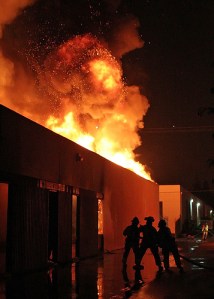
Courtesy of http://www.flickr.com/photos/smokeshowing
With everything going on out here in California this week with the Kern County wildfires, this post is more about risk management and mitigation rather than insurance. Fires and natural disasters can happen to anyone at anytime and in the blink of an eye and destroy everything you own and have worked extremely hard to build. Although there’s no stopping the rage of a fire, the devastation of an earthquake, or the wreckage of a flood, there are things you can do to mitigate loss.
Here’s a small list of steps you can take to prepare yourself for a natural disaster courtesy of The Hartford Emergency Preparedness Planning.
9 Practical Tips for the Small Business Owner
1- Establish an Evacuation Plan: Be sure everyone can get out quickly in an emergency. Designate primary and secondary evacuation routes and exits. Make sure these routes are clearly marked, well-lit, wide enough, and clear at all times. Train your employees in evacuation procedures and practice at least annually.
2- Keep an updated list of telephone numbers, including emergency personnel, hospital, public health, utilities, insurance agent, and disaster relief agencies. Include contact names and telephone numbers for customers, suppliers, and distributors. Keep a copy off site
3-Keep essential items on hand in the event of an emergency: first aid kit, flashlight with fresh batteries, battery powered radio, waterproof plastic bags and covers, camera with film, tool kit, and appropriate supply of bottled water and nonperishable food.
4- Protect vital records critical to your business (e.g., financial statements, account information, blueprints, product lists, etc.) Select a safe that has been tested and listed by Underwriters Laboratories UL rates safes for resistance to fire and heat, as well as resistance to burglary tools and torches. Or, keep copies offsite if possible.
5- Back up all critical electronic data and programs at least daily. Backing up these valuable assets can help a business recover from a data loss or hardware failure and get back online quickly.
6- Secure backup copies of critical data and programs in a physical location seperate from your premises to protect against damage from theft, fire, water and other physical hazards.
7- Determine if your business is located in an area that is prone to natural hazards (e.g., flood, earthquake, wildfires). Once you have identified perils to which your business is vulnerable, take steps to minimize potential damage to the building and contents (e.g.- if you are in earthquake territory, anchor tall bookcases and file cabinets to wall studs to keep them from falling).
8- Review your current property insurance policy with your insurance agent. Be sure that you understand the coverages (e.g., buildings, personal property, presonal property of others, business income, etc.), deductibles, and limits of insurance. You will need to buy seperate policies for flood or earthquake damage as they are excluded perils on property insurance policies.
9- Keep insurance information and contact names and numbers in a safe place. This will expedite the claim process in the event of a loss.
-JK
Blanket Your Commercial Property Insurance
Perhaps you’re a property owner of more than one commercial building. Or, a retailer with several retail stores. Maybe a professional service firm with multiple office locations. In any case, you want to blanket all your property together on your insurance policy under a combined single limit of insurance.

Think about it, blankets are always comforting, even insurance blankets
WHAT IS BLANKET INSURANCE?

Think about it, blankets are always comforting, even insurance blankets
Blanket insurance combines a number of separate property coverages and/or coverages at two or more locations under a single combined limit of insurance.
For example:
(1) A distribution plant at one location address has three different warehouse buildings on the property. You can combine the replacement cost of each of the three buildings and add them together to get one blanket limit. The benefits of this are if one of the buildings went down in fire, that particular structure isn’t at risk of being under-insured with its own insurance limit. It is covered under the blanket limit of all three buildings.
(2) A commercial building owner owns five different buildings, all at different location addresses. Under his/her commercial property insurance policy, they should take the total replacement cost of all five of their properties and blanket them together under one limit. Why? For the same reasons as above. If there was a loss at one location, the owner wouldn’t run the risk of being under-insured at that particular location.
It’s very inexpensive to endorse your commercial property insurance policy and blanket everything together. Blanketing your property offers you better protection on your assets for next to nothing in annual premium. It’s a no-brainer.
As with any property insurance policy, loss due to flood and earthquakes is excluded.
-JK
Jack of all trades?
 I feel like I’ve been getting a lot of calls lately from general consultants inquiring about insuring themselves for a wide array of services provided.
• An Emergency Management Consultant/IT Consultant/Auto Consultant.
• A Software Developer tossing the idea around of construction staffing services.
• A Marketing Consultant/Producer/Event Planner
I think the ambition is great, but there needs to be some degree of caution taken in regards to liability exposure. Insurance policies aren’t intended to be written as “one size fits all.”
Insurance carriers look at your business entity (sole proprietor, LLC, corp, etc) when underwriting a risk. Underneath that entity, they want to know what types of business operations are being carried out. Most businesses tend to fall under one general classification, but offer a wide array of services. For example, an IT consultant may do software development, website design, and web hosting services. No big deal, a single general liability or professional liability policy can probably be written with ease to cover these related services.
However, if you’re a handyman/marketing consultant/inflatable bouncer rental guy, then you should consider different entities for each line of business. Insurance carriers all have their own appetites as to which types of risks they like to write, so if you’re all over the board, your coverage options are limited.
If it’s too much time, trouble, or money for you to start a new business entity, then consider taking a step back and concentrate on what you do best with and focus your efforts there. Once you find success and business is rolling, then start exploring other opportunities if that’s your passion. Taking it one step at a time might not be such a bad thing.
As the saying goes, “Jack of all trades, master of none.” You can be a Jack of all trades, but be smart about it and know your exposures.
-JK
What Is The Aggregate Limit On A Liability Insurance Policy?
When you see the term “aggregate” on an insurance quote or policy, it is a limit stipulating the most an insurance carrier will pay for all covered losses sustained during an insurance policy term, usually a policy year. Aggregate limits are commonly included in liability policies, from general liability to professional liability. These policies have a “per occurrence” or a “per claim” limit as well.
When you look at your policy form, the liability section is laid out something like this:
| BUSINESS LIABILITY | LIMITS OF INSURANCE |
| LIABILITY AND MEDICAL EXPENSES | $1,000,000 |
| MEDICAL EXPENSES – ANY ONE PERSON | $10,000 |
| PERSONAL AND ADVERTISING INJURY | $1,000,000 |
| DAMAGES TO PREMISES RENTED TO YOU | $300,000 |
| PRODUCTS-COMPLETED OPERATIONS AGGREGATE | $2,000,000 |
| GENERAL AGGREGATE | $2,000,000 |
The per occurence limit is the most the carrier will pay per occurence, and the aggregate is the most they’ll pay in claims during the policy period regardless of the number of claims.
Earthquake Insurance: Don’t Get Caught Off Guard
Lately, Southern California has been rocking with small earthquakes. Luckily they have been small, rolling quakes for the most part, but every time they strike, they scare the crap out of people two reasons: for one, they come out of nowhere, and second, they make people brace themselves in fear that they’ll grow stronger and more violent.
A third reason why earthquakes are scary is often overlooked and unknown to many. That reason is: standard property insurance policies exclude coverage for damages resulting from earth movement, including earthquakes. So, if your home or business is destroyed in an earthquake and you don’t have a separate earthquake insurance policy, you’re out of luck.
In order to cover your home or business for earthquake damage is to purchase a separate earthquake insurance policy. Earthquake insurance covers a building and its contents, but inevitably includes a large percentage deductible on each. Even if you don’t own a building or structure, but have high value contents and possessions like stock or merchandise, you might want to consider earthquake insurance. In California, most policies are sold by the state-run insurance pool, the California Earthquake Authority (CEA), although a few private companies also sell earthquake coverage.
To determine if earthquake insurance is right for you, or how much coverage is right for you depends on your individual circumstances. The following questions may help you decide:
- Can you afford to replace your business possessions (such as stock, merchandise, furniture, computers/media, and general equipment) if they were destroyed in an earthquake? How much would they cost?
- If you have to find temporary accommodations because you cannot operate at your business location as a result of an earthquake, how much will you need to pay for those additional operating expenses?
- If you own a commercial building, how much home equity do you have? Can you afford to risk losing that equity if an earthquake damages or destroys it?
- How much would it cost to rebuild? Do you have assets available to repair or even rebuild your building after an earthquake?
- Do you have a mortgage, second mortgage, or line of credit on your commercial building? Can you afford to continue repaying those loans while also paying to rebuild or replace your structure?
Earthquakes are surprising enough when they strike. Don’t get caught off guard by your insurance policy coverages and exclusions after it’s too late. Be prepared!
What Is Coinsurance?
If you think about a building and consider the potential causes of loss, what do you think the chances are that it could suffer a total loss vs. a partial loss? Take into account some of the more common causes of loss: fire, theft, water damage, vandalism, etc. It’s not often that a building is completely destroyed. Usually the only time you hear stories about this is in the news under extreme circumstances.
 Insureds who recognize this might take a gamble and limit the amount of insurance they purchase. Why pay the higher premium for full coverage when chances are it will never be needed? Individuals who purchase full coverage pay much higher premium than those who reduce the amount of their insurance.
In an effort to prevent this for happening and to encourage insureds to carry a reasonable amount of insurance in relation to the true value of their property, a coinsurance clause is included within many commercial property insurance policies. The coinsurance clause determines what percentage of the value of your property must be insured in order to be fully reimbursed for a loss. The most commonly issued coinsurance percentage is 80%
Here’s how it works:
Say a policy carries an 80% coinsurance clause. Using the following numbers as an example:
Total replacement cost of Building – 1,000,000
Applicable Coinsurance Percentage – 80%
Amount insurance carried – $600,000
Amount of Loss – $300,000
80% coinsurance means the insured is required to carry an amount of insurance equal to 80% of the replacement cost of the building ($800,000 in this case).
To compute the loss payout for the above example, use the following coinsurance equation:
(Amount of insurance Carried / Amount of insurance required) multiplied by the amount of loss equals the settlement.
Filling in the numbers, take ($600,000 / $800,000) multiplied by $300,000 equals $225,000.
So the insured lost out on $75,000 by not insuring their building to 80% of the replacement cost ($800,000)
Coinsurance limits the amount the insurer must pay for damaged property to that proportion of the loss. It is crucial that values of property are accurately reported and updated annually to reflect inflation and other increases in cost.
Now you know, and knowing is half the battle. –G.I. Joe
Do I need Errors and Omissions Insurance?
If you are in the business of providing a service to your clients for a fee, you have an Errors and Omissions (E&O) exposure and should consider Errors and Omissions Liability Insurance.
What is E&O insurance?
 E&O insurance, also referred to as professional liability insurance, covers businesses or individuals in the event that a client holds such company or individual responsible for a service that was provided, or failed to be provided, and did not have the expected or promised results. In very basic terms, it protects you when you perform a service for your client and they claim it was done incorrectly and caused them harm. Most E&O policies cover defense costs and any resulting settlements and judgments against you or your company, up to the coverage limits on your policy. Your Commercial General Liability policy does NOT provide this coverage.
Who needs E&O Insurance?
Any company that is in the business of providing a service to clients for a fee faces an E&O exposure. Some of the more common professions which need E&O insurance are real estate agents, architects, engineers, doctors, lawyers, IT consultants, and accountants to name a few. The list of professions is a lot more extensive. If you are in doubt as to whether you might need it, consult with your insurance agent.
Why do I need it?
For one, E&O is excluded on general liability insurance policies. More importantly, mistakes are inevitable for any business or individual. Nobody’s perfect.
Here are some claim scenarios courtesy of Philadelphia Insurance Company.
When should I buy E&O insurance?
The best time to buy errors and omissions insurance is before you begin practicing. If you know you have an exposure, make E&O insurance part of your insurance program before conducting business.
I will be covering more aspects of E&O insurance in future blogs and how it differentiates from general liability insurance. There is no such thing as “one size fits all” in an E&O policy. These policies are customized and tailored to each and every business. It is very important that your insurance agent understands E&O coverage and the marketplace. Neither you nor your business can afford to get it wrong.
About Me

I grew up in Fullerton, CA and graduated from Servite High School in Anaheim. I have my Bachelors degree from Loyola Marymount University in Los Angeles. I currently live in Tustin, CA.
Please contact me if you need help with any of the following lines of insurance for your business:
-Cyber / Data Breach
-Commercial Property
-Commercial General Liability
-Products Liability
-Workers Compensation
-Commercial Auto
-Umbrella/Excess Liability
-Errors & Omissions/ Professional Liability
-Employment Practices Liability
-Directors & Officers
-Life & Disability Insurance
 Jimmy Kinmartin, CPCU