
California Business Owner Convicted of Insurance Fraud
Here’s a word of advice for you: If you’re a business owner, make sure you’re accurately reporting your payroll on your workers compensation insurance policy. If you are using subcontractors/ independent contractors to perform services for your clients, you must obtain a certificate of insurance from these contractors confirming they carry their own workers compensation insurance coverage. If not, you may be liable for any losses that occur as a result of the services they are performing for your business.
Here’s a friendly reminder that it doesn’t pay to cheat the system:
California insurance commissioner, Dave Jones, announced in a press release on 2/23 the conviction of a California business owner for insurance fraud and perjury. The case involves a $1.6 Million penalty for failure to pay premiums and failure to accurately report payroll.
Ronald J. Haas Sr., 69, has been convicted on 10 counts of insurance fraud for failing to accurately report payroll and for failing to pay insurance premiums to his workers’ compensation insurance carriers. Haas was sentenced to one year in the county jail and restitution to the entities involved, and three years probation.
“Workers’ compensation insurance fraud is an egregious offense and it will be fully investigated by my Department,” said Commissioner Dave Jones. “Those who would seek to cheat a fund to help workers who were legitimately injured will be prosecuted to the fullest extent of the law.”
On January 12, 2007, State Compensation Insurance Fund Special (SCIF) reported a suspected fraudulent claim to the California Department of Insurance Fraud Division for investigation of suspected workers’ compensation insurance premium fraud. The report alleged that Haas, President of R J Haas Construction Corporation, et al., Saratoga, CA, failed to accurately report employee payroll to his workers’ compensation insurance carrier, SCIF. From July 1, 1998 to June 1, 2005, Haas claimed that he had no employees and that sub-contractors did all the work for his company. However, during this period, four workers’ compensation claims were filed by injured employees. Haas reported payroll to SCIF only after an injury was discovered and then payroll reporting stopped shortly thereafter, with the cancellation of his policy. Subsequently, Haas obtained workers compensation insurance policies through First Comp and again reported minimal to no employees.
An investigation by the Silicon Valley Regional Office of the California Department of Insurance, Fraud Division and the California Employment Development Department (EDD) revealed that Haas misrepresented office staff, project superintendents, foremen, and even some of his own family members as subcontractors. A forensic audit was conducted and revealed that Haas owed $594,293.22 in insurance premiums to SCIF, $229,167.71 in insurance premiums to First Comp and $813,328.27 to EDD for failing to accurately report employee payroll for the purpose of determining employment tax liabilities.
On April 29, 2009, Haas was arrested for felony violations of Insurance Code. Haas is eligible to apply for a home electronic monitoring program in lieu of county jail time. At time of sentencing Haas had already paid the full amount of restitution owed to insurance carriers SCIF and First Comp and to EDD.
Source: California Department of Insurance
-JK
Has An Earthquake Detection System Become Reality??
Plain and simple, natural disasters are horrendous! To put it politely, they S-U-C-K! Floods, tornado’s, hurricane’s, volcanic eruption’s, landslide’s, and notoriously here in California…earthquakes! All these natural disasters lead to some kind of loss, whether it be financial, environmental, or human loss. In most cases, there’s actually some degree of advanced warning as to when a natural disaster might strike. Take hurricane’s for example. We are able to pinpoint powerful storms in advance and prepare accordingly. If nothing else, this allows us to reduce the probability of human loss.
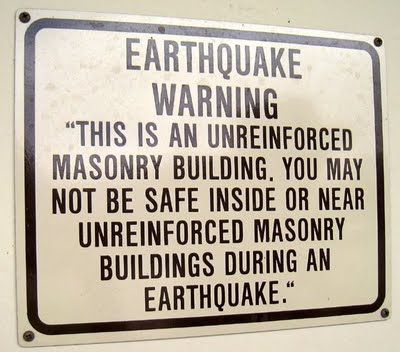 Unfortunately, advanced warning does not apply when it comes to the earth shifting, otherwise known as EARTHQUAKES! ………Or does it??
In an article published by Fox News, there is now “a state-of-the-art, first-in-the-world earthquake detection system in now installed and operational” in southern California, near Palm Springs, in the Coachella Valley. In fact, twelve locations are now in place with 120 sites planned, all meant to detect an earthquake and give people a chance to duck and cover, or brace themselves before the shaking begins.
This earthquake detection system was created by a company called QuakeGuard. The system works by way of sensors which are designed to detect the initial, or “P” energy waves given off by every quake, even though it’s only the later, or “S” waves that do all the damage. The time in-between the two waves varies depending on the proximity to the epicenter and as the first sensor closest to the quake goes off, it can offer advance notice — from a few seconds to a full minute– to other locations farther away.
The system can also be set to automatically open fire station doors, and water and gas valves for municipalities could be shut off. Back-up generators for hospitals could be turned on and, most importantly, warn school kids to duck and take cover.
Of the 12 sets of sensors currently set in place throughout the Coachella Valley in Southern California, all are tied to fire stations. Soon, they will be networked to every school in the area. Down the road, they can possibly be linked to hospitals, private businesses and even people’s homes.
A mobile system is also in development and would help rescue crews detect aftershocks. A few seconds could get rescuers out from under the rubble and thus out of harm’s way.
How great would this be for California or for any other regions affected by the earth moving?? It’ll be interesting to see how technology progresses. In this case, not soon enough! We can’t stop an earthquake, but it would be nice to be warned if one is on the way . The sudden jolt of the earth shifting is the probably the scariest part of an earthquake in my opinion. Let alone the damage and destruction that comes with it.
Would an earthquake detection system ease your fear of earthquakes?
–JK
Winter Blizzards- Tips For Winter Driving
Take a look at this accident footage from Salem, NH. I feel kind of guilty writing this post from Southern California as virtually everyone east of us is getting hammered with snow, but I guess the cost of living makes up for it sometimes. With that being said, below the video clip are winter driving tips courtesy of Travelers Insurance. There wouldn’t be any legitimacy to these recommendations if they came directly from me. What does a Los Angeles native know about driving in the snow anyways??
Prepare for winter driving before a storm hits
- Have a mechanic check your car’s battery, brakes, fluid levels (antifreeze, windshield washer fluid and oil), as well as the heating and exhaust systems to ensure that your car is in good, safe working condition.
- Try to keep your gas tank full during the winter months. Don’t allow the gas to go below half a tank. Not only will this prevent damage from freezing, you’ll avoid running out of gas if you’re stuck in a traffic jam during the dead of winter.
- Install snow tires or all-weather radials with adequate treads.
- An adequate supply of windshield washing liquid is critical to wash away the mud and melted snow that can severely limit visibility.
- Prepare for an emergency. Keep blankets, flares, a sack of sand for traction, shovel, windshield scraper and brush, tool kit, tow-rope, booster cables and a flashlight with extra batteries in your trunk. You should also stock your car with material for survival, such as waterproof matches to melt snow for drinking water, a first aid kit, dry clothing and a brightly colored cloth (to tie to the antenna).
When driving under adverse winter conditions
- Take care pulling out of streets blocked by mountains of snow. It’s often difficult to see who or what is coming.
- Back your car into the driveway so you have better vision when pulling out.
- Be aware of joggers on the street. Often sidewalks are impassable and die-hard joggers venture onto the street for a clearer path. Unfortunately, they may not see icy spots or other hazards hidden below the slush.
- Don’t turn corners too tightly.
- If your car does not have anti-lock brakes and you start skidding on the ice, try not to slam on your brakes. Gently pump your brakes to maintain better control and prevent your wheels from locking.
- If your car does have anti-lock brakes, slam on your brakes when skidding on the ice. Pumping your brakes prevents the anti-lock system from taking over.
Traveling during a severe storm. Travel only if necessary during a blizzard or severe storm. If you must travel:
- Don’t travel alone. Notify someone of your estimated time of arrival as well as your primary and alternate travel routes.
- If STUCK, stay in the car and wait for help. Run the engine and heater sparingly. Also make sure your exhaust pipe is clear of snow and ventilate your car so that carbon monoxide fumes won’t poison you.
- Keep your energy. Eat food that provides the body with energy for producing its own heat. Replenish your body with fluids to prevent dehydration. Don’t eat snow; it will lower your body temperature. Melt it first.
Source: Travelers Insurance; Insurance Information Institute
–JK
NY Tortilla Factory Shut Down After Fatal Work Related Accident
 Earlier this week, a Brooklyn, NY tortilla factory employee died after falling into a waist-high dough mixing machine. Now, the state has closed the factory because authorities discovered the company’s workers compensation policy had lapsed in March 2010.
A NY State Workers Compensation spokesman said, “The owner would need to get the insurance and pay fines before he is permitted to reopen.” While the Workers Comp board doesn’t always shut down companies where the insurance is lapsed, the fact that there was a workplace death prompted officials to visit the tortilla factory. As it stands, the company owes $56,000 in penalties. OSHA and the Department of Labor are also looking into the incident.
This $56,000 in outstanding penalties is sure to be dwarfed by lawsuits likely to be coming from the employee’s family and surviving members. All this could have been avoided or significantly curtailed if the factory owner carried the workers compensation insurance coverage required by law.
The very core of workers compensation insurance is that it provides medical care for employees who are injured in the course of employment. Beyond medical care, Workers Comp insurance provides temporary and/or permanent disability benefits, supplemental job displacement benefits or vocational rehabilitation and death benefits. Workers Comp is a trade-off between employers and employees. Employees receive prompt effective medical treatment for on-the-job injuries or illnesses no matter who is at fault and, in return, are prevented from suing employers over those injuries.
The tortilla factory’s owner was reached on the phone by a newspaper Friday but said he couldn’t talk and hung up. He had previously said that the death was the first worker injury at the company and said it had been caused by “human error.”
Unfortunately, business owners usually learn the hard way when it comes to a loss. This being a prime, and severe, example. Personally, I would be surprised if this business survives considering what surely lies ahead with lawsuits, etc.
–JK
Lawyers Professional Liability Insurance – Guest Blog

Harold Mayhack
This is a guest blog from Harold Mayhack, a colleague here at ISU/The Olson Duncan Agency. Harold received his Bachelor of Arts in Business Administration from the University of Strathclyde in Glasgow, Scotland in 1985. He spent several years underwriting lawyer’s professional liability insurance before becoming an insurance broker specializing in the insurance needs of law firms. For the past twenty years Harold has worked with local law firms; assisting with all of their insurance and risk management needs. He has presented to law firm groups and members of the Association of Legal Administrators and has been published in legal administrators’ newsletters. He is a member, and former local steering committee member, of the Professional Liability Underwriting Society; the Insurance Brokers & Agents Association and the ISU Network.
This is the first of several blogs that will focus on the pricing mechanisms for lawyers’ professional liability insurance; from the basics to some more subjective items underwriters take into consideration. Essentially, we are going to review the application as it impacts the final cost of your insurance with the hope that you will know the impact of your answers and what information you can provide to help underwriters offer their best pricing; they really do want to write your law firm’s insurance. We will also touch on a few questions that can qualify or disqualify your firm from some of the ‘preferred’ programs.
The first, and I believe the most important, consideration for law firms to consider when you complete your applications is the attitude brought to the process; why are you doing this? The application is your opportunity to tell the story of your law firm; why should an underwriter want to insure you and why should they offer you the best pricing they have available? Many of the applications we see include the basic answers but no additional details; especially for mid to large size firms, firms with higher hazard areas of practice or claims, the subjective picture we paint can be as important as the objective answers in the application. Why are you different? Every principal or firm administrator I meet is very proud of their firm; yet that often does not come across in their application. This is the information we want to provide to underwriters.
We will include this ‘attitude’ consideration in each of the sections that follow. Some things to keep in mind are; you started your firm for a reason, let’s explain that reason. You hired your attorneys and non attorney staff for a reason, let’s explain that. You manage your firm and its’ structure the way you do for a reason, again let’s explain that. If you have claims let’s explain why. Yes, this takes some time but it pays dividends in the number of insurance offers you receive and the premiums and terms of insurance you will have to consider.
Beginning with the basics, APPLICANT INFORMATION; your firm’s name, is it correct in the application? Most of the lawyers’ professional liability insurance policies available state; ‘we shall pay on behalf of the insured’. Insured is typically defined as the Named Insured, which will be listed on the policy’s Declarations page. This seems obvious but it is not unusual to see the Named Insured listed incorrectly. This becomes more important as we look at the definition of insured which will typically insure principals, employed attorneys, attorneys ‘of counsel’ and independent contractors among others and will include the limitation ‘for legal services on behalf of the Named Insured’.
Also requested in APPLICANT INFORMATION, your contact information; address, phone number, contact name, email and often year established. Most importantly, this is the information the insurance company will use to issue legal notices they are required to mail directly including; notices of non renewal, coverage changes among others. However, they also impact your premium. Most insurance companies have some form of territory rating; metropolitan areas like Los Angeles or San Francisco are often rated with a higher premium than outlying areas. Your year established is used as one factor along with your insurance history in the consideration of prior acts coverage. This date should be the establishment date of the earliest entity to which the current Named Insured is the majority successor in interest to ensure the policy will include the necessary prior acts coverage.
The next few blogs on pricing lawyers professional liability insurance will take us through the remaining application questions and several of the key supplemental applications. If you have any questions about any of the issues raised here please feel free to call me at any time. I would also appreciate any comments or feedback you would like to share.
Workers Compensation Insurance – Independent Contractor vs. Employee
The difference between independent contractors and employees is a common debate within the insurance world. I wrote another post about it back in August, but the question continually arises, so it’s worth reinforcing. Determining which is which, employee vs. independent contractor is all fun and games until someone gets hurt. As an employer, think about the following points from the California State Compensation Insurance Fund before trying to dance around paying workers compensation insurance premiums.

Employees vs. Independent Contractors is a common debate for contractors and Work Comp insurance
California courts typically use a number of tests to determine whether an individual is an employee or an independent contractor. A crucial factor in determining employment status is the employer’s right to direct and control the work being performed. If you have the right to control the manner and means of the work performed, the courts have routinely decided that the “independent contractor” is actually your “employee”.
There are many other factors, but the reality is there is no definitive test to determine employee or an independent contractor. The following circumstances can help determine the relationship between the two. Among them, whether the person performing the service:
- Has the right to terminate the relationship at will.
- Is engaged in a distinct occupation or business.
- Has voluntarily chosen the burdens and benefits of self-employment.
- Has the skill required in the particular occupation.
- Supplies the instrumentalities, tools, the work location, and carries the license or certificate required to perform the work.
- Has the right to hire and terminate others.
- Is paid by the time worked, or by piece rate.
- Works under the direction of the employer or by a specialist without supervision.
- Whether the services are a part of the regular business of the employer.
- Whether the parties believe that they are creating the relationship of employer/employee or employer/independent contractor.
If there are questions, the Labor Code assumes a worker is an employee for workers’ compensation purposes. The burden of proof to support the independent contractor status of a worker falls on the employer. The Labor Code also requires that any subcontractor who does not have an active valid contractor’s license be treated as an employee, not an independent contractor. However, even though a worker may have a valid license, the worker may still be an employee depending on the factors as discussed above.
A good rule of thumb: as an employer, always protect yourself.
- If certain jobs require a license, request a copy for your records.
- Obtain original Certificates of Workers’ Compensation Insurance addressed to you from all contractors and subcontractors who have employees or who, in turn, subcontract any portion of their own work.
Remember, it’s all fun and games until someone gets hurt. If proper documentation is not maintained and presented to insurance auditors, carriers are obligated to charge premium for any liability that may exist under your workers’ compensation insurance policy.
–JK
Fired ESPN Announcer Strikes Back With Lawsuit

Ron Franklin
Former ESPN announcer Ron Franklin, who was recently fired for allegedly making sexist comments to a sideline reporter before the Chick Fil-A Bowl, is suing ESPN for wrongful termination.
He confirmed the lawsuit on Wednesday but did not comment on the details of the lawsuit.
Franklin allegedly said to the sideline reporter, “Listen to me sweet baby, let me tell you something.” After the reporter told him not to talk to her like that, Franklin responded, “OK, then listen to me a-hole.”
Franklin later apologized in a statement. The longtime college football and basketball announcer worked for ESPN for 25 years.
What’s the moral of the story?
Employment Practices Liability claims such as this are not limited to major corporations such as ESPN. In today’s litigious climate, employers of all sizes are vulnerable. According to U.S. Equal Employment Opportunity Commission (EEOC) data, 41% of all EPL claims are brought against small employers with 15 to 100 employees. This is why any business with employees, or those which begin to hire employees must consider Employment Practices Liability Insurance (EPLI).
Employment Practices Liability insurance insures against claims of wrongful termination, failure to hire, failure to promote, various types of discrimination, as well as sexual harassment.
These insurance policies will reimburse your company against the costs of defending a lawsuit in court. They will also compensate for judgments and settlements. It doesn’t matter whether your company wins or loses the suit. Policies typically do not pay for punitive damages or civil or criminal fines, however.
One more benefit of these policies is that most include risk management services. Employment Practices Liability Insurance policies will typically offer an unlimited phone hotline service, online training, and state and federal compliance assistance from licensed attorneys.
If you are a business owner and are interested in more information on Employment Practices Liability Insurance, you can reach us here and we’ll be sure to follow-up with you:


Thank you,
–JK
Earthquake Safety – Prepare Your Workplace
For you Californians out there, according to the US Geological Survey, there is a 60% chance that a 6.7 magnitude or greater earthquake will occur in California in the next 30 years. I’ve been hearing that since elementary school so I don’t know how much longer we have if this is true. An earthquake of this size can can severely strain public services and disrupt business operations. The best way to survive an earthquake is to prepare before a big one hits. Here are some earthquake safety recommendations to consider for general guidance purposes.
Prepare your workplace for an earthquake
- Large equipment such as boilers, tanks, and machines need to be secured properly so they will not fall over in an earthquake.
- Furniture such as bookshelves and file cabinets along with storage racks and shelving should be strapped or attached to the wall to keep it stable and upright.
- Survey your workspace to make sure that heavy items are stored at lower heights or secured so they won’t fall.
- Photos and pictures should be hung onto the wall with screws or earthquake “j” clips.
- Keep doors, exits, and aisle ways clear at all times for quick evacuations.
- Keep areas under desks and tables uncluttered to make room to take cover in an earthquake.
- Store chemicals properly and in compatible groups.
Gather emergency supplies for the workplace
- Fire extinguishers should be charged and inspected monthly so they are always ready to use.
- Periodically test fire alarms, sprinklers, and emergency lighting.
- Keep flashlights, a radio, extra batteries, and a first aid kit on hand at all times.
- Consider stockpiling food, water, blankets, and sanitary supplies such as toilet paper and portable toilets.
- Keep enough supplies for the number of workers that may need to shelter or work at your facility after an earthquake.
- Prepare personal emergency supplies for your desk and your car, including comfortable clothes and shoes, a flashlight and batteries, first aid kit, food, water, and necessary medications.
Make an emergency plan at work and at home
- Businesses must have an emergency evacuation plan that details how employees will evacuate from the building, where they will meet, how to account for everyone, and how to get further instructions to act.
- Current emergency contact phone numbers for all employees and management are critical in an emergency.
- Businesses should also list and prioritize their functions in a Business Continuity Plan (BCP) that ensures access to the people, materials, and other supplies needed to continue work after an earthquake.
- Workers should have family emergency plans in place at home in case they are stranded at work or required to work after an earthquake.
- Keep enough emergency supplies on hand to maintain your family for at least 3 days.
- Make lists of emergency contact phone numbers and determine a meeting place for the family after an emergency.
Practice and train on your emergency procedures
- Practice emergency evacuations.
- Get training on first aid and CPR techniques.
- Train and remember to Duck, Cover and Hold in an earthquake. If you cannot take cover, stand against an interior wall and protect your head and neck with your arms.
- Practice your business recovery procedures by inspecting and restarting equipment and computers in the proper and prioritized order.
Earthquakes aren’t planned, but you can at least plan and practice earthquake safety measures to increase your chances of survival.
Keep in mind that standard property insurance policies exclude coverage for damages resulting from earth movement, including earthquakes. Read more about it here. In order to cover your home or business for earthquake damage, you must purchase a separate earthquake insurance policy.
–JK
What Do I do In the Event of An Auto, Property, or Liability Loss?
 Ever been in a car accident? Or, been affected by a fire, burglary, theft, etc? Even injured someone accidentally?
Chances are there was a flood of emotions going through your head if you’ve experienced any of these scenarios. During times like these, it’s likely you’ll have to rely on your insurance coverage to help you through it. These are the times you’re actually really happy your paid those insurance premiums.
Here are some tips on what to do in the event of an auto, property, or liability loss courtesy of Golden Eagle Insurance*:
Automobile Losses
- Make sure everyone is okay – call for medical assistance if necessary
- Notify the police about the loss
- Exchange contact and insurance information with other parties
- Get the names and phone numbers of any witnesses
- Make a diagram of accident
- Photograph the scene prior to moving the vehicle(s) if this can be safely done
- Take reasonable steps to move your vehicle from the scene and to safeguard it and any personal property contained in the vehicle from subsequent damage
- Make no commitments for payment
- Do not discuss fault or blame at the scene
- Do not discuss the details of the accident with anyone except the police, your insurance agent, claim adjuster, or your legal counsel
Property Losses
- Protect all property from further damage
- Preserve all evidence
- Locate purchase records to document values
- Describe extent of damage to property
- If emergency restoration services are needed, call a service such as Servpro at 1-800-SERVPRO
General Liability Losses
- Contact emergency personnel if necessary
- Document how, when and where the accident occurred
- Photograph scene and/or all damaged articles
- Complete accident investigation form (available from your agent or insurance carrier)
- Collect names, addresses and telephone numbers of injured persons
- Make note of any injuries/complaints
- Identify any potential witnesses and secure their names, addresses and telephone numbers
- Make no commitments for payment
- Do not discuss fault or blame at the scene
- Do not discuss the details of the loss with any party representing the injured person without first consulting with your insurance agent, claim adjuster or legal counsel
*While not an exhaustive list, the above information is provided to assist you should a loss occur. Nothing contained within this material should be construed as providing legal advice nor does it imply coverage will be afforded. Every claim submitted must be reviewed and evaluated based upon the applicable policy of insurance and the facts of loss.
–JK
Amazing Raw Video Footage of Flooding In Australia
Check out this intense raw footage from of heavy flooding in Toowoomba, Australia on Monday. A true lesson on the power of Mother Nature:
Floods are not covered by a homeowners or commercial property insurance policy. Rather, they must be covered on a separate policy. Homeowners and commercial property insurance covers damage to your property if caused by other perils, such as a fire or a tree falling, but water damage that results from flooding is not included in homeowners coverage.
What Is Flood Insurance?
Flood insurance provides protection from flooding which your home or business may experience. Flood insurance is a national program that’s backed by the federal government, which means you’ll pay the same price regardless of who sells you a flood insurance policy.
Purchasing flood insurance is fairly simple and may be required by your mortgage company if you live in an area that has a higher risk of flooding. In most cases, if you’re required to have flood insurance, the amount of coverage you should have should match the cost to rebuild your home or building.
What Types of Flooding Does Flood Insurance Cover?
Flood insurance covers flooding or rising waters due to sources such as rivers overflowing from melting snow, ocean surge driven by a hurricane, and failed dams or levees. If any of these situations could apply to your home or business, you may want to consider purchasing flood insurance if it’s not already required.
How to Find Out If You’re at Risk
The National Flood Insurance Program offers a flood risk profile to determine if your house is in a high-risk flood area. The site also offers helpful information and tools that include how much a flood could actually cost you, types of flood insurance policies, and how to prepare for and recover from a flood.
Where to Buy Flood Insurance
If you determine you need flood insurance, you may be able to purchase it from your insurance agent. If your agent doesn’t sell flood insurance, you can find coverage through the NFIP.
Note that when it comes to your auto insurance, flood is covered as long as you carry comprehensive physical damage on your vehicle and you have no special exclusions on your policy.
–JK
About Me

I grew up in Fullerton, CA and graduated from Servite High School in Anaheim. I have my Bachelors degree from Loyola Marymount University in Los Angeles. I currently live in Tustin, CA.
Please contact me if you need help with any of the following lines of insurance for your business:
-Cyber / Data Breach
-Commercial Property
-Commercial General Liability
-Products Liability
-Workers Compensation
-Commercial Auto
-Umbrella/Excess Liability
-Errors & Omissions/ Professional Liability
-Employment Practices Liability
-Directors & Officers
-Life & Disability Insurance
 Jimmy Kinmartin, CPCU