
Soooo…. I’ll Never Drive Behind A Big Rig Ever Again
Watch this video and you’ll be thinking a lot differently about your commute home tonight!
Most underride guards fail to stop deadly crashes
-JK
Small Business Insurance with The Hartford
Working as a broker, I work with a lot of different carriers on behalf of my clients to place their business insurance. One of the major carriers that I work with is The Hartford, an AM Best A (Excellent) XV ($2B or Greater Financial Size) rated carrier. The Hartford’s a great carrier to work with if you have a small business.
Interested in what they have to offer? Contact me anytime to discuss. Maybe we can find you something competitive backed by great coverage.
Here’s a new video featuring their focus on small businesses insurance.
-JK
Super Bowl XLVII Tip: How to Eat a Chicken Wing
Today marks the 47th NFL Super Bowl (Roman Numeral XLVII for those who follow). Chances are likely you’re going to be at a Super Bowl party today. Let’s face it, it’s basically a national American holiday. And chances are really likely that you’ll be eating some chicken wings at the party.
Well today I am going to share with you a Super Bowl tip that will probably blow your mind. Honestly, it kind of blew mine. This isn’t just a lesson you can take for Super Bowl game day, this is a lesson you can use for life. Because if you’re an American, you probably eat chicken wings all year round.
Behold, a practical lesson that will change the way you eat wings forever.
-JK
General Liability Insurance: Avoid Winter Slip-Ups
Here’s a general liability insurance claim waiting to happen. Check out this video…..8 minutes of people falling over the same patch of ice. It’s actually pretty entertaining.
The winter months bring general liability insurance hazards that are typically not factors for during warmer weather – especially, slip and fall hazards. With snow and ice-covered conditions, you run the risk of taking major spills.
Consider the following recommendations to prevent slip and fall injuries during the winter months
- Wear the proper footwear that provides traction on snow and ice. Footwear should be made of anti-slip material; avoid plastic and leather-soled shoes or boots.
- Be cautious when entering and exiting vehicles, and use the vehicle for balance and support.
- Try to walk only in designated areas that are safe for foot traffic. If you notice that a walkway is covered in ice, walk on the grass next to the sidewalk, which will have more traction.
- Avoid inclines that are typically difficult to walk up or down as they may be more treacherous in winter conditions.
- Take small steps to maintain your center of balance, walk slowly and never run. When possible, walk with your hands free to maintain your balance. And despite the cold temperatures, avoid putting your hands in your pockets. This will help you better maintain your balance and allow you to break a fall should you slip.
- Use handrails, walls or anything stationary to assist in steadying your feet.
- Look ahead to the path in front of you to avoid hazards.
- Test a potentially slippery area before stepping on it by tapping your foot on the surface first.
- Remove debris, water and ice from all working walkways.
- Steer clear of roof edges, floor openings and other drop-offs to avoid slipping hazards.
- Sand or salt surfaces covered by ice or snow to provide traction.
- Dry your shoes or boots on floor mats when entering a building.
- If you’re at work, report trip and fall hazards immediately to your supervisor.
-JK
Source: Zywave
Solar Panel Fire Insurance
Check out these pictures showing fire damage from a car fire which spread throughout the car port it was parked under. The fire damaged solar panels affixed to the roof which are operated by an insured of mine. Good thing for property insurance. The claim has been submitted with the carrier and we’re working on getting these fixed and back in order. Not only does the property need to be replaced, but the insured will need to be compensated for lost income due to the business interruption.

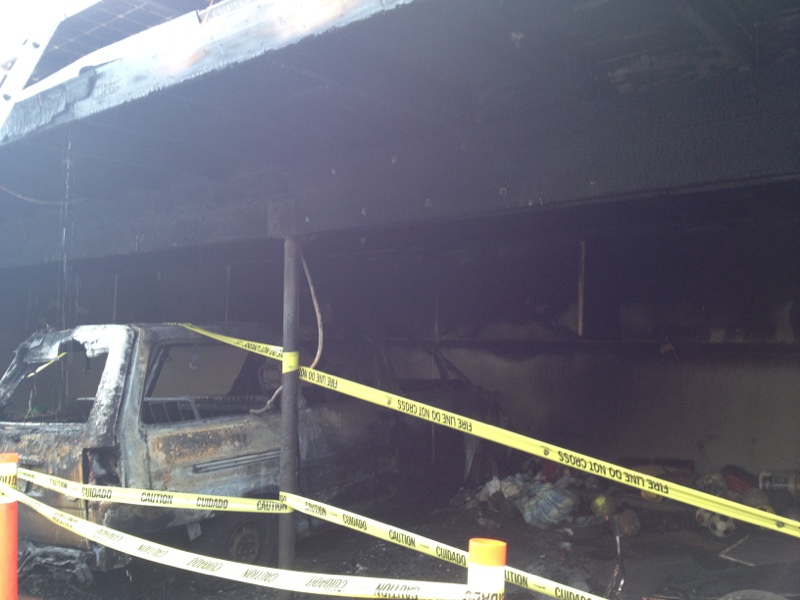
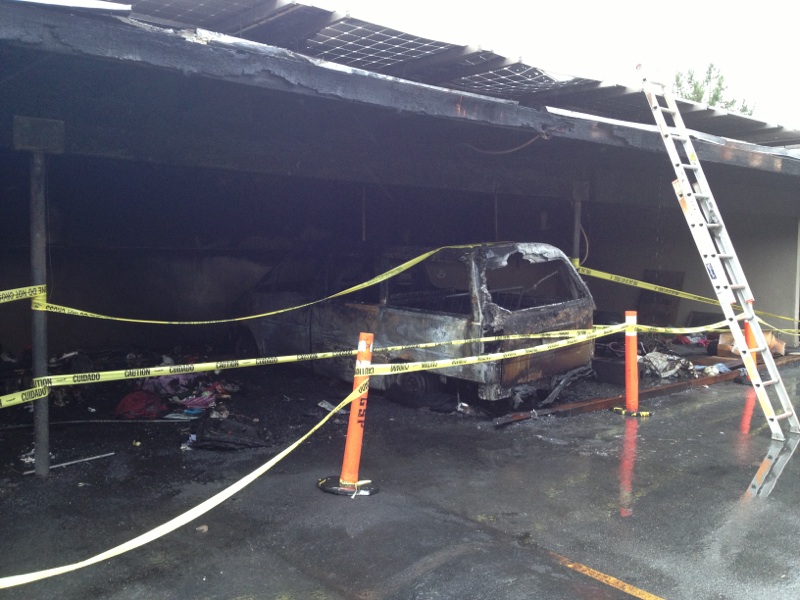
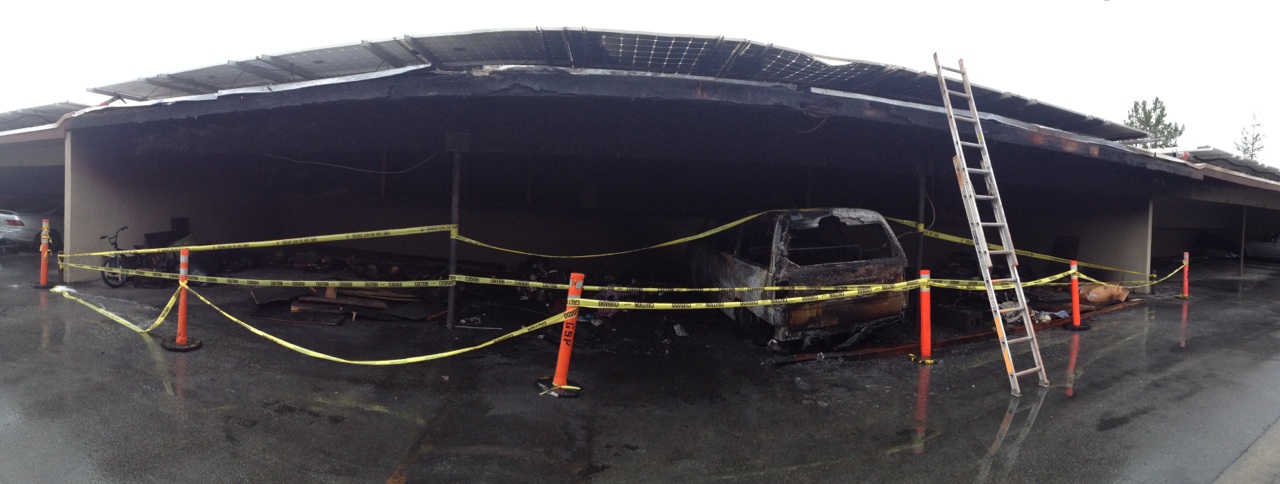
-JK
Workplace Safety in the Restaurant
Last night I found the most horrifying commercial/ad ever on Youtube. It shows very graphically that Commercial Kitchens can be extremely dangerous places to work. It’s only an advertisement, but it’s a heavy message but I guess it served it’s purpose as it’s now scarred in my brain. See for yourself:
The pressure of service and working in a restaurant with dangerous equipment and products can have a serious impact on one’s livelihood. As a restaurant owner, it’s critical to maintain a safe workplace for your kitchen staff. Good communication between co-workers as well as understanding and following all workplace safety procedures are essential in preventing burn injuries in restaurants. To reduce your risk of suffering a scald burn injury or causing a co-worker to be burned, consider the following precautions:
- When you are manually transferring hot liquids, make sure the container is no more than half full, and use a lid or splash guard.
- When using a rolling cart to transfer hot liquids, check to be sure the container is secure on the cart so it will not tip or fall from sudden stops or jarring.
- Use extreme care when handling foods or liquids that have been microwaved, as they can reach temperatures greater than boiling without bubbling.
- Keep floors clear of liquids and debris. Slips, trips and falls are responsible for many restaurant scald burns, and often these injuries can result in more time lost at work than other scald injuries.
- When appropriate, use hot pads, pot-holders or proper gloves/mittens.
- Always wear protective shoes with slip-resistant soles – never open-toed shoes, sandals or boots.
- Follow all safety procedures when working with deep fryers.
*This information is for informational purposes only . It’s not intended as medical or legal advice
Source: Zywave, Inc.
-JK
Office Waterfall
I can across this picture on Reddit today of an office getting pounded by water from a pipe burst in the ceiling:

Looking at this picture, I’ll guarantee you this business didn’t expect Niagara Falls to be suddenly pouring through their ceiling on this day.
Which leads me to the topic of insurance.
Insurance is intended to cover sudden and unexpected losses like burst pipes and fires among other things.
I talk to all different types of businesses on a weekly basis about their insurance. From offices to stores, manufacturers to distributors, and everything in between. A common sentiment I get when discussing coverage’s is, “I don’t need that, it’ll never happen to me.”
Let’s hope this business didn’t skimp out on insurance to save money thinking this would never happen to them. Not only is there a major property loss, but what about the downtime and all the intangibles you don’t even think about that result from a loss. What if you’re the business located downstairs?
The point is, a loss can happen to anyone, anytime. Be prepared. Be proactive, not reactive. A loss to this magnitude can put you out of business for good if your don’t have the proper risk management tools in place. Don’t wait to learn the hard way.
-JK
Business Income Insurance – Coverage to Help Keep a Business Running
When disaster happens, a business may need to close temporarily. And when closed, that means loss of income.
 Loss of income is one of the main reasons most businesses don’t reopen after a serious loss. Expenses don’t suddenly go away. In fact, they may spike significantly. Without revenue, it can be difficult for a business to survive.
Business Income insurance helps keep the capital flowing when a businesses doors are shut temporarily and indefinitely after a loss.
With business income insurance, you are reimbursed for revenues lost during downtime when your property is damaged by fire, theft, vandalism or a natural disaster. Business income will also reimburse for expenses incurred to minimize the suspension of business operations, such as rent paid for a temporary office while the damaged property is being repaired.
What’s more, options might include coverage for business interruption resulting from:
- Loss of off-premises utility services, including water, communication or power
- Loss to a dependent property, such as a major supplier or customer
- Electronic vandalism for business conducted over the Internet
- Food contamination in restaurants and food service businesses
Business income coverage is usually included under a property insurance policy, but you should double-check that you have this and understand what the terms of the policy form are. If you have a Businessowners insurance policy, business income insurance will most definitely be included under the policy.
Source: The Hartford
Water Damage Exclusions On A Property Insurance Policy
In my last blog post, I shared information on the water damage loss a client of mine suffered the week of the 4th of July.
Water damage claims can be tricky. Here’s what you need to understand about water damage when it comes to insurance coverage.
When your building and/or its contents have suffered water damage, it’s never a good situation. It’s more prone to happen if you have not been properly maintaining your building. Probably the two biggest characteristics of the building that apply to water damage claims are the roof and plumbing. If you have ever purchased property insurance for a building you own, or a space you lease, you are asked what year the building was built. If it’s over 25 years in age, insurance carriers typically want to know when the last renovation or update was made on the roof and plumbing, as it can affect your contents and the likelihood of water damage.
The property insurance policy defines water damage as “accidental discharge or leakage of water or steam as the direct result of the breaking or cracking of any part of a system or appliance containing water or steam.”
What could this mean for you? Assume for a minute that the gutters on your building are rusty and water is not being properly diverted off your roof. A rainstorm pushes water through the weakened area into your roof. Water leaks under the eaves, into your walls and starts to pool. And because it was over a weekend, your desk is now an island in a small lake. This damage is not covered by your insurance because it is due to improper maintenance, not a sudden and unforeseen event.
You should also know that flood, including the “accumulation of surface water, waves, tides, tidal waves, overflow of streams or any other bodies of water, or their spray, all whether driven by wind or not” are NOT covered under a property insurance policy. You must have a separate flood insurance policy in place to protect your business from these perils.
A general rule of thumb is water rising from the ground up is generally not covered by property insurance, unless you have your policy endorsed to include sewer or drain backup.
If in doubt about whether you’re covered or not for certain aspects of water damage, contact your agent or broker to discuss.
-JK
Nasty Water Damage Loss; Insurance Claim
Upon returning to my office last Thursday morning after the July 4th “holiday”, we received a call from a client who returned to their office after the day off, only to find every square inch of their floor covered by 2-3 inches of water.
At first glance, they weren’t overly concerned about what they saw, but as they entered the building, they realized this was a severe loss for them. It turned out the sink in the break room had been building up pressure which caused the faucet head to shoot like a rocket across the room knocking a 5-inch wide hole through a wall and sprayed water like a fountain throughout the office for over a day.
The phones had been knocked out, employees couldn’t enter the building, and the entire office was under water. They needed help, fast.
We immediately called the claim in to the carrier and contacted a damage restoration company to get in there to begin cleaning up the mess. The restoration service company ended up spending the entire day Thursday sucking up the thousands of gallons of water.
On Friday morning, I visited my client’s premises to check it out and meet with the carrier claims adjuster, plumbers, contractors, and my client.
Here are some pictures of the damage:
The good news is insurance coverage is in place to help with this loss. Not only are the repairs being made, but there is business interruption coverage and the carrier found a temporary office to relocate our insured while their office is being repaired. In a conversation I had with our client, they told me they see the value of their insurance more now than they ever had. Unfortunately, there are many businesses out there who don’t see the value of carrying insurance, thinking issues like this will never happen to them. And when it does, they learn the hard way. With a six-figure loss like this, would your business survive without insurance?
About Me

I grew up in Fullerton, CA and graduated from Servite High School in Anaheim. I have my Bachelors degree from Loyola Marymount University in Los Angeles. I currently live in Tustin, CA.
Please contact me if you need help with any of the following lines of insurance for your business:
-Cyber / Data Breach
-Commercial Property
-Commercial General Liability
-Products Liability
-Workers Compensation
-Commercial Auto
-Umbrella/Excess Liability
-Errors & Omissions/ Professional Liability
-Employment Practices Liability
-Directors & Officers
-Life & Disability Insurance
 Jimmy Kinmartin, CPCU