
15 Signs of Workers’ Compensation Insurance Fraud
Workers’ compensation fraud costs the insurance industry roughly $5 billion each year, according to estimates by the National Insurance Crime Bureau. And depending on whom you ask, fraud accounts for as much as 10% of the costs of all workers’ comp claims.
With the tougher economic times, particularly as lay-offs mount, we’ve definitely seen a trend in our agency of work-related injuries for a variety of manufactured reasons, such as for an injury that occurred on personal time.
Look for these tell-tale signs of potentially fraudulent claims. Usually one of these items alone is not enough to point to fraud, but if you have two or more of these signs, it could suggest a problem.
1. Late reporting. If you have an employee who suffers a legitimate on-the-job injury, they will generally report it right away. This may not always be indicative of a fraudulent claim, though, because sometimes the true effects of an injury may not be known until the following day.
2. The Monday morning claim. If the injury allegedly occurred on Friday, usually late in the day, but did not get reported until Monday, there is reason to suspect there might be a little more going on than meets the eye. The logic is that the employee likely suffered an injury over the weekend and does not want to pay for it themselves if they lack health coverage, or if they don’t want to foot the bill even for their health coverage deductible.
3. Lack of witnesses. Often your employees won’t be working in a solitary environment and there ought to be somebody on your staff who witnessed the accident. Still, not every claim has a witness and this should not be used solely to determine fraud.
4. Sketchy details or conflicting descriptions. Most claimants can recall the details of their injury. If the claimant seems to be fuzzy on the details and gives vague responses to questions, it could be a warning sign. Also, if the employee’s description of the accident conflicts with the medical history or First Report of Injury, there may be a problem. This could arise if, upon further investigation, the employee keeps changing the story and adding or removing pertinent information – a good reason to suspect it to be a fraudulent workers’ compensation claim.
5. Disgruntled employee. A disgruntled employee is more likely to place fraudulent claims than an employee with high job satisfaction.
6. Financial hardship at home. Workers’ compensation benefits are sometimes seen as a way out of a tight financial situation at home. Although temporary disability benefits are lower than normal working wages, the worker could use the time to “double dip,” that is, take on extra work when they are supposed to be at home recovering from the alleged injury.
7. Hard to reach. This ties in with number six. If this occurs every time the claimant is called, there is a possibility of fraud.
8. Misses medical appointments. If an employee is truly injured, they want to get better and will make sure to go to all medical appointments. Missing appointments is another reason to suspect fraud.
9. Employee is engaged in activities at home that are not consistent with the injury. If your employee reported a back injury and other employees find that he is playing softball on the weekends or renovating his yard, there is a good reason to suspect fraud.
10. Employment change. The employee reports the injury right before or after being laid off, near the end of a contract job or near the end of seasonal work.
11. Post-termination claims. If an employee files a claim after being laid off or fired, red flags should pop up.
12. Frequent moves and changes. The claimant has a history of frequently changing physicians, addresses and places of employment.
13. History of claims. If the claimant has filed suspicious or litigated claims in the past, they could be a person who feeds off the system.
14. Employee refuses treatment. There should be no reason that a legitimately injured worker refuses a diagnostic procedure to confirm the nature or extent of an injury.
15. Rigorous hobby. If the injured worker has a pastime that could cause an injury similar to the alleged work injury, the claim could warrant further investigation.
Remember, if you suspect fraud, you should talk to your broker or the insurance company claims representative to alert them. All insurance companies are required to have special investigations units that look into claims fraud. It benefits both you the employer and the insurer if the insurance company investigates and uncovers a fraudulent claim.
If the insurer suspects fraud, they can reject the claim and report their suspicions to the local district attorney’s office and the Department of Insurance.
Credit: Atlas General Insurance Services
Cleaning The Cobra Pit
When you watch this video, what kind of thoughts come to mind? Terror? Fear? Panic? Shock?
Working in the property & casualty insurance world, it got me thinking about workers compensation insurance. Hey, when you work as an insurance agent/broker, you tend to analyze everything from a risk management standpoint.
Whatever country of origin this video is from, there’s probably no such thing as workers compensation insurance, but in the U.S., this would be a tricky policy to write. This guy is nuts and a little bit too comfortable with his job. I’m probably just as crazy for thinking about workers compensation insurance as it relates to this video.
-JK
The Workers Compensation Insurance Market Can Be Cruel
The workers compensation insurance market can be a really cruel beast. Take for example a client of ours with a pretty sizable payroll (and big premium account) whose workers compensation insurance policy is renewing this month. They hadn’t sustained a work related injury in almost ten years which is a feat in itself considering the risky work they do as seismic retrofitters of unreinforced buildings.
After almost ten years with a clean workers compensation loss history, this client experienced two unexpected employee injuries this year with over $100,000 in claims paid for injuries and disability. This $100k is only a fraction of the premium this client has paid for their workers compensation insurance over the last ten years. However, the current carrier is non-renewing their policy and most other carriers are declining to quote. Funny thing is, these same carriers were begging for a chance to write their renewal in years past. In either case, this is how the workers compensation insurance market works sometimes as harsh as it can be.

Although it’s impossible to completely eliminate employee injuries, there are steps you can take as an employer to help minimize the frequency and severity of injuries:
7 Steps To Manage Workers Compensation Costs
1. Hire responsibly. Employers should take time to find the right employees for the workplace and use tools like employment applications, reference checks, pre-hire drug screens, motor vehicle driving history and background checks.
2. Establish a safety program. Develop policies, procedures and rules. Provide employees with the necessary training, proper tools and personal protective equipment to do their job safely.
3. Enforce safety rules. It is not enough to train employees and provide them with the proper tools. Businesses should routinely remind employees to work safely through the use of workplace audits, safety meetings, toolbox talks and annual training.
4. Provide immediate medical care. Pre-arrange medical facilities for employees in the event of a workplace injury. Be prepared to provide transportation for nonemergency injuries. For emergencies, call 911. Always require a post-accident drug test to be administered.
5. Report all injuries immediately. All injuries should be reported to the insurance carrier within 24 hours of the incident. Ongoing communication with the injured employee and the claims adjuster is extremely important in order to better manage the claim.
6. Investigate all accidents and near misses. Businesses should review accidents to assess what happened and take necessary steps to make sure it does not occur again.
7. Provide transitional modified jobs. Once an employee is released to return to work, businesses should be prepared to offer alternate duty if the employee is not currently able to perform duties required by their position.
These steps don’t have to be taken alone. Talk to your broker or carrier about the resources available to help your business mitigate risk.
–JK
Do I Include Tips In My Payroll For Workers Compensation Insurance?
Man, I haven’t posted anything new for way too long, mostly because I have been devoting a lot of time to studying for my next CPCU test…..”Accounting and Finance for Insurance Professionals.” Does anything sound more dry and boring than that?? Accounting/finance/insurance…….sounds worse than influenza/ the DMV/ or paying bills. Oh well, I am learning a lot.

Anyways, someone asked me a good question today. This came from a salon owner, “Do I include tips in my payroll estimate (for workers compensation insurance)? The answer to this question is NO, do not include tips. Tips and severance pay are to be disregarded in developing payroll with one exception: sums for accrued vacations, sick pay, commissions, and bonuses included in severance pay shall be included.
One the same note, with regards to overtime, only straight time is used in the premium calculation for workers compensation insurance. In other words, all hours worked are considered but only at straight-time rates. Premium rates for pay of overtime are disregarded. However, payroll records must be kept which show these details.
Bonuses are considered as regular compensation and used in developing payrolls.
Premium pay for working certain hours on the clock, such as swing shift or night shift work, is used in developing payrolls.
–JK
Source: Merritt Manual
Your Workers Compensation Insurance Premium Likely To Increase in 2012
 Are you a California business concerned about your workers compensation insurance costs? Well get ready to see some premium increases in 2012.
On Friday, November 4, 2011, California Insurance Commissioner Dave Jones approved new workers’ compensation insurance advisory pure premium rates for policies that renew January 1, 2012 or later. This decision will likely mean a substantial increase in the price employers pay for workers’ compensation insurance compared to what they paid last year for identical coverage.
- The average pure premium rate approved for January 1, 2011 was 4.66
- The average pure premium rate approved for January 1, 2012 is 6.34
- This is an average rate increase of 35.87%
Even though all of the rates for the 490+ standard classifications are increasing in 2012, it is important to know that not all rates will increase uniformly by 36%.
The Workers’ Compensation Insurance Rating Bureau of California, which tracks trends in the workers compensation insurance market and advises the state, had recommended an average $2.33 per $100 of payroll in the summer. The state insurance commissioner can adopt what the Rating Bureau suggests or offer his own recommendation. Workers’ compensation insurers, in turn, use the recommendation as guidance when setting rates but they are not bound by it.
Pure premium or “base” rates reflects only the estimated cost of benefits and insurer loss expenses. They don’t account for other carrier expenses.
The insurance market as a whole has been very soft over the past several years with rates on the decline. Insurance industry professionals have been waiting anxiously to see when the tides will change and the pendulum will start swinging towards a “hard” market with increasing insurance premiums. There has been a lot of speculation as to when the market will turn, but this workers compensation pure premium increase is a good indication that the tides will start turning in 2012.
Against the theme of a terrible economy and many small businesses in trouble, it will be interesting to see how all this plays out. Business owners- keep a close eye on your 2012 workers compensation insurance policy renewals.
–JK
Sources: WorkCompare.com, Sacramento Business Journal
Contractor Dies After Falling 30 feet at Local Plant
A man working on a construction project at the coastal Hyperion wastewater treatment plant near Playa del Rey was killed last Tuesday after 30-foot fall. Los Angeles city firefighters were called to the plant and found the worker dead at the scene.

The Hyperion Treatment Plant, Playa del Rey, CA
The man, who was not an employee, was erecting a 30-foot wall panel at the plant according to the state Division of Occupational Safety and Health (Cal/OSHA).
The man’s employer is a Stanton-based general contracting firm which has been working at the plant to construct a gas compressor facility that will replace equipment built in the 1950s. The incident is believed to be the plant’s first construction-related fatality since the plant was first modernized in the 1950s.
This incident is a strong reminder of the importance of carrying workers’ compensation insurance. Even more notably, the importance of making sure any subcontractors you have working for you carry workers’ compensation insurance. No matter if you’re a professional consultant, or a large construction company, you MUST be certain any independent contractors you hire carry workers compensation insurance and show you proof with a certificate of insurance before working any jobs for you. Otherwise, you as the employer are liable for any work related injuries or loss.
Have them furnish you with evidence of coverage with a Certificate of Insurance. Mark their policy expiration down on your calendar to remind yourself to request a renewal Certificate before their policy expires. (While you’re at it, make sure their general liability coverage is also listed on the Certificate and that you’re named as an Additional Insured)
Your workers’ compensation insurance carrier will want to see copies of your independent contractor’s workers’ compensation certificates. Without the certificates, your carrier may consider the independent contractors your employee and charge you an additional workers’ compensation premium at the time of audit.
A good rule of thumb is to have ALL your workers, whether employees or independent contractors, covered by workers’ compensation insurance. Numerous court cases have ruled the hiring party is responsible for injuries to independent contractor’s employees when the independent contractor did not have their own workers’ compensation insurance.
–JK
What Is A Workers Compensation Insurance Experience Rating?
I attended a workers compensation related seminar this past week on the subject of insurance and more specifically, the infamous “experience rating.” Five minutes after the seminar began, I was reminded how complicated the subject is when it comes to the statistics and calculations of experience ratings. I figured it would make a good insurance blog topic if I could somehow weed out the x’s and o’s and put it into layman’s terms on what it all means to you, the business owner who has an experience rating tied to your workers compensation insurance policy.
What is an experience rating?
 California’s workers’ compensation experience rating system is a rating system intended to provide employers a financial incentive to reduce work-related accidents. It’s a method for adjusting premium rates to reflect an individual employer’s claims history. Essentially, it predicts an employer’s future losses based on past experience and compares the loss or claims history of one company to all other companies within the same industry/classification.
Employers may receive discounts off their premium for good claims records or may be surcharged for their poor claims records.
There are approximately 500 different business classifications used to describe the various types of businesses in California. Businesses assigned to your SIC (standard industry classification) are relatively similar to your business, however, there are differences which can have an impact on workers’ compensation claims costs. To address these variations and encourage workplace safety, experience rating adjusts the premium you pay either upward or downward based on a comparison of your company’s history of payroll and claims to what is expected for businesses of similar size within the same industry classification. This comparison results in your “experience modification.” An experience modification greater than 100 results from less favorable loss experience compared to the average of other similar businesses, and vice-versa, an “ex-mod” less than 100 results from more favorable loss experience compared to the average of other similar businesses .
Experience rating places more emphasis on the frequency of injuries than on the severity. An employer with one large loss ($100,000) will pay less for future insurance than an employer with 10 smaller lost time claims of $5,000 each – a total of $50,000 in losses. Experience rating cushions the blow of a large loss, but hammers employers with frequent losses.
What is the need for experience rating?
- To provide a direct financial incentive for employers to reduce accidents and encourage safety– This allows employers to develop loss control programs and establish safety programs which create premium incentives.
- To distribute the cost of insurance equally among employers in an industry classification– The reality is there is no “average” employer for a given classification code. The experience modification takes this into account to encourage the emphasis on loss control. Differences in management practices and methods of operation are reflected in final premium.
Who gets experience rated?
All California employers meeting minimum qualifying premium (Qualifying premium for 1/1/2011 is $16,700 and is amended annually). This accounts for approximately 120,000 employers in CA. Qualification is automatic and mandatory.
So what does this mean?
The science to determining your experience modification is pretty complicated. What you need to know is you want to keep your experience modification down, as it will bring your workers compensation premium down. To do help do this, you should develop loss control and safety programs to control work related injuries. It starts with you. Your management practices and methods of operation are reflected in your final workers compensation premium. If you don’t know where to start, contact your agent or carrier. Insurance carriers will help customize a loss control program for your business. They want to control loss just as much as you do.
Resources: WCIRB California; State Compensation Insurance Fund
–JK
Safety First: Ladders
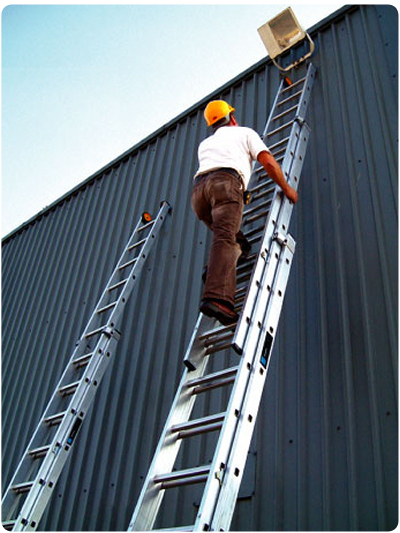 Yesterday I received a call from a client, a contractor, reporting that one of his employees fell off a ladder and broke his elbow on the job on Monday afternoon. As the employer, he did the right thing in seeking immediate medical care for the employee at the nearest medical facility. He obtained as much information as he could about the injury and supporting info from the employee’s personnel file including name, address, phone, DOB, SS#, date of hire, and wage info. We called in the claim this morning to the carrier and a claim adjuster is now working with our insured to guide him and the employee through the treatment process.
Safety In The Workplace
Statistics show that falls from ladders injure over 20,000 workers annually. Some injuries result in permanent disabilities and even fatalities. If you’re working in a job capacity that calls for ladder use, be sure to make ladder safety a high priority for your employees. By following these safety guidelines, you can help prevent ladder accidents.
Safety starts before the ladder is even mounted.
- Before using any ladder, check its condition. Make sure there are no broken, cracked, or missing rails and that rungs are not slippery from grease or oil.
- Check for damage or corrosion on metal ladders.
- If a ladder is in poor condition, don’t use it. Report the problem so it can be tagged and repaired.
- A competent person should periodically inspect all ladders and remove damaged ladders from use until they are repaired.
When choosing and using a ladder, keep the following in mind:
- Choose the appropriate type and size ladder for the job, including correct fittings, and safety feet.
- Near electrical conductors or equipment, use only ladders with non-conductive side rails.
- Set the ladder on solid footing, against a solid support.
- Place the base of a straight ladder out away from the wall or edge of the upper level about one foot for every four feet of vertical height.
- Be sure straight ladders are long enough so that the side rails extend above the top support point by at least 36 inches.
- Single cleat job-made ladders should be 15 to 20 inches wide with ladder cleats uniformly spaced 12 inches apart.
- Never try to increase the height of a ladder by standing it on other objects, such boxes or barrels, or by splicing two ladders together.
- Portable ladders should be tied, blocked or otherwise secured against movement.
- Keep ladders away from doorways or walkways, unless they can be protected by barriers.
- Keep the area around the top and base of the ladder clear. Don’t run hoses, extension cords, or ropes on a ladder; these may create obstructions.
- To avoid slipping on a ladder, check your shoes for oil, grease, or mud and wipe it off before climbing.
- Climb the ladder carefully, facing it and using both hands. Use a tool belt or hand line to carry materials.
- Most ladders are designed to hold only one person at a time. Two persons may cause the ladder to fail or be thrown off-balance.
- Don’t lean out to the side when you’re on a ladder. If something is out of reach, get down and move the ladder.
- Ladders should never be used sideways as platforms, runways or scaffolds.
- Choosing and using ladders wisely is a step in the right direction.
Source: State Compensation Insurance Fund
–JK
Ten Steps You Can Take To Lower Workers Compensation Costs

Hurt On the Job
Workers’ Compensation insurance can get costly and is a big pain in the butt for some businesses. In fact, the costs to carry coverage can even threaten the existence of some small businesses, especially in states such as California. The good news is that the insurance market is currently “soft”, meaning lower rates than we have seen in the past five plus years. However, it’s pretty much a guarantee the pendulum is just beginning to turn and we’re going to see work comp rates creeping upwards again as healthcare costs have skyrocketed, among other things.
Workers Compensation premiums are based in part on some things which you have little or no control, such as the type of industry your business is in, or the region or state you’re located. But rates are also based on things you do have some control over, such as your claim history and payments.
Here are 10 steps you can take to help lower your Workers’ Compensation costs:
- Match the applicant carefully to the job: Base the match on the applicant’s skills and abilities. Your careful hiring practices can go a long way toward reducing your costs. The Department of Fair Employment and Housing offers brochures to help guide you in conducting job interviews. Note: Discrimination because of a handicap is unlawful.
- Make safety a priority on the job every day: A safe workplace can lower your claims costs. It is far less expensive to prevent an accident than to pay for one.
- Fix dangerous conditions: When you become aware of a hazard on the job site, take appropriate corrective measures. Your failure to do so could result in a “Serious and Willful Misconduct” suit against you. This suit carries severe penalties that you would pay, not your insurance carrier.
- Train Supervisors: Workers’ compensation law includes supervisors in the definition of “employer.” When a supervisor fails to follow the law, it counts against you. Make sure your supervisors know all that is required of employers.
- Report employee injuries: As soon as you are aware of an injury, notify your insurance carrier by completing and sending the Employer’s Report of Occupational Injury or Illness form. The report requires you to provide information that includes the nature of your business, the type of employee injury or illness, and how it occurred. Your complete statements in each of these sections are necessary for determining the appropriate benefits. For example, information about your employee’s work hours and salary is necessary for computing benefit payments.
- Provide the employee claim form: You must provide the employee with a Workers’ Compensation Claim Form within one working day of learning of an injury. The employee should return the completed form to you. When you receive the employee’s claim form, make sure you sign and date it. You must then immediately forward the original to your carrier. The first indemnity payment is due within 14 days of your knowledge of a disabling injury. Failure to provide timely benefits may result in a penalty. The penalty may cost you, the employer, if findings indicate that you did not file the claim form with your carrier on time.
- Exercise medical control: Be sure to refer all of your injured workers to your carrier’s Medical Provider Network (MPN) physician. If you do not know of a physician or medical facility, contact your agent or carrier. Be sure to post notices with the name, address, and phone number of your medical provider so your employees know where to go in case of an injury. If the employee has previously notified you in writing of his or her personal physician, the employee has the right to be seen by that physician.
- Communicate with your employees: Show them you care about their well-being. If an employee sustains an injury, stay in touch throughout the recuperation period.
- Consider a Return To Work program: A Return To Work (RTW) program can help bring your injured employee safely back to work as early as possible. You adjust the transitional job to accommodate the employee’s improving condition until he or she can return to his or her usual duties. You reduce your costs; your employee can return to a self-supporting status; everybody benefits.
- Maintain records: Your personnel files can be of great assistance to your carrier in dealing with some cases. Information about an employee’s job description, wages, previous work history, recreational activities, any current work problems, and previous injuries is essential when fighting disputed claims.
As with any type of insurance, contact your insurance agent or carrier if you have questions on your workers’ compensation coverage, or if you need help controlling your costs. Insurance carriers have just as much incentive as you to prevent and/or mitigate loss, so there are risk control options to help.
–JK
Dude, Where’s My Arm?
File this one under bad trips, the Montana Supreme Court ruled a Montana man is entitled to receive workers compensation insurance benefits after being mauled while feeding bears at an adventure park…….after smoking pot. Yep, the man got high before he stepped into a bear pen to feed the omnivores. Shouldn’t he be chillin’ on the couch be playing Madden or something instead?
 The court ruled that the man was an employee who had been compensated and was “within the scope of his employment” while working at the park. His impairment wasn’t a “major factor” in his mauling since there wasn’t specific evidence about his level of impairment . Also acknowledged was the fact that grizzlies are “equal opportunity maulers.”
Some notable analogies from the judge: “when a grizzly bear is sighted on a trail in Glacier National Park, the trail is closed to all hikers, not just the hikers who may have recently smoked marijuana.” And, the owner “installed multiple electrified fence lines at the bear park to separate the grizzly bears from all customers, not just the customers who may have recently smoked marijuana.
On the flip side of the story, the park owner claimed the man was really a volunteer. It was discovered that the adventure park didn’t even carry worker’s compensation insurance.
Really? You own an adventure park with wild animals and don’t carry workers compensation insurance? I don’t know who’s more foolish, the guy getting high before feeding bears, or the owner of an adventure park, with a bear pen, who doesn’t carry workers compensation insurance?
Luckily for the baked bear feeder, he was able to recover some of his medical expenses stemming from the attack.
I’m not advocating smoking marijuana, but if you choose to, don’t step into a cage to feed wild animals! What a buzz kill.
–JK
Source – KXLU – Helena, MT
About Me

I grew up in Fullerton, CA and graduated from Servite High School in Anaheim. I have my Bachelors degree from Loyola Marymount University in Los Angeles. I currently live in Tustin, CA.
Please contact me if you need help with any of the following lines of insurance for your business:
-Cyber / Data Breach
-Commercial Property
-Commercial General Liability
-Products Liability
-Workers Compensation
-Commercial Auto
-Umbrella/Excess Liability
-Errors & Omissions/ Professional Liability
-Employment Practices Liability
-Directors & Officers
-Life & Disability Insurance

