
NY Tortilla Factory Shut Down After Fatal Work Related Accident
 Earlier this week, a Brooklyn, NY tortilla factory employee died after falling into a waist-high dough mixing machine. Now, the state has closed the factory because authorities discovered the company’s workers compensation policy had lapsed in March 2010.
A NY State Workers Compensation spokesman said, “The owner would need to get the insurance and pay fines before he is permitted to reopen.” While the Workers Comp board doesn’t always shut down companies where the insurance is lapsed, the fact that there was a workplace death prompted officials to visit the tortilla factory. As it stands, the company owes $56,000 in penalties. OSHA and the Department of Labor are also looking into the incident.
This $56,000 in outstanding penalties is sure to be dwarfed by lawsuits likely to be coming from the employee’s family and surviving members. All this could have been avoided or significantly curtailed if the factory owner carried the workers compensation insurance coverage required by law.
The very core of workers compensation insurance is that it provides medical care for employees who are injured in the course of employment. Beyond medical care, Workers Comp insurance provides temporary and/or permanent disability benefits, supplemental job displacement benefits or vocational rehabilitation and death benefits. Workers Comp is a trade-off between employers and employees. Employees receive prompt effective medical treatment for on-the-job injuries or illnesses no matter who is at fault and, in return, are prevented from suing employers over those injuries.
The tortilla factory’s owner was reached on the phone by a newspaper Friday but said he couldn’t talk and hung up. He had previously said that the death was the first worker injury at the company and said it had been caused by “human error.”
Unfortunately, business owners usually learn the hard way when it comes to a loss. This being a prime, and severe, example. Personally, I would be surprised if this business survives considering what surely lies ahead with lawsuits, etc.
–JK
Workers Compensation Insurance – Independent Contractor vs. Employee
The difference between independent contractors and employees is a common debate within the insurance world. I wrote another post about it back in August, but the question continually arises, so it’s worth reinforcing. Determining which is which, employee vs. independent contractor is all fun and games until someone gets hurt. As an employer, think about the following points from the California State Compensation Insurance Fund before trying to dance around paying workers compensation insurance premiums.

Employees vs. Independent Contractors is a common debate for contractors and Work Comp insurance
California courts typically use a number of tests to determine whether an individual is an employee or an independent contractor. A crucial factor in determining employment status is the employer’s right to direct and control the work being performed. If you have the right to control the manner and means of the work performed, the courts have routinely decided that the “independent contractor” is actually your “employee”.
There are many other factors, but the reality is there is no definitive test to determine employee or an independent contractor. The following circumstances can help determine the relationship between the two. Among them, whether the person performing the service:
- Has the right to terminate the relationship at will.
- Is engaged in a distinct occupation or business.
- Has voluntarily chosen the burdens and benefits of self-employment.
- Has the skill required in the particular occupation.
- Supplies the instrumentalities, tools, the work location, and carries the license or certificate required to perform the work.
- Has the right to hire and terminate others.
- Is paid by the time worked, or by piece rate.
- Works under the direction of the employer or by a specialist without supervision.
- Whether the services are a part of the regular business of the employer.
- Whether the parties believe that they are creating the relationship of employer/employee or employer/independent contractor.
If there are questions, the Labor Code assumes a worker is an employee for workers’ compensation purposes. The burden of proof to support the independent contractor status of a worker falls on the employer. The Labor Code also requires that any subcontractor who does not have an active valid contractor’s license be treated as an employee, not an independent contractor. However, even though a worker may have a valid license, the worker may still be an employee depending on the factors as discussed above.
A good rule of thumb: as an employer, always protect yourself.
- If certain jobs require a license, request a copy for your records.
- Obtain original Certificates of Workers’ Compensation Insurance addressed to you from all contractors and subcontractors who have employees or who, in turn, subcontract any portion of their own work.
Remember, it’s all fun and games until someone gets hurt. If proper documentation is not maintained and presented to insurance auditors, carriers are obligated to charge premium for any liability that may exist under your workers’ compensation insurance policy.
–JK
Employee Injuries & Return to Work Programs
When you think about workplace injuries and workers compensation insurance, what are the first thoughts that come to mind? Perhaps the cost for medical care and rehab? Compensation for lost wages? Legal services related to a claim?
Have you ever thought of the hidden costs associated with workplace injuries? Consider the following:
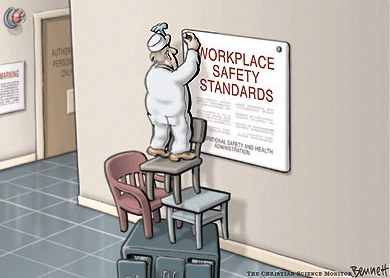
- Lost productivity from an experienced employee
- Equipment or product damage
- Lost efficiency among employees
- Time spent completing forms and communicating with medical providers and insurance adjusters
Hidden costs are those costs that are not immediately recognized, but take a toll on business profitability. These hidden costs are not typically covered under a workers compensation policy and drain from a business’s bottom line. This is why a Return to Work (RTW) Program should be implemented to help control costs.
What is a Return to Work Program?
A return to work program gets an injured employee back to work in a productive position when they are physically capable; not necessarily the position they had at the time of injury. There are studies show that the longer an injured employee is off work, the more difficult it becomes to get them back into the workplace. A return to work program keeps the employee engaged in a work based routine, interacting with fellow employees and contributing productively to the business.
For a Return To Work Program to be effective, communication must occur. Prompt notification of the injury to your insurance carrier allows the carrier to work with the injured employee and medical provider to assess the employee’s physical capabilities after the injury. From there, your carrier and provider can work with you to develop a plan to return the employee to work.
Benefits of Returning Employees To Work
Accepting an injured employee into the workplace can help your business:
- Regain lost productivity.
- Avoid temporary or new employee hiring and training costs.
- Reduce or avoid litigation and discourage malingering.
- Increase awareness of safe work practices.
How to Develop a Return To Work Program
- Identify the physical demands of jobs or tasks. Involve key employees to help with this task. Evaluation forms are available from the Safety and Health Department.
- Identify transitional jobs that an injured employee could perform. Full time work is not required. Injured employees may work fewer hours and at a lower wage and be eligible to receive compensation benefits. This reduces insurance costs which may affect your insurance rates for several years.
- Tell existing and new employees during orientation that your company has a RTW Program and at time of hire. Let employees know that if they are injured on job, the company will attempt to find modified work for them.
- Before an injury occurs, speak with your designated medical provider or doctor. Tell them that you have a RTW Program, and that you have jobs to accommodate an employee who has physical limitations.
A RTW program can help control workers’ compensation costs after an injury occurs; however, the best method to control these costs is to prevent injuries through an effective Injury and Illness Prevention (IIP) Program. Contact the Safety & Health Department for a model IIP program.
–JK
Terrell Owens Nails Security Guard on MNF
Did anybody watch this touchdown catch by Terrell Owens on Monday Night Football? After the catch, a security guard on the sidelines gets nailed pretty good, and he looks like a pretty big guy too! Practicing insurance every day, my mind always thinks like an insurance agent. Call me sad, but the first thing that came to my mind watching this live was workers compensation insurance. If this guy was hurt on the hit, it would be a unique work comp claim. ‘Security guard hit by T.O. after a touchdown catch.’ Since he was on the job, it would definitely be a legitimate claim!
Take a look at this video.
About Me

I grew up in Fullerton, CA and graduated from Servite High School in Anaheim. I have my Bachelors degree from Loyola Marymount University in Los Angeles. I currently live in Tustin, CA.
Please contact me if you need help with any of the following lines of insurance for your business:
-Cyber / Data Breach
-Commercial Property
-Commercial General Liability
-Products Liability
-Workers Compensation
-Commercial Auto
-Umbrella/Excess Liability
-Errors & Omissions/ Professional Liability
-Employment Practices Liability
-Directors & Officers
-Life & Disability Insurance
 Jimmy Kinmartin, CPCU