
Dude, Where’s My Arm?
File this one under bad trips, the Montana Supreme Court ruled a Montana man is entitled to receive workers compensation insurance benefits after being mauled while feeding bears at an adventure park…….after smoking pot. Yep, the man got high before he stepped into a bear pen to feed the omnivores. Shouldn’t he be chillin’ on the couch be playing Madden or something instead?
 The court ruled that the man was an employee who had been compensated and was “within the scope of his employment” while working at the park. His impairment wasn’t a “major factor” in his mauling since there wasn’t specific evidence about his level of impairment . Also acknowledged was the fact that grizzlies are “equal opportunity maulers.”
Some notable analogies from the judge: “when a grizzly bear is sighted on a trail in Glacier National Park, the trail is closed to all hikers, not just the hikers who may have recently smoked marijuana.” And, the owner “installed multiple electrified fence lines at the bear park to separate the grizzly bears from all customers, not just the customers who may have recently smoked marijuana.
On the flip side of the story, the park owner claimed the man was really a volunteer. It was discovered that the adventure park didn’t even carry worker’s compensation insurance.
Really? You own an adventure park with wild animals and don’t carry workers compensation insurance? I don’t know who’s more foolish, the guy getting high before feeding bears, or the owner of an adventure park, with a bear pen, who doesn’t carry workers compensation insurance?
Luckily for the baked bear feeder, he was able to recover some of his medical expenses stemming from the attack.
I’m not advocating smoking marijuana, but if you choose to, don’t step into a cage to feed wild animals! What a buzz kill.
–JK
Source – KXLU – Helena, MT
Why Buy Life Insurance?
A: Although not the only answer, life insurance is a good business succession plan
Would your business suffer if they lost a key person?
If you are a business owner, would you like to be in business with your partner’s spouse?
These are two questions that most often lead to the purchase of life insurance by a business. Replacing the value of a key team member can literally spell the difference between survival and demise of a business. This reinforces the need for Key Person Life Insurance.
Not only do most business people not want to be in business with their partner’s spouse, but the spouse doesn’t want to be in business. To provide dignity in a time of pain, and to allow the business to go on without controversy over who gets what and who is in charge – these are the reasons for a Buy/Sell Agreement funded with life insurance.
Do you have a life insurance insurance policy as a business succession plan? If not, here’s a good resource to start: ISUQuickLife.com
Or, call your agent to discuss.
–JK
Happy St. Patrick’s Day!
Happy St. Patrick’s Day! Especially to my very own brother Patrick. To commemorate the big day, be sure to read these priceless Irish toasts. Simple and comical. Enjoy!
I drink to your health when I’m with you,
I drink to your health when I’m alone,
I drink to your health so often,
I’m starting to worry about my own!
But the greatest love, above all loves,
Even greater than that of a mother,
Is the tender, passionate, undying love
Of one beer drunken slob for another.
Here’s to being single…
Drinking doubles…
And seeing triple!
Here’s to women’s kisses,
and to whiskey, amber clear.
Not as sweet as a woman’s kiss,
But a darn sight more sincere!
Here’s to our wives and girlfriends…
May they never meet!
As you ramble through life, whatever be your goal,
Keep your eye upon the doughnut, and not upon the hole.
Best while you have it, use your breath.
There is no drinking after death.
May misfortune follow you the rest of your life,
But never catch up.
May you die in bed at 95 years,
Shot by a jealous wife!
May you have the health of a salmon:
A strong heart and a wet mouth!
May your bank account always be bigger than your troubles.
A toast to your coffin.
May it be made of 100 year-old oak,
And may we plant the tree together, tomorrow.
–JK
Flood Safety Awareness Week: March 14-18, 2011
Apparently, it is flood safety awareness week. I had no clue.
With the potential for massive snow melt and rain storms, many communities nationwide face the threat of flooding this spring. When it comes to insuring your home or business from floods, the most important thing to note is that flood is NOT a covered peril on your property insurance policy. Flood insurance must be purchased separately and can financially protect your property and belongings from costly flood damage.
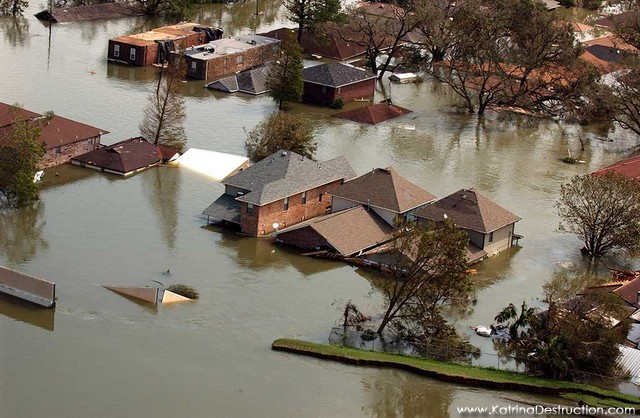
Photo by Jocelyn Augustino/FEMA
Flood Safety Awareness Week is sponsored by the National Oceanic and Atmospheric Administration (NOAA) and supported by the Federal Emergency Management Agency (FEMA). It was created to highlight the causes and consequences of flooding and educate communities on how to prepare for and protect their homes and businesses from the devastating effects of flooding.
Tips & Tools You Can Use
The National Flood Insurance Program’s (NFIP) FloodSmart Campaign is working with FEMA and NOAA to encourage home and business owners to take the steps necessary now to guard against the risks of flooding. Here are some tools and resources you can use:
- Ready.gov/floodawareness: Visit the Ready’s Flood Safety Awareness landing page for fact sheets and other important preparedness tips.
- FloodSmart.gov: Visit FloodSmart.gov’s homepage to find important spring preparedness and flood insurance information and outreach tools.
- Blog posts and social media promotion. FEMA will be blogging and spreading the word through their social media tools (Facebook and Twitter) next week.
Insurance Topics In the News (3/6-3/12)
- States Must Decide if Workers’ Comp Benefits Extend to Illegal Workers: (Read)
- Property & Casualty insurance workforce hit a 20-year low in January: (Read)
- THEN AND NOW: Long Beach Earthquake, 1933 & 2011
- Court: Former NFL Redskins Punter Can Collect Workers Compensation for back injury: (Read)
- Virgin Atlantic forced to pay $500,000 for massage injuries to employees: (Read)
- Japan Earthquake 2011: Devastating Photos Of The Wreckage
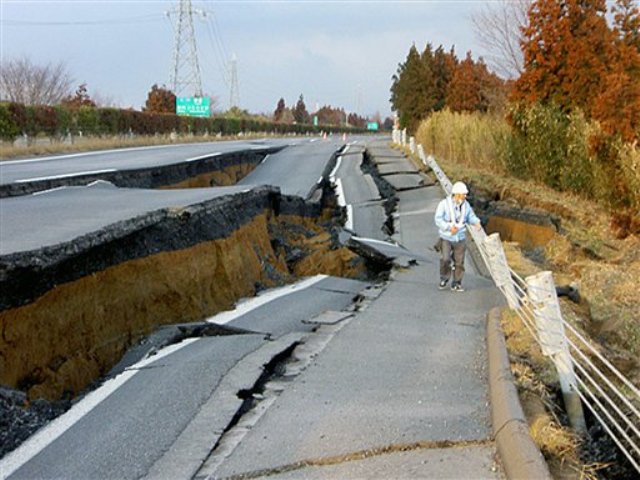
AP Photo/Nexco East Japan via kyodo News
–JK
Employee Benefits Liability
Do you offer employee benefits for your employees? If so, pay close attention to this subject: Employee Benefits Liability.
Picture this scenario:
Busy Betty, office manager for your small business, functions in countless different job capacities ranging from purchasing agent to human resources manager. One day while dealing with other urgent issues, Betty forgets to enroll a new employee on your firm’s medical insurance plan. The error isn’t discovered until the employee is hospitalized with a life threatening cancerous tumor and the bills started to roll in—over $300,000 in all.
What now?!
Well, in a case like this, it’s safe to assume that busy Betty (your business essentially) will be found liable for the damages. This is when you’re hoping you have an endorsement on your commercial general liability insurance policy known as “Employee Benefits Liability” coverage.
Carrying Employee Benefits Liability coverage means your commercial general liability insurance carrier will pay those sums that the you become legally obligated to pay as damages because of any negligent act, error, or omission committed in the “administration” of your employee benefit program, barring any exclusions. The amount of insurance paid is limited to the amount of liability coverage you carry on your general liability insurance policy.
“Administration” of employee benefit programs is defined as:
- Counseling employees, including their dependents and beneficiaries, with respect to your employee benefit program;
- Handling records in connection with your employee benefit program;
- or, effecting or terminating any employee’s participation in a plan included in the employee benefit program.
Employee benefit programs typically entail group life insurance, group accident or health insurance, profit-sharing plans, and pension plans.
Employee Benefits Liability coverage does not apply to losses arising out of any dishonest, fraudulent, criminal or malicious act or omission, committed by any insured; or claims or suits based upon failure of any investment to perform as represented by any insured; or advice given to any person to participate or not to participate in any plan included in the employee benefit program. Other exclusions apply, so keep a close eye on your policy forms. Here’s an example of a typical Employee Benefits Liability coverage form.
In most cases, minimal premium charges apply for this important endorsement (as low as $50 to $100 annually). This is a no brainer if you have an employee benefit program in force. Don’t waste time digging up a copy of your policy to confirm. Call your insurance agent today. Also keep in mind that this coverage is written on a claims made basis.
–JK
Gas Prices Up- Reduce Your Fuel Costs, NOW!
I don’t know about you, but as I have making my daily 40 minute commute to work, I’m seeing these gas prices skyrocketing by the hour it seems! I can’t help but notice the local gas station signs and their prices increasing over .07 cents a day! Whoever’s job it is to bring the pole out and update those numbers is working overtime. Here in LA, we’re above the $4 mark per gallon at some stations. In fact, I filled up my tank on Monday and my receipt came out to $62.70 and I’m not even driving a truck or an SUV. As if it isn’t frustrating enough for individuals, businesses with auto fleets are feeling more pain at the pump and it’s cutting into their bottom line.
Here are 10 Ways to Reduce Your Fuel Costs, NOW!
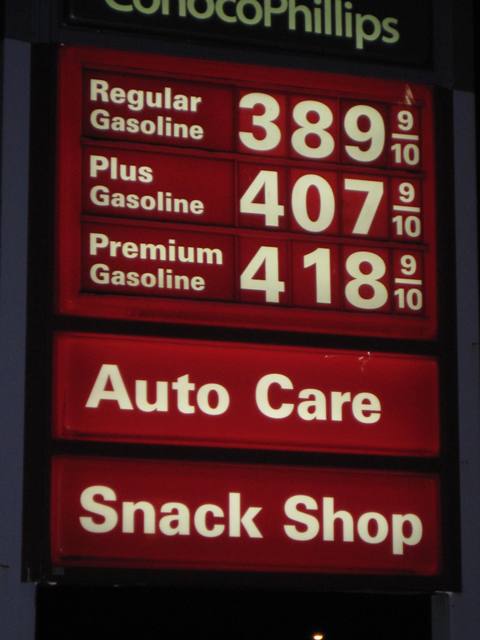
Here's a picture I took last night, 3/02, of a gas station sign in my neighborhood in Long Beach
Purchase Fuel Wisely – Save up to 20%
- Use the right grade of gasoline/ Don’t top off: most cars run fine on regular. Check your vehicle owner’s manual to find out what’s right for your car. (See regular vs. premium.) Don’t “top off” at the pump and make sure your fuel fill cap is on tight and working right. Regular grade fuel cost about 20-cents per gallon less than premium grade.
- Look for the Best Price / Limit Purchases When gas prices are High: Today’s gasolines provide very similar engine performance (although some brands have different gasoline blends that provide other benefits), so choose stations in your area with the lowest prices. Fuel prices can vary 10% within a few blocks. Avoid filling the tank during high-price periods.
Alter Travel Practices – Save up to 30%
- Use Carpooling/ Public Transit/ Non-Motorized Options: Ride the bus, carpool, bicycle or walk instead of driving alone. Sharing a ride to work with a friend or two effectively doubles your fuel economy for the trip and may allow you to use the diamond lane.
- Take Advantage of Telecommuting/ Telecommunications Technology: Many employers offer telecommuting as an option. Use the computer and telephone to replace vehicle trips for business, shopping and services when possible.
Drive More Efficiently – Save up to 20%
- Don’t Drive Aggressively/ Drive at the Speed Limit: Avoid aggressive driving and aggressive starts. All vehicles lose fuel economy at speeds above 55 mph. Driving 65 instead of 75 mph reduces fuel cost 13%. Driving 55 would save 25%.
- Reduce Air Conditioner Use/ Close Windows: Using the air conditioner increases fuel cost from 13% up to 21%. If it’s cool enough, use the flow-through ventilation instead of rolling down the windows or using the AC.
- Eliminate Extra Wind Resistance and Weight: Using a loaded roof rack increases fuel consumption. Carry the load inside your vehicle if you can. Removing unnecessary weight is better still.
- Minimize Vehicle Idling: Today’s vehicles are designed to warm up fast. Avoid idling when you can; idling is 0 miles per gallon.
Improve the Efficiency of the Vehicle You Drive – save up to 50%
- Maintain Vehicle Efficiency: Regular maintenance as prescribed by the vehicle owner’s manual will help your vehicle achieve its best fuel economy. Some overlooked maintenance items, such as a dirty air filter and under-inflated tires, can increase your fuel cost up to 13%. When replacing your tires, replace them with the same make and model as the tires that were on your vehicle when it was new. It’s been estimated that if all Californians properly inflated and aligned their tires, we’d save 300 million gallons of gasoline a year!
- Drive or Purchase a Fuel-Efficient Vehicle: Drive your most fuel-efficient vehicle whenever possible. When purchasing, consider the most fuel-efficient vehicle and save up to 50%. Consider a hybrid-electric, a diesel vehicle, or even a motorcycle. The next best option is to purchase the most fuel-efficient vehicle within the class of vehicles you are considering.
Final Word on Gasoline-Saving Devices
Please also be aware that many companies will try to sell you mileage improving devices. Some claim that they will save you 10 to 50%. Buyers Beware! The U.S. EPA and Federal Trade Commission have both said that there are no devices that will boost your mileage any appreciable amount. See web page for Energy Myths on Gasoline-Saving Products.
Source: California Energy Commission
-JK
California Business Owner Convicted of Insurance Fraud
Here’s a word of advice for you: If you’re a business owner, make sure you’re accurately reporting your payroll on your workers compensation insurance policy. If you are using subcontractors/ independent contractors to perform services for your clients, you must obtain a certificate of insurance from these contractors confirming they carry their own workers compensation insurance coverage. If not, you may be liable for any losses that occur as a result of the services they are performing for your business.
Here’s a friendly reminder that it doesn’t pay to cheat the system:
California insurance commissioner, Dave Jones, announced in a press release on 2/23 the conviction of a California business owner for insurance fraud and perjury. The case involves a $1.6 Million penalty for failure to pay premiums and failure to accurately report payroll.
Ronald J. Haas Sr., 69, has been convicted on 10 counts of insurance fraud for failing to accurately report payroll and for failing to pay insurance premiums to his workers’ compensation insurance carriers. Haas was sentenced to one year in the county jail and restitution to the entities involved, and three years probation.
“Workers’ compensation insurance fraud is an egregious offense and it will be fully investigated by my Department,” said Commissioner Dave Jones. “Those who would seek to cheat a fund to help workers who were legitimately injured will be prosecuted to the fullest extent of the law.”
On January 12, 2007, State Compensation Insurance Fund Special (SCIF) reported a suspected fraudulent claim to the California Department of Insurance Fraud Division for investigation of suspected workers’ compensation insurance premium fraud. The report alleged that Haas, President of R J Haas Construction Corporation, et al., Saratoga, CA, failed to accurately report employee payroll to his workers’ compensation insurance carrier, SCIF. From July 1, 1998 to June 1, 2005, Haas claimed that he had no employees and that sub-contractors did all the work for his company. However, during this period, four workers’ compensation claims were filed by injured employees. Haas reported payroll to SCIF only after an injury was discovered and then payroll reporting stopped shortly thereafter, with the cancellation of his policy. Subsequently, Haas obtained workers compensation insurance policies through First Comp and again reported minimal to no employees.
An investigation by the Silicon Valley Regional Office of the California Department of Insurance, Fraud Division and the California Employment Development Department (EDD) revealed that Haas misrepresented office staff, project superintendents, foremen, and even some of his own family members as subcontractors. A forensic audit was conducted and revealed that Haas owed $594,293.22 in insurance premiums to SCIF, $229,167.71 in insurance premiums to First Comp and $813,328.27 to EDD for failing to accurately report employee payroll for the purpose of determining employment tax liabilities.
On April 29, 2009, Haas was arrested for felony violations of Insurance Code. Haas is eligible to apply for a home electronic monitoring program in lieu of county jail time. At time of sentencing Haas had already paid the full amount of restitution owed to insurance carriers SCIF and First Comp and to EDD.
Source: California Department of Insurance
-JK
Has An Earthquake Detection System Become Reality??
Plain and simple, natural disasters are horrendous! To put it politely, they S-U-C-K! Floods, tornado’s, hurricane’s, volcanic eruption’s, landslide’s, and notoriously here in California…earthquakes! All these natural disasters lead to some kind of loss, whether it be financial, environmental, or human loss. In most cases, there’s actually some degree of advanced warning as to when a natural disaster might strike. Take hurricane’s for example. We are able to pinpoint powerful storms in advance and prepare accordingly. If nothing else, this allows us to reduce the probability of human loss.
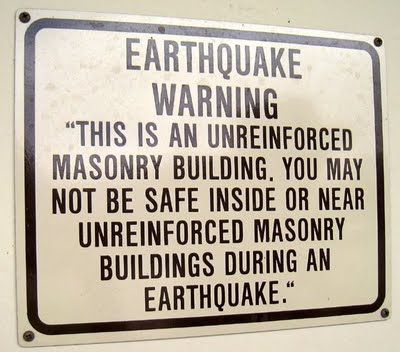 Unfortunately, advanced warning does not apply when it comes to the earth shifting, otherwise known as EARTHQUAKES! ………Or does it??
In an article published by Fox News, there is now “a state-of-the-art, first-in-the-world earthquake detection system in now installed and operational” in southern California, near Palm Springs, in the Coachella Valley. In fact, twelve locations are now in place with 120 sites planned, all meant to detect an earthquake and give people a chance to duck and cover, or brace themselves before the shaking begins.
This earthquake detection system was created by a company called QuakeGuard. The system works by way of sensors which are designed to detect the initial, or “P” energy waves given off by every quake, even though it’s only the later, or “S” waves that do all the damage. The time in-between the two waves varies depending on the proximity to the epicenter and as the first sensor closest to the quake goes off, it can offer advance notice — from a few seconds to a full minute– to other locations farther away.
The system can also be set to automatically open fire station doors, and water and gas valves for municipalities could be shut off. Back-up generators for hospitals could be turned on and, most importantly, warn school kids to duck and take cover.
Of the 12 sets of sensors currently set in place throughout the Coachella Valley in Southern California, all are tied to fire stations. Soon, they will be networked to every school in the area. Down the road, they can possibly be linked to hospitals, private businesses and even people’s homes.
A mobile system is also in development and would help rescue crews detect aftershocks. A few seconds could get rescuers out from under the rubble and thus out of harm’s way.
How great would this be for California or for any other regions affected by the earth moving?? It’ll be interesting to see how technology progresses. In this case, not soon enough! We can’t stop an earthquake, but it would be nice to be warned if one is on the way . The sudden jolt of the earth shifting is the probably the scariest part of an earthquake in my opinion. Let alone the damage and destruction that comes with it.
Would an earthquake detection system ease your fear of earthquakes?
–JK
Winter Blizzards- Tips For Winter Driving
Take a look at this accident footage from Salem, NH. I feel kind of guilty writing this post from Southern California as virtually everyone east of us is getting hammered with snow, but I guess the cost of living makes up for it sometimes. With that being said, below the video clip are winter driving tips courtesy of Travelers Insurance. There wouldn’t be any legitimacy to these recommendations if they came directly from me. What does a Los Angeles native know about driving in the snow anyways??
Prepare for winter driving before a storm hits
- Have a mechanic check your car’s battery, brakes, fluid levels (antifreeze, windshield washer fluid and oil), as well as the heating and exhaust systems to ensure that your car is in good, safe working condition.
- Try to keep your gas tank full during the winter months. Don’t allow the gas to go below half a tank. Not only will this prevent damage from freezing, you’ll avoid running out of gas if you’re stuck in a traffic jam during the dead of winter.
- Install snow tires or all-weather radials with adequate treads.
- An adequate supply of windshield washing liquid is critical to wash away the mud and melted snow that can severely limit visibility.
- Prepare for an emergency. Keep blankets, flares, a sack of sand for traction, shovel, windshield scraper and brush, tool kit, tow-rope, booster cables and a flashlight with extra batteries in your trunk. You should also stock your car with material for survival, such as waterproof matches to melt snow for drinking water, a first aid kit, dry clothing and a brightly colored cloth (to tie to the antenna).
When driving under adverse winter conditions
- Take care pulling out of streets blocked by mountains of snow. It’s often difficult to see who or what is coming.
- Back your car into the driveway so you have better vision when pulling out.
- Be aware of joggers on the street. Often sidewalks are impassable and die-hard joggers venture onto the street for a clearer path. Unfortunately, they may not see icy spots or other hazards hidden below the slush.
- Don’t turn corners too tightly.
- If your car does not have anti-lock brakes and you start skidding on the ice, try not to slam on your brakes. Gently pump your brakes to maintain better control and prevent your wheels from locking.
- If your car does have anti-lock brakes, slam on your brakes when skidding on the ice. Pumping your brakes prevents the anti-lock system from taking over.
Traveling during a severe storm. Travel only if necessary during a blizzard or severe storm. If you must travel:
- Don’t travel alone. Notify someone of your estimated time of arrival as well as your primary and alternate travel routes.
- If STUCK, stay in the car and wait for help. Run the engine and heater sparingly. Also make sure your exhaust pipe is clear of snow and ventilate your car so that carbon monoxide fumes won’t poison you.
- Keep your energy. Eat food that provides the body with energy for producing its own heat. Replenish your body with fluids to prevent dehydration. Don’t eat snow; it will lower your body temperature. Melt it first.
Source: Travelers Insurance; Insurance Information Institute
–JK
About Me

I grew up in Fullerton, CA and graduated from Servite High School in Anaheim. I have my Bachelors degree from Loyola Marymount University in Los Angeles. I currently live in Tustin, CA.
Please contact me if you need help with any of the following lines of insurance for your business:
-Cyber / Data Breach
-Commercial Property
-Commercial General Liability
-Products Liability
-Workers Compensation
-Commercial Auto
-Umbrella/Excess Liability
-Errors & Omissions/ Professional Liability
-Employment Practices Liability
-Directors & Officers
-Life & Disability Insurance

