
Commercial Insurance Market Remains Firm, But Shows Early Signs of Moderation
According to the latest data from the Ivans Index, the commercial insurance market continues to stay firm overall. Nevertheless, there are early signals that conditions may be easing from the peak tightening we’ve seen in recent years.
For most major commercial lines, average premium renewal rates increased year-over-year in the fourth quarter of 2025. This is a sign that carriers are still disciplined in their pricing. They demonstrate careful underwriting. However, some lines showed moderation or even decreases compared to the prior quarter.
Here is some notable data by line of business (Q4 2025 vs Q3 2025):
Lines Showing Reduced Renewal Momentum
- Commercial Auto: Average renewal rate declined to 6.97% from 7.60% last quarter potentially indicating more competitive pricing or underwriting tightening easing. Based on other reports I regularly monitor, I don’t expect this to be the case anytime soon.
- Business Owners Policy (BOP): Averaged 7.52% with a slight reduction vs Q3.
- Workers’ Compensation: Continued its downtrend with a -1.61% change. Still negative but a modest move compared with prior quarters.
Lines Still Firm or Hardening
- General Liability: Saw a notable increase……7.23% in Q4 vs 5.89% in Q3.
- Commercial Property: Continued upward momentum with an average 8.01% renewal change.
- Umbrella: Also ticked up slightly, ending the quarter at 9.49%.
The data suggests the overall market is still firm, particularly in liability and property exposures where carriers remain cautious. That said, the softening in some lines, like commercial auto and workers’ compensation, indicates that carriers are adapting. They are reacting to evolving risk conditions and competitive dynamics.
For insureds, expect continued firm conditions in key exposures, especially if loss activity or inflationary pressures persist.
One thing that remains consistent, proactive risk management and strong loss history remain crucial differentiators when negotiating renewals with underwriters.
If you’d like help analyzing how these market trends impact your portfolio, I can also help with your renewal strategy. Feel free to reach out. I’m here to help you navigate this dynamic landscape.
-JK
August 2025 Insurance Trends: What SMBs Need to Know
Running a small or mid-sized business comes with enough challenges—managing insurance costs shouldn’t feel like deciphering Wall Street reports.
Every month, the Ivans Index tracks how commercial insurance renewal rates are trending nationwide. The August 2025 results are in, and there are a few key takeaways that matter directly to your bottom line.
Commercial Insurance Rates Are Still Climbing, But at Different Speeds
- Commercial Auto: Renewal rates slowed slightly, now averaging +7.19% (down from 7.96% in July).
- Businessowners Policy (BOP): Continued climbing to +7.65% (a bump from 7.55%).
- General Liability: Saw one of the bigger jumps, moving to +5.91% (from 4.98%).
- Commercial Property: Ticked down slightly to +7.84% (from 7.98%).
- Umbrella Liability: Rose to +9.02%, the highest among all lines.
- Workers’ Compensation: Still trending negative at –1.45%, but that’s actually good news—premiums are still decreasing year over year.
What This Means for SMBs
- Auto Fleets & Delivery Vehicles
If your business owns company cars or vans, you may see some relief compared to earlier this year. But, rates remain elevated. Now is the time to revisit fleet safety programs, driver training, and telematics—steps that can earn discounts. - Protecting Your Core Business (Businessowners & Property)
BOP and property insurance continue to trend upward. For businesses that rent or own space—or rely heavily on equipment and inventory—this means budgeting for higher premiums at renewal. It’s also a reminder to double-check coverage limits: rebuilding and replacement costs are still affected by inflation. - Liability Coverage
Both General Liability and Umbrella are climbing. With lawsuit costs rising, insurers are charging more to provide extra protection. SMBs often underestimate their liability exposure, but a single claim can easily pierce through a $1M policy. Umbrella coverage, while pricier, is becoming more critical. - Workers’ Compensation
The lone bright spot—rates remain in the negative. If your payroll has grown, this can help offset increases elsewhere. Strong safety programs and low claims history can keep this trend working in your favor.
Why Staying Ahead Matters
The Ivans Index pulls data from over 120 million transactions across 700+ carriers and 38,000 agencies. In short: these numbers reflect what’s actually happening in the market right now.
For SMB owners, the lesson is clear:
- Don’t wait until renewal time to discover higher premiums.
- Review your policies proactively with your insurance broker.
- Explore risk management strategies that can reduce claims and keep costs in check.
Final Takeaway
Insurance costs for small and mid-sized businesses are still trending upward, especially in liability and umbrella coverage’s. Workers’ comp is the exception, offering some balance.
By planning ahead, SMBs can manage these shifts. They can do this by working closely with a knowledgeable advisor. This approach protects both their people and profits.
Why Are Commercial Property Insurance Costs So High Right Now?
The market for commercial property insurance has been getting more and more challenging over the past couple of years and it’s feeling like there’s no immediate end in sight.
Over the past 12 months, we’ve seen countless insured’s get non-renewed on their property insurance policies even with no claims. Very few markets are looking to write new business unless a risk is impeccable. Underwriting is tight and it seems like you have to go through hell and back providing loads of information to carriers for review.
In many cases, coverage is getting cut in half with limitations and endorsements and premium is doubling. It’s frustrating to be in the thick of all of it. No doubt, this is the hardest property insurance market we’ve seen in a generation.
So, why are commercial property insurance costs so high you ask?
Here are several factors contributing to premium increases for commercial property insurance coverage:
Catastrophe Losses: Hurricanes, floods, wildfires, tornadoes, winter storms. The frequency and severity of major catastrophes continue to stress the industry. In five of the past six years, these events have caused annual insured losses of more than $100B. Last year, total insured losses globally were estimated at a shocking $140B.
Reinsurance: Catastrophic events are a major factor driving up the cost of reinsurance — an expense carriers need to pass along to policyholders. Call it a perfect storm, but inflation and the economic environment has been making reinsurers more selective.
Underinsurance: High inflation has driven the cost of materials and services much higher, but not even half of business owners say they have increased their policy limits to accurately reflect what it would take to replace insured property now. Policyholders must have accurate valuations for their assets so they don’t come up short after a loss, and premiums will reflect those higher values.
Property Replacement Costs: Led by sizable increase in the cost of structural steel and the price of lumber, construction costs have jumped over the past few years. Similarly, machinery and equipment costs have increased over the same period. Also, many are still dealing with materials shortages and supply chain disruptions.
Skilled Labor Shortage: Nearly half of reconstruction costs are wages and salaries, which have increased over the past few years. Even with higher pay, contractors are struggling to find skilled labor and are delaying projects as a result. Higher rebuilding costs and longer delays may trigger an increase in business interruption losses.
Property Rate Need: For years, rising loss trends have outpaced rate increases, primarily because of the costs of catastrophes. Carriers need to continue to raise rates to try to close the gap.
In a nutshell, it’s a “perfect storm” of these variables that have really put the commercial property insurance market in a tough spot. And in talking to many professionals in the industry, this doesn’t seem to be ending any time soon. Maybe by way of a miracle we can get a year with [much] lower than average catastrophe loss? That would be a good start. And we definitely need inflation to level out too. Maybe we can get the perfect storm to happen the opposite way to get us back on track for a more stabilized commercial property insurance market. Fingers crossed.
What is the Terrorism Risk Insurance Act (TRIA)?
Terrorism is often an excluded peril on property and casualty insurance policies because the losses could prove to be too catastrophic for private insurers to underwrite coverage or because the inclusion of terrorism coverage would make policy premiums unaffordable for consumers. This uninsurability makes government assistance necessary.
The Terrorism Risk Insurance Act (TRIA) was enacted in direct response to the terrorist attacks on September 11, 2001. The act created a reinsurance facility allowing the federal government to share in losses with private insurers in the event a certified act of terrorism took place.
TRIA protects consumers by addressing market disruptions and ensuring continued widespread availability and affordability of commercial property and casualty insurance for terrorism risk.
TRIA is a temporary program that has been extended by a number of reauthorization acts. The program is set to expire December 31, 2027.
Authority
The act allowed the Department of the Treasury to establish the Terrorism Risk Insurance Program, administered by the Secretary of the Treasury. The legislation defined an act of terrorism as any act certified by the Secretary of Treasury, in cooperation with the Secretary of Homeland Security and Attorney General, to be an act of terrorism that endangered human life, property, or infrastructure and that was committed by an individual or group of people acting on behalf of any foreign person or interest.
The 2007 reauthorization act amended this definition to include acts committed by persons with no foreign affiliation to also be treated as acts of terrorism.
An act must result in at least $5 million in property and casualty insurance losses to be certified as an act of terrorism.
Insurance Limits
The program has a trigger applying to certified acts of terrorism.
In 2015, this trigger was insurance losses exceeding $100 million, and this amount increases incrementally by $20 million per year until reaching $200 million in 2020 (meaning the trigger amount for any year after 2020 is also $200 million). Private insurers and the government will share losses greater than the coverage trigger and less than the program cap, which is $100 billion.
The insurer deductible is 20% of all covered losses. Once the deductible is met, the insurance companies have a coshare, or share of the loss. This coshare amount started at 15% in 2015, meaning the government paid for 85% of covered losses, and incrementally increased until reaching 20% in 2020 (and thereafter), meaning the government pays for 80% of covered losses.
2023 Commercial Property Insurance Outlook
The commercial property insurance market has been a tough one over the past several years. Unfortunately, 2023 won’t be any better. The property insurance market will certainly see increased rates in 2023, so it’s critical to start renewals well before deadlines. At least 90 days + prior to expiration.
Most seasoned industry brokers and underwriters agree that 2023 will likely be the firmest market they have ever experienced, despite most buyers feeling that they didn’t think things could get much worse after the last few years.
Almost all carriers have had less reinsurance capacity and options available to them to offset rate and retention increases, so without a doubt, buyers need to be prepared for carriers to pass the bulk of these costs onto them.
It’s more important now than ever to start property insurance renewals as far out as possible because it’s likely that renewal terms will continue to come down to the wire, despite everyone’s best efforts. As insurance programs see changes and increased costs, policyholders will need to see various deductible and limit options, and each option will take time to iron out with underwriters.
This post definitely has a pessimistic tune which is not how I like to sound. I’m simply passing along what I’ve seen in the market and what I have heard from industry leaders.
The positive in all of this is knowing that this is the state of the commercial property insurance market which we cannot control. What you can control is being prepared ahead of time for your policy renewals, so that you can secure the best possible terms for your organization.
Graffiti Prevention for Businesses
You see it everywhere you go. It doesn’t matter what city, state, or country…..graffiti is EVERYWHERE. And it looks like crap and if it’s on the wall of your business or building! Not only does it look like crap, but graffiti contributes to reduced retail sales, a decline in property values, and citizen fear. Not what you want when it comes to running a thriving business. Or owning a successful commercial building.
A business littered with graffiti is less likely to be patronized. Citizens feel less safe and secure entering a storefront where graffiti is present.
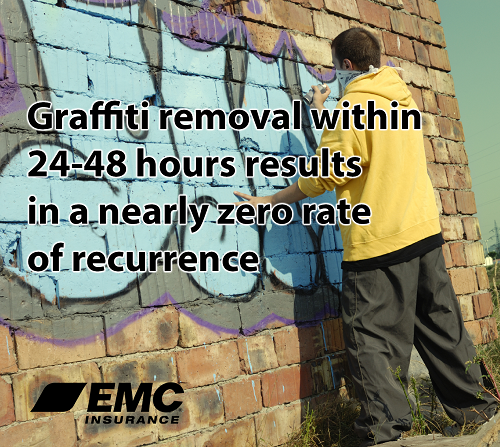
Graffiti Prevention: Tips for Businesses
If you have any questions about the following:
- How can a business prevent graffiti?
- How might a “graffiti ordinance” affect a business?
- What should a business do if it’s hit with graffiti?
- How should graffiti be removed?
Then check out this Tips for businesses fact sheet
Hopefully with enough businesses on board to prevent graffiti, we don’t have to see it everywhere we go. Pure and simple, it looks like CRAP! More importantly, it contributes to reduced retail sales, declines in property values, and community fear.
What measures are you taking to prevent graffiti on the walls of your business or building?
-JK
Fire Prevention for Apartment Buildings
If you own an apartment building, you know it’s a valuable asset that you want to make sure to protect to ensure it continues to bring monthly income into your pocket in the form of rental income. Take care of your baby!
Philadelphia Insurance Companies has identified three leading causes of residential fires: electrical issues, smoking, and cooking. Additional hazards include laundry dryers, barbeques, and flammable liquids. To address these causes, Philadelphia recommends the following tips and resources to help you reduce the chances of a fire at your apartment building:
Electrical Fire Safety
- Do not overload your system by using “daisy chains” of power strips or extension cords
- Have the entire electrical system inspected by a qualified electrician prior to building purchase or occupancy
- Have your electrical system inspected at least every 10 years by a qualified electrician
- Have an infrared scan of your electrical system with a thermographic camera every three to seven years to identify hot spots
- Tighten or replace components where hot spots exist to help prevent electrical fires and for possible savings in electrical consumption
- Visually inspect key electrical components, like breakers and switches, on an ongoing basis, making sure they are clean, dry, and tight
- If your apartment building has aluminum wiring or Federal Pacific Stab-Lok breakers, these are known fire hazards; contact your insurance broker or carrier for Risk Management Services to help
Smoking Fire Safety
- Make your apartment building smoke-free
- If you cannot have a non-smoking apartment building, create a safe smoking area at least 20 feet away from the building with a non-combustible, non-tipping receptacle for ash and butts
Cooking Fire Safety
- Implement cooking fire preventative devices, such as stovetops that sense unattended cooking or limiting the temperature of the cooking surface
- Implement Auto-Out fire reactive devices that expel an extinguishing agent in the event of a fire
Laundry Dryer Fire Safety
- Verify that dryer lint traps are in good condition and being cleaned often to prevent buildup
- Ducting from the dryers should be smooth aluminum, and should also be on a cleaning schedule
Flammable Liquid Fire Safety
- Do not store more flammable liquids or aerosols than necessary on a property. Discard all not being used and store the remainder in a UL listed flammable liquids cabinet
Barbecue Fire Safety
- Consider a policy of “no personal” barbecues on site. Provide a community barbecue located away from any building
- Do not allow any charcoal barbecues to be used onsite
- If personal barbecues are allowed, they should be used a minimum of 10 feet from any structure and not allowed on any combustible deck
Finally, make sure smoke detectors are present and operational. In residential fires resulting in deaths, 57% of the time a smoke alarm was not present or was not operational, according to the NFPA. Ultimately, the goal is to prevent fires, which requires a joint effort by apartment building owners, apartment building managers, and residents. A reasonable investment of time and resources by all three parties can help keep people safe and protect real estate investments. For more information, watch the four-minute video above from Philadelphia Insurance Company. And contact me anytime you have questions about protecting your apartment building. This is an ever-valuable asset you want to keep in good standing.
Credit: Philadelphia Insurance Companies
-JK
Own A Vacant Commercial Building? Beware

If you own a vacant commercial property like a retail shopping center, office building, industrial building, etc., be really careful when it comes to your property insurance. There are limitations with coverage.
By definition, a building is considered vacant unless at least 31% of its total square footage is rented to a lessee or sub-lessee and used by the lessee or sub-lessee to conduct its customary operations.
Typically, insurance carriers will not pay for any loss or damage caused by any of the following, even if they are Covered Causes of Loss if the building where loss or damage occurs has been “vacant” for more than 60 consecutive days before that loss or damage occurs:
- Vandalism;
- Sprinkler Leakage, unless you have protected the system against freezing;
- Building glass breakage;
- Discharge or leakage of water;
- Theft; or
- Attempted theft
With respect to Covered Causes of Loss other than those listed in Paragraphs (1) through (6) above, an insurance carrier will reduce the amount they would otherwise pay for the loss or damage by 15%.
If you own a commercial building which is currently vacant, or if you know you will be losing a tenant soon, the first thing you should do is contact your insurance broker to see what options are available before you secure a new tenant.
-JK
Construction Material Cost Continues To Increase. What Does This Mean For My Commercial Building?

Construction material costs increased by 7.4% in September compared to the same month in 2017, according to an Associated General Contractors of America (AGC) analysis of U.S. Labor Department data. In the past year, tariffs have caused producer price index increases of 29.3% for diesel fuel, 22.1% for steel pipe and tubing and 11.7% for fabricated structural metal, among other cost increases. Over the past year, contractors increased their construction fees for nonresidential properties by 3.5%, which indicates firms are absorbing increased costs, according to the report. Additionally, 80% of respondents to an AGC August survey reported difficulty filling hourly worker positions, resulting in 62% of firms paying higher salaries to attract and retain workers.
What does this mean for my Commercial Building Insurance policy?
If you own a commercial building, whether it be an apartment, industrial, office, or retail building, you should pay close attention to the Building insurance limit you have on the policy.
Perhaps you secured a policy years ago and haven’t looked at it in a long time. Or, have no idea how much you should be insuring your building for in the event of a fire, or earthquake.
Our economy is cranking right now. Contractors have more jobs than they know what to do with. Their employees are in high demand and they need to pay high salaries to keep their talent. More demand equals higher costs.
This isn’t 2009 when contractors were begging for work and you could basically name a price when hiring them for a job. They are busy and selective on which jobs they choose in today’s economy.
From what we’re hearing from Southern California based general contractors right now, their costs for material and labor are at least $300-$400 per square foot to build. So if you have a 20,000 square foot commercial building, you should probably be insuring that for at least $6M Replacement Cost value (20,000 x $300 per sq/ ft).
My suggestion is that you dig up your commercial building insurance policy and check what limits of insurance you have for the building coverage. If you’re severely underinsured, call your commercial insurance agent/broker and ask them what it would cost to endorse your policy with the limits suggested above. You’ll be happy you did if you suffer a loss in the coming day/week/month/year.
-JCK
Online Grocery Sales Could Increase Demand For Industrial Real Estate

Growth in online grocery sales could increase demand for industrial cold storage space, causing 35 million square feet of cold storage to shift from retail locations, according to a report by CBRE. Online purchases will make up 13% of all grocery sales by 2024, the report states. California would likely have the most industrial cold storage at nearly 400 million cubic feet.
Industrial building owners and investors take note!
-JK
About Me

I grew up in Fullerton, CA and graduated from Servite High School in Anaheim. I have my Bachelors degree from Loyola Marymount University in Los Angeles. I currently live in Tustin, CA.
Please contact me if you need help with any of the following lines of insurance for your business:
-Cyber / Data Breach
-Commercial Property
-Commercial General Liability
-Products Liability
-Workers Compensation
-Commercial Auto
-Umbrella/Excess Liability
-Errors & Omissions/ Professional Liability
-Employment Practices Liability
-Directors & Officers
-Life & Disability Insurance
 Jimmy Kinmartin, CPCU