
Why Am I Being Asked For A “Waiver of Subrogation” On My Insurance?
Ever heard of the term, “waiver of subrogation”? Sounds pretty foreign, doesn’t it? Well it kind of is. If you’re a business owner with liability insurance, you may have had a request from a client or landlord at some point asking for a certificate of insurance with a “waiver of subrogation” for general liability, workers compensation and/or auto liability. I’m actually writing this post because it’s something that I have been working on this week trying to place a new client with an insurance carrier. This client happens to be a self-storage facility.
You see, this self storage facility houses a beer distributor. One of the conditions of writing insurance for this client (the storage facility) with this particular carrier, is to have the tenant (beer distributor) provide a “certificate showing that the insured is named as an additional insured on the General Liability policy with waivers for both the GL and auto. Minimum $1 million limits.”
What does Waiver of Subrogation mean?
The definition of ‘Waiver of Subrogation” is: “The relinquishment by an insurer of the right to collect from another party for damages paid on behalf of the insured. A waiver of subrogation is often referred to as “transfer of rights of recovery.” A waiver prohibits an insurance carrier from recovering the money they paid on a claim from a negligent third-party.
For example, suppose you own a building which burns down due to the negligence of a third-party. Normally you could sue the negligent third-party for causing your building to burn down. If your fire insurance company pays off your claim, however, the insurance company is then “subrogated” to your claim against the negligent third-party. This means your claim against the negligent third-party is treated as having been assigned to the insurance company, which may sue him/her to recover the amount it paid you on account of the fire loss.
Many, but not all, general liability policies allow you to waive your rights of subrogation as long as it is done in writing and prior to a loss. Some contractual agreements, such as some facility rental agreements, require you to waive your right of subrogation (and therefore your insurance company’s rights) against them in the event of a claim.
The good news is that you, the insured, doesn’t have to worry too much about what this terminology means should you get a request from a client or landlord. Simply forward to your insurance agent/broker and be sure to bounce any questions that you may have off them. Our job is to be your insurance partner and deal with these types of insurance requirements or questions you have.
–JK
Memorial Day Weekend In Chicago
I’ve been wanting to put up a post for a few days now, but our internet has been all messed up since a power outage we faced earlier in the week. Anyhow, we had an awesome Memorial weekend in Chicago last weekend, a city I can say I’ve FINALLY seen. I’ve been wanting to go for forever but the wait was well worth it.
We got to go game 5 of the NBA Eastern Conference finals between the Heat and the Bulls. That was an unbelievable surprise from friends, Mike and Sara. Also, the one thing I wanted to do most, we went to Wrigley Field for a Cubs/Pirates game. For a huge baseball fan- what an experience…..I was in awe the entire game that we were sitting in Wrigley friggin field. My brother and I used to watch daytime baseball almost daily on WGN, listening to Harry Caray on our summer breaks. No school, nothing to worry about, just watching baseball.
Oh yeah, has anyone ever been to Kuma’s Corner?!?! We waited an hour and a half on a Thursday afternoon to be seated (I hear 3+ hours on the weekend). Best mac-n-cheese I’ve ever had and possibly the best burger too, along with an excellent variety of beers. This is an even better atmosphere if you like metal. My burger, the Iron Maiden burger. This place is a must if you visit Chicago.
Here are some photos of our trip. Enjoy…
Car Flies Off Ramp Into A Local Nail Salon
I was in the office Friday just before the lunch hour when I saw a Twitter news feed, “#BREAKINGNEWS: Car crashed into nail salon in Rolling Hills Estates along Deep Valley Drive – 5 minor injuries reported.” Seeing this was no more than a couple of miles from the office, I took a drive up the hill to check out what was going on, and I brought the camera with me. Here’s what I found:
It turns out an elderly woman driving up a ramp in the Rolling Hills Estates parking lot, crashed through a guard rail and went airborne before plunging into this nail salon. The 2001 Infiniti landed completely inside the Peninsula Center business. Somehow, the woman’s gray Infiniti missed hitting four other people as it embedded itself inside the building. .
From seeing the premises first-hand, it’s remarkable that nobody was seriously injured or even killed!
The crash crushed furniture and demolished tables inside. City building inspectors were expected to check the salon for structural damage. Here are a few still photos:


Looking at this video and pictures, it’s evident that this salon will be out of commission for some time. However, if the business is adequately insured, the business owner shouldn’t have to worry much. The following coverages should keep the business alive:
- Building and Business Personal Property: Coverage to help pay for the cost to repair or replace property, including inventory, office furniture or fixtures damaged by the accident. Not only is the business covering their own contents, but think about the building owner carrying a policy to cover the building itself.
- Business Income and Extra Expense Insurance (AKA – Business Interruption Insurance): Coverage that reimburses a business owner for lost profits and continuing fixed expenses during the time that a business must stay closed while the premises are being restored because of physical damage from a covered peril, such as a fire. It also may cover financial losses that may occur if civil authorities limit access to an area after a disaster and their actions prevent customers from reaching the business premises.
On the flip side of the coin, let’s hope the driver of the car carried an appropriate amount of liability insurance as you can bet the insurance company for the nail salon and the building owner will be looking to subrogate their losses as a result of the drivers negligence (The legal process by which an insurance company, after paying a loss, seeks to recover the amount of the loss from another party who is legally liable for it).
As with any other insured, do you think this business owner ever thought this would happen to them? If you own a business, don’t think it can’t happen to you. Don’t wait to carry business insurance coverage. Cover your business now and always expect the unexpected.
–JK
Ten Steps You Can Take To Lower Workers Compensation Costs

Hurt On the Job
Workers’ Compensation insurance can get costly and is a big pain in the butt for some businesses. In fact, the costs to carry coverage can even threaten the existence of some small businesses, especially in states such as California. The good news is that the insurance market is currently “soft”, meaning lower rates than we have seen in the past five plus years. However, it’s pretty much a guarantee the pendulum is just beginning to turn and we’re going to see work comp rates creeping upwards again as healthcare costs have skyrocketed, among other things.
Workers Compensation premiums are based in part on some things which you have little or no control, such as the type of industry your business is in, or the region or state you’re located. But rates are also based on things you do have some control over, such as your claim history and payments.
Here are 10 steps you can take to help lower your Workers’ Compensation costs:
- Match the applicant carefully to the job: Base the match on the applicant’s skills and abilities. Your careful hiring practices can go a long way toward reducing your costs. The Department of Fair Employment and Housing offers brochures to help guide you in conducting job interviews. Note: Discrimination because of a handicap is unlawful.
- Make safety a priority on the job every day: A safe workplace can lower your claims costs. It is far less expensive to prevent an accident than to pay for one.
- Fix dangerous conditions: When you become aware of a hazard on the job site, take appropriate corrective measures. Your failure to do so could result in a “Serious and Willful Misconduct” suit against you. This suit carries severe penalties that you would pay, not your insurance carrier.
- Train Supervisors: Workers’ compensation law includes supervisors in the definition of “employer.” When a supervisor fails to follow the law, it counts against you. Make sure your supervisors know all that is required of employers.
- Report employee injuries: As soon as you are aware of an injury, notify your insurance carrier by completing and sending the Employer’s Report of Occupational Injury or Illness form. The report requires you to provide information that includes the nature of your business, the type of employee injury or illness, and how it occurred. Your complete statements in each of these sections are necessary for determining the appropriate benefits. For example, information about your employee’s work hours and salary is necessary for computing benefit payments.
- Provide the employee claim form: You must provide the employee with a Workers’ Compensation Claim Form within one working day of learning of an injury. The employee should return the completed form to you. When you receive the employee’s claim form, make sure you sign and date it. You must then immediately forward the original to your carrier. The first indemnity payment is due within 14 days of your knowledge of a disabling injury. Failure to provide timely benefits may result in a penalty. The penalty may cost you, the employer, if findings indicate that you did not file the claim form with your carrier on time.
- Exercise medical control: Be sure to refer all of your injured workers to your carrier’s Medical Provider Network (MPN) physician. If you do not know of a physician or medical facility, contact your agent or carrier. Be sure to post notices with the name, address, and phone number of your medical provider so your employees know where to go in case of an injury. If the employee has previously notified you in writing of his or her personal physician, the employee has the right to be seen by that physician.
- Communicate with your employees: Show them you care about their well-being. If an employee sustains an injury, stay in touch throughout the recuperation period.
- Consider a Return To Work program: A Return To Work (RTW) program can help bring your injured employee safely back to work as early as possible. You adjust the transitional job to accommodate the employee’s improving condition until he or she can return to his or her usual duties. You reduce your costs; your employee can return to a self-supporting status; everybody benefits.
- Maintain records: Your personnel files can be of great assistance to your carrier in dealing with some cases. Information about an employee’s job description, wages, previous work history, recreational activities, any current work problems, and previous injuries is essential when fighting disputed claims.
As with any type of insurance, contact your insurance agent or carrier if you have questions on your workers’ compensation coverage, or if you need help controlling your costs. Insurance carriers have just as much incentive as you to prevent and/or mitigate loss, so there are risk control options to help.
–JK
Sunset Beach, CA $10M House Fires
So, yes, this is a blog devoted to business insurance topics, but sometimes events happen close to home that stir interest and are worth writing about. One such event is a major fire that occurred Thursday in Sunset Beach, only a few miles from home down the road on Pacific Coast Highway.
At least three different million dollar beach-front homes were severely damaged or destroyed by an intense fire. More than 80 firefighters responded to the four-alarm blaze shortly before 5 p.m. Thursday afternoon. One of the homes involved actually collapsed from fire damage and two others sustained major damage.
Here’s some raw footage from YouTube user medxproductions:
Firefighters from Newport Beach, Huntington Beach, Fountain Valley and the county fire authority fought the blaze. The cause of the initial fire might have been an overturned barbecue grill, officials said.
The Orange County Fire Authority advised that damage to the four buildings could reach $10 million . That includes damage and contents to the four homes torched by the fire, three of which have been red-tagged and deemed uninhabitable.
One neighbor said “I always imagined that we would have an earthquake or tsunami, but never a fire. It‘s one of those things that you actually don‘t prepare for.” As an insurance agent, these are infamous last words often heard after a major loss. Sadly, many don’t feel like an event of this magnitude will ever happen to them. As a result, they might pass on insurance, or under-insure their belongings and possessions in order to “save money” on premiums.
Regardless, summer is approaching and barbecue season has arrived. Now that the season is here, it’s essential that you’re barbecuing safely. Here are some recommendations provided by the U.S. Fire Administration:
Use Barbecue Grills Safely
- Position the grill well away from siding, deck railings, and out from under eaves and overhanging branches.
- Place the grill a safe distance from lawn games, play areas, and foot traffic.
- Keep children and pets away from the grill area by declaring a 3-foot “kid-free zone” around the grill.
- Put out several long-handled grilling tools to give the chef plenty of clearance from heat and flames when cooking food.
- Periodically remove grease or fat buildup in trays below grill so it cannot be ignited by a hot grill.
- Use only outdoors! If used indoors, or in any enclosed spaces, such as tents, barbecue grills pose both a fire hazard and the risk of exposing occupants to carbon monoxide.
Charcoal Grills
- Purchase the proper starter fluid and store out of reach of children and away from heat sources.
- Never add charcoal starter fluid when coals or kindling have already been ignited, and never use any flammable or combustible liquid other than charcoal starter fluid to get the fire going.
Propane Grills
- Check the propane cylinder hose for leaks before using it for the first time each year. A light soap and water solution applied to the hose will reveal escaping propane quickly by releasing bubbles.
- If you determined your grill has a gas leak by smell or the soapy bubble test and there is no flame:
- Turn off the propane tank and grill.
- If the leak stops, get the grill serviced by a professional before using it again.
- If the leak does not stop, call the fire department.
- If you smell gas while cooking, immediately get away from the grill and call the fire department. Do not attempt to move the grill.
- All propane cylinders manufactured after April 2002 must have overfill protection devices (OPD). OPDs shut off the flow of propane before capacity is reached, limiting the potential for release of propane gas if the cylinder heats up. OPDs are easily identified by their triangular-shaped hand wheel.
- Use only equipment bearing the mark of an independent testing laboratory. Follow the manufacturers’ instructions on how to set up the grill and maintain it.
- Never store propane cylinders in buildings or garages. If you store a gas grill inside during the winter, disconnect the cylinder and leave it outside.
Commercial Insurance or personal insurance, fires are a reality for all and should not be taken lightly. They don’t discriminate on who they target. Learn from events like these that this can happen to anyone. Be certain your property insurance policies are up to date with the coverages you need to protect your livelihood.
–JK
What is Inland Marine Insurance?
Without prior knowledge of ‘Inland Marine’ insurance, you might think this is some kind of boating insurance or something. Ironically, it’s not. Marine insurance is a type of property coverage that has a long history behind it.
Marine insurance came into existence in the early days of shipping when merchants relied on bodies of water such as oceans, rivers, and canals as their main routes of transportation.

Source: Cunnington & Associates Inc
Then the twentieth century came along, and with it, a whole new system of transportation: planes, trains, and automobiles. With this, the demand for insurance to protect goods in transit over land came into existence. This is where inland marine insurance was born.
Inland marine is one of the most varied types of Property & Casualty insurance with many unique and unusual exposures. It is a form of property insurance, but the distinction between property and marine coverage can be very confusing. As a general rule, property coverage is designed to cover stationary property, property that predominately remains at a “scheduled” premises, and property not considered “unique.” Inland marine coverage is intended for property that may be moving from location to location, property off premises at new locations, temporary locations, or work locations, and/or subject to “unique” causes of loss that traditional property policies do not cover.
The four major types of inland marine coverages written today are:
- Property being transported
- Buildings under construction (builders risk)
- Computer equipment and data
- Contractors equipment
There are numerous other inland marine policy coverages written to handle expensive and unique property situations. They include:
- Accounts Receivable
- Bailee’s Coverage (for property of others accepted for cleaning, repairing, etc)
- Camera and Musical Instruments
- Exhibition Floater
- Equipment Dealers
- Fine Arts
- Furriers Block
- Jewelers Block
Does your business need Inland Marine Insurance?
Depending on the type of small business you own, this coverage can be essential to protecting business property. Consider any items you place in your car or truck daily to get your work done or the valuables, including data, you own or are responsible for. Most property policies limit or exclude coverage for these items.
Or maybe you are in the construction trade or are building an addition to your office. Inland Marine Insurance can protect the building materials—and a contractor’s tools and equipment.
If you clean, repair, service or perform work on property of others, Inland Marine Insurance can work for you. It can cover losses to goods that occur at your premises, while being transported to or from your premises or in storage.
These are just a few examples.
As you can see, marine insurance means a lot more than what it sounds like from the surface. Don’t let the term “Marine” fool you. It’s not just some kind of boating insurance. Rather, inland marine insurance is one of the most varied types of Property & Casualty insurance on the market that shouldn’t be overlooked.
–JK
Insurance Topics In the News (4/24-4/30)
- Commercial Insurance Premiums continue to decrease
- A New Aflac Duck Is Chosen out of 12,500 auditions
- Looking for a “Pay As You Go” Workers Compensation insurance option? We now have it for you!
- CA Woman Wins $400,000 in Slip & Fall Case Against Car Dealership
- Firefighters douse flames at Garden Grove commercial building. Estimated $1M loss
- Cellphone crackdown: Hang up and drive, cops say
- Insurers could pay more than $1 billion to cover Alabama tornado damages
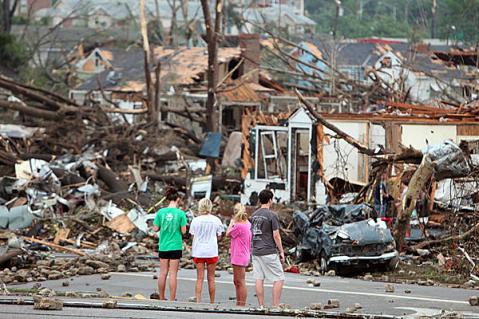
Bystanders look at storm damage in Tuscaloosa, Alabama, Wednesday, after a strong tornado moved through the city. (Dusty Compton/The Tuscaloosa News/AP)
–JK
Long Beach Grand Prix (and 10 Safe Driving Tips)
This past weekend was the Long Beach Grand Prix, probably the biggest weekend annually in Long Beach and by far one of my favorites. We went on Saturday and enjoyed a perfect day of sun, fast cars, thundering loud sound and jam-packed bars. I’m not necessarily a race fan, but if you ever get a chance to check out a live race and get up front in the action, you won’t be disappointed. The speed and noise of these IndyCars give me the chills every time I see them.
Check out this short clip I filmed track-side. This was Saturday’s IndyCar qualifying for the main race on Sunday. Cars are flying by at 160-170 mph at this point on the track:
With the theme of fast cars and driving, take a moment to browse over these 10 safe driving tips:
Top 10 Safe Driving Tips
- Don’t Drive Drunk – More than 30 percent of all auto accident fatalities in the United States involve drivers impaired by alcohol. It’s easy to avoid driving drunk. If you’ve been drinking, ask a sober friend for a ride or call a cab. If you’re planning to drink, make sure you have a designated driver. The mild inconvenience of taking a cab home is nothing compared to the disastrous consequences of driving drunk.
- Don’t Speed – Research has shown that for every mile per hour you drive, the likelihood of your being in an accident increases by four to five percent
- Avoid Distractions – One researcher compared the reaction time of a 20-year-old driver talking on a cell phone to that of a 70-year-old driver. What’s more, working a cell phone behind the wheel can delay reaction times by as much as 20 percent.
- Don’t Drive Drowsy – A study conducted by researchers at Virginia Tech reported that 20 percent of all accidents have sleepiness as a contributing factor
- Wear Your Seat Belt– NHTSA statistics reveal that more than half of all accident fatalities were people who weren’t using seat belts
- Be Extra Careful in Bad Weather
- Don’t Follow Too Closely – The three-second rule is simple. Find a stationary object on the side of the road. When the car ahead of you passes it, start counting seconds. At least three seconds should pass before your car passes the same object
- Watch Out for the Other Guy – One good rule of thumb to use is, “Assume everyone else on the road is an idiot.”
- Practice Defensive Driving – Defensive driving is not only safer, it can save you money. Many insurance companies offer discounts to drivers who complete defensive driving courses.
- Keep Your Vehicle Safe– One of the most common maintenance problems that can lead to a crash is improper tire pressure. Uneven tire pressure, or pressure that is too high or low, can impact performance or lead to a blowout — especially in high-performance cars or heavy vehicles like SUVs
For these tips and more, visit www.howstuffworks.com
My Other Job – Secret Service Agent
I bet you didn’t know I have a second job as a secret agent. Don’t believe me? Take a look:


Actually, I was just being used as a prop on Sunday night for Steve Bridges, an Obama impersonator. If you haven’t seen his stuff, you must check out his website. He also does George Bush, Bill Clinton, and Arnold Schwarzenegger. Here’s a great clip of him doing Obama:
-JK
Six Reasons Why You DON’T Need Life Insurance
 You are never going to die
- You are going to inherit a fortune
- You are going to win the lottery
- Your children are going to support you
- You are never going to retire
- The government will take care of you

People, don’t take these literally. Needless to say, this is a joke so don’t take it as literal advice!
I wish I could give a shout out to the person who was creative enough to come up with these, but I got them from a handout at a networking event from another insurance agent.
If you have been procrastinating and need a good resource to start researching the costs of a life insurance policy, here’s a good start:
Or, contact your insurance agent to discuss.
–JK
About Me

I grew up in Fullerton, CA and graduated from Servite High School in Anaheim. I have my Bachelors degree from Loyola Marymount University in Los Angeles. I currently live in Tustin, CA.
Please contact me if you need help with any of the following lines of insurance for your business:
-Cyber / Data Breach
-Commercial Property
-Commercial General Liability
-Products Liability
-Workers Compensation
-Commercial Auto
-Umbrella/Excess Liability
-Errors & Omissions/ Professional Liability
-Employment Practices Liability
-Directors & Officers
-Life & Disability Insurance
 Jimmy Kinmartin, CPCU