
Be Stocked and Ready For Small Business Saturday
Small Business Saturday is a nationally recognized day celebrated on November 30th when millions of consumers spend billions of dollars at independent neighborhood shops and restaurants. In anticipation of the upcoming holiday season, find out what every Main Street business owner needs to know and do to stay safe, grounded and be ready for the busy holiday season provided by Travelers Insurance Company.
Here are some nice resources provided by Travelers Insurance Company touching on the following risk management topics. Be sure to click on the links for each of these topics to learn more:
Store Safety Tips (Workplace Safety | Slips, Trips, and Falls | Fire Safety | Ladder Safety | Ergonomics)
Business Continuity (Why You Need a Business Continuity Plan | Create A Business Continuity Plan in Four Steps | Identifying Business Threats | Employee Communications and Considerations)
Supply Chain Management (Tips for Managing Your Supply Chain | Working With Overseas Suppliers | How To Identify Counterfeit Parts | Have An Inventory Backup Plan)
Cyber Threats (Employee Training | Cyber Safety Tips | Password Security | Business Continuity For Data Management | Incident Response Plan)
You can contact me for additional information or if I can help you in developing risk management plans for your business.
-JK
Grand Opening of Long Beach Fire Station 12
On Tuesday, September 24, 2013 Mayor Bob Foster, Councilmember Steven Neal, Long Beach Development Services, and the Long Beach Fire Department hosted the Grand Opening and Dedication of newly constructed Fire Station 12.
The new Fire Station 12 and the Emergency Resource Center is located at 1199 E. Artesia Blvd., on a 1.2 acre site covering the entire northwest corner of Artesia Boulevard and Orange Avenue.
The 11,296 square-foot Fire Station has a 100-foot-tall communication tower that will greatly enhance radio coverage throughout the city. The Station has been built on a highly visible major traffic corridor; which provides noise and traffic-safety benefits.
The landscape design at this location uses native vegetation with water-saving irrigation systems 90 percent of construction debris was diverted from landfills and recycled.
In addition, the facility will also serve as home to a 5,294 square-foot Emergency Resource Center (ERC) that will serve as an important supply and distribution facility in North Long Beach. With the ERC in place, Station 12 will allow the City to create a regional disaster supply depot with enough materials to handle the northern half of the City in case of a major disaster.
-JK
Insurance For a Men’s Retail Clothing Store
I spent some time this Saturday morning working up some insurance quotes and options for a new men’s clothing retail store opening this Fall in Laguna Beach (CA). We’re looking into property, general liability, and workers’ compensation insurance coverage for the store.
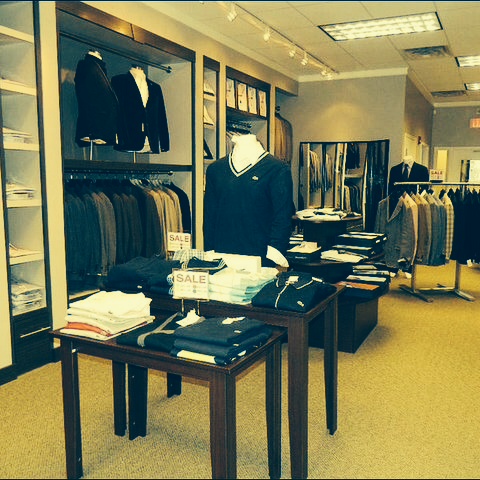 Since my brain is on the subject of insurance for retail clothing stores, i wanted to share a brief risk summary that you should think about if you own a retail clothing store.
Property exposures are limited, but if a fire should occur, the clothing provides a combustible fire load and is highly susceptible to water and smoke damage. Theft may be a concern if any of the items sold have high value. Appropriate security measures should be in place.
Crime exposures are from Employee Dishonesty and Theft of Money and Securities either from holdup or safe burglary. Employee dishonesty is controlled through inventory monitoring, control of the cash register, disciplined controls and division of duties. Theft prevention requires controls of monies kept in the cash drawers and regular bank drops.
Premises liability is always a concern in a retail exposure where the public comes to the premises. Floor covering must be in good condition with no frayed or worn spots on carpet and no cracks or holes in flooring. Sufficient exits must be provided and be well-marked, with backup systems in case of power failure. Dressing rooms must be well maintained and privacy carefully guarded. Shoplifting procedures must be fully understood and utilized by all employees.
Parking lots and sidewalks need to be in good repair with snow and ice removed, and generally level and free of exposure to slip and fall. If the business is open after dark, adequate lighting and appropriate security for the area must be present.
Products liability for this type of operation is normally low. Direct importing of clothes and tailoring can add to the exposure.
Workers compensation exposure is from lifting, which can cause back injury, hernia, sprain, and strain. What kind of training do employees receive, and what types of material lifting or conveying devices are used? If tailoring services are offered, injuries due to sewing and cutting injuries are possible.
Minimum recommended coverage:
Business Personal Property, Business Income, Employee Dishonesty, Money and Securities, Accounts Receivable, Computers, General Liability, Employee Benefits, Umbrella, Hired and Nonownership Auto, Workers Compensation. Many of these coverage’s can be included within a single Businessowners insurance policy.
Other coverages to consider:
Building, Leasehold Interest, Real Property Legal Liability, Forgery, Computer Fraud, Bailees Customers, Fine Arts, Employment Related Practices, Business Auto Liability and Physical Damage.
Have a retail clothing store and need some guidance on your insurance? You can contact me anytime to discuss. I’d be happy to help you out.
-JK
Source: Rough Notes, Inc
The Cost of NOT Buying Insurance. A True Story
Last week I got a phone call from a guy (a business owner) who sounded totally panicked. I could hear it in his voice immediately. Panicked about the need for workers’ compensation insurance. The conversation started casually,
“Um, yeah, we need a workers’ compensation insurance policy to cover our employees.”
We talk for a bit as I try to get an understanding of his current situation.
“Well it was something we kind of, um, overlooked over the past couple years.”
“Past couple years?” I ask. “So why are you suddenly looking for a policy now?”
Still no direct answer.
“Have you had any claims or losses in the past 3 years?” I ask.
I didn’t need to ask much more.
“Yes, I received notification from an attorney about a former employee of mine.”
The business, a retail bakery, received a letter from an attorney in the mail. It turns out a former employee who quit over a month ago dropped a bomb with a claim for cumulative trauma to the feet, back, neck, knees.
So here this business is at a point with a serious issue to contend with. They didn’t buy workers compensation insurance policy when they first hired employees. Their reasoning was they just didn’t want to incur the costs and figured this could never happen to them.
As an insurance resource partner, I hear this way too often from prospective clients trying to save money on insurance. Not just for workers compensation insurance either. This is for all lines of insurance like general liability, errors & omissions, property, etc.
Buying a workers compensation policy now will not do anything to help this business for a loss that has already occurred. You cannot buy a workers compensation policy with retroactive coverage. That’s like buying a health insurance policy after getting sick. This retail bread bakery is going to have deal with this claim on their own, without the support of insurance.
As if the day-to-day stress of operating a business isn’t enough, throwing this claim into the mix is sure to make things much more challenging from both a time and cost standpoint.
It doesn’t end here. In addition to handling this claim on their own, finding workers compensation insurance coverage at a reasonable cost moving forward with a standard carrier is going to be pretty much impossible. Any underwriter who sees a business with active employees and no insurance for over two years AND a claim?? No way. Costs now will be more than they would have ever paid if they secured insurance before they hired new employees.
Another potential problem this business could face is:
“It is a criminal offense for an employer to be unlawfully uninsured regardless of whether or not an employee is injured. California Labor Code Section 3700.5 specifies that it is a misdemeanor punishable by either a fine of up to $10,000 or imprisonment in the county jail for up to one year, or both. In addition, the state issues penalties of up to $100,000 against illegally uninsured employers. If an employee is injured, the employer is responsible for paying all benefits and may be subject to additional liability.”
So I ask you business owners out there, are you avoiding buying insurance because you feel it costs too much? Are you one of those who think a loss will never happen to you?
Well I recommend you think again. If this scenario isn’t enough to get you to think twice, there’s probably not a whole lot more that will. Put yourself in this business owners shoes. How much do they wish now that they were paying a workers compensation premium over the past two years for a policy to help now when they need it most?
It will be interesting to see how things pan out for this business, but one thing’s for sure, this mistake could put them out of business for good depending on the ultimate severity of the claim.
Can you afford to not carry insurance? The cost of not buying it in some form or another could be the demise of your business and livelihood depending on the severity of a loss.
-JK
Fire Burns Through La Bodega Market In Long Beach
A two-alarm commercial building fire burned through La Bodega Market on 7th and Magnolia in Long Beach on Monday night. Long Beach Fire Department received the first report of a fire at 9:27PM. According to the Long Beach Fire Department, the building was heavy with smoke and fire upon first arrival and a second alarm was called within a minute. For the full story, read about it HERE in the Long Beach Post.
Here’s some video from the Long Beach Post of the fire:
Have a small business in Long Beach? When’s the last time you reviewed your business insurance policies to make sure your coverage is sufficient and accurate? Make sure you’re reviewing your policies at least annually with your insurance agent or broker.
Beyond insurance, you might want to consider establishing a fire prevention plan or a business continuity and recovery plan. If you need help in any of these areas, I have some resources that I can help you with. You’re welcome to contact me anytime to discuss.
-JCK
Why Are My Insurance Rates Going Up??
As we’re halfway through 2013, many businesses are finding their insurance premiums increasing at renewal. This is mostly the case for workers compensation insurance here in California. We’re certainly seeing this for a majority of our clientele regardless of their industry or loss history. Calls come in asking, “why the hell is my premium going up?? I don’t have any losses and I’ve been a loyal customer paying my premiums on time for years and years.”
The property & casualty (P&C) insurance market cycle is cyclical to some extent like the real estate market. It’s characterized by periods of soft market conditions, in which premium rates are stable or falling and insurance is readily available, and by periods of hard market conditions, where rates rise, coverage may be more difficult to find and insurers’ profits increase.
The P&C insurance market has been soft over the past 6-7 years, but beware, that’s starting to change.
A driving factor in the P&C insurance market cycle is intense competition within the industry. Premium rates drop as insurance carriers compete vigorously to increase market share. As the market softens to the point that profits diminish or vanish completely, the capital needed to underwrite new business is depleted. In the up phase of the cycle, competition is less intense, underwriting standards become more stringent, the supply of insurance is limited due to the depletion of capital and, as a result, premiums rise. The prospect of higher profits draws more capital into the marketplace leading to more competition and the eventual down phase of the cycle.
The chart below shows the real, or inflation-adjusted, growth of P&C net written premiums over more than three decades and three hard markets. This chart uses net written premiums, which reflect premium amounts after deductions for reinsurance transactions.
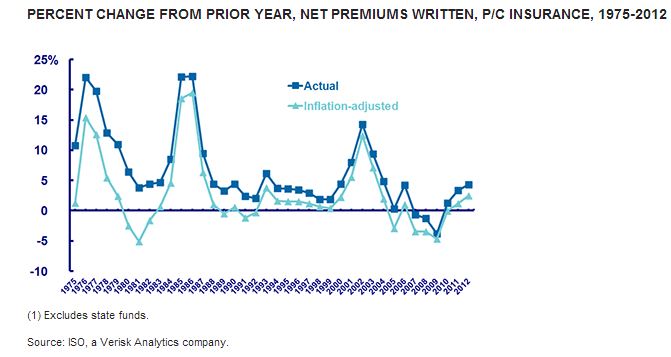
During the last three hard markets, inflation-adjusted net premiums written grew 7.7 percent (1975 to 1978), 10.0 percent (1984 to 1987) and 6.3 percent (2001 to 2004).
If you’re renewal premium is going up, contact your independent insurance broker to discuss ways to help curb the costs. If you’re not getting the service you expect from your broker, contact me and we can discuss your situation and review ways to find a resolution.
-JK
Credit: Insurance Information Institute
Professional Liability Insurance Coverage For Technology Businesses
Every business has unique risks that can seriously harm an organization’s operations if not properly protected against. As a business utilizing technology to produce and deliver products and/or services, it’s important to recognize and take precautions against risks that your Commercial General Liability insurance coverage does not include.
Technology Professional Liability insurance coverage, also referred to as Tech Errors and Omissions (E&O) insurance, is essential for companies using technology because it addresses a lack of protection in Commercial General Liability policies, which typically do not cover claims of third-party financial harm.
Who needs Tech E&O Coverage?
Not only technology industry businesses have technology-related risks. Most companies today utilize technology in some part of providing a service or product and need to take the necessary precautions. To ensure your company is covering all bases, a full risk management assessment is needed.
What does Tech E&O cover?
Tech E&O insurance manages risks, resulting from providing a product or service to a third party, that are not covered by a Commercial General Liability insurance policy. Specifically, Tech E&O insurance protects your business in the event that a third party suffers a financial loss due to your product or service not performing as it was intended or expected, including the event of an error or omission committed by your company. These insurance policies also cover defense costs in the event of litigation.
Tech E&O coverage would apply in the following situations:
- A mistake was made and an error in the code of a website or program your company produced isn’t found before it is implemented. A third party depends on this product or service to operate its business and its operations are stalled due to the error, causing them a financial loss.
- A part your company produces is installed in a piece of equipment. After a short amount of time, the component simply stops working, causing the equipment to fail to work, but otherwise not damaging anything or hurting anyone. The third party that relies on this equipment for its business has to stop operations and suffers a financial loss.
- An employee of your company recommends that a client make an adjustment to its network. The client follows the advice and its network crashes as a result, causing a time and financial loss for its operations.
In all of these cases, Commercial General Liability insurance coverage would not cover a claim or any costs of litigation because of the presence of an error and the lack of resulting physical damage to the third party’s property.
Contact me anytime to learn more about protecting yourself with a comprehensive professional liability insurance policy.
Credit: Zywave
FEMA Wireless Emergency Alerts
Today the The Ready Campaign and the Ad Council released a new Public Service Announcement to help Americans Prepare for Severe Weather with Wireless Emergency Alerts (WEAs). There are many things that can save your life, and now your phone could be one of them. For more information visit www.Ready.gov/alerts.
You do not need to register to receive Wireless Emergency Alerts notifications. You will automatically receive alerts if you have WEA-capable phone and your wireless carrier participates in the program. To find out if your mobile device is capable of receiving WEA alerts, contact your mobile device carrier or visit this CTIA Customer Info Page
–JK
Retailers with Sales in CA at Risk of Penalties Following State Court Decision
A recent decision by the California Supreme Court has placed retailers and other businesses that obtain and record personally identifiable customer information during point-of-sale transactions in the state at risk of significant penalties.
 Retailers with transactions in California are being named in class-action lawsuits following a February 2011 California Supreme Court decision, Pineda v. Williams Sonoma Stores, Inc. The decision found that the state’s Song-Beverly Credit Card Act of 1971 prohibits retailers and other businesses engaged in credit card transactions from collecting and recording customer information such as zip codes or any other personally identifiable information not provided by the credit card itself during point-of-sale transactions.
The statute authorizes penalties of up to $1,000 for each transaction that violates the statute. While coverage will depend upon the claimant’s allegations, the loss is likely not covered by a business’ general liability insurance policy.
A retailer may be headquartered anywhere in the country, but only the transactions conducted in the state of California are subject to the statute and its penalties.
Retailers with California transactions, consider the following tips:
- Do not ask for customer zip codes, even if only for marketing or security purposes. Asking for this information is risky.
- If retailers use zip codes for security measures, instead ask to see customers’ driver’s license or other forms of identification, but don’t record the information.
- If a retailer has been recording zip code information, even if only for marketing purposes, seek legal counsel.
Source: The Hartford
Tustin, CA Commercial Office Building Burns In Massive Fire
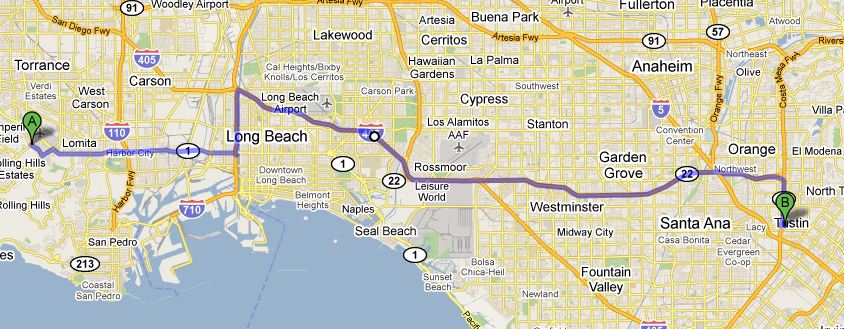 Not far from our office in Torrance, about 35 miles east in the city of Tustin, two firefighters were injured while battling a massive fire in a 50,000-square-foot commercial building on Tuesday.
The fire erupted inside the Maxim Healthcare building which is ironically the company I used to work for almost four years ago before I transitioned into the insurance world.
“All of a sudden, the glass just burst out of the first floor window, and flames immediately started coming out,” said a Maxim Healthcare employee. Firefighters had difficulties dealing with the massive 6-alarm fire. There were people inside the building at the time the fire was reported, however everybody got out okay.
The building was filled with years of important medical files and records. “All of our records were in there, either on the computer or on paper, so they’re up in flames,” said one Maxim employee. The flames were so intense that at one point, firefighters had to back out of the structure, and smoke could be seen for miles. About 100 firefighters responded, but an official cause of the fire has not been determined.
Here are pictures taken from the scene:


Large local fires like these always hit closer to home and make people realize it could happen to anyone, anytime. What if this happened to your building, your business, your office? Are you prepared?
7 tips for fire preparedness planning:*
- Establish an Evacuation Plan: Be sure everyone can get out quickly in an emergency. Designate primary and secondary evacuation routes and exits. Make sure these routes are clearly marked, well-lit, wide enough, and clear at all times. Train your employees in evacuation procedures and practice at least annually.
- Keep an updated list of telephone numbers, including emergency personnel, hospital, public health, utilities,insurance agent, and disaster relief agencies. Include contact names and telephone numbers for customers, suppliers, and distributors. Keep a copy off site
- Protect vital records critical to your business (e.g., financial statements, account information, blueprints, product lists, etc.) Select a safe that has been tested and listed by Underwriters Laboratories UL rates safes for resistance to fire and heat, as well as resistance to burglary tools and torches. Or, keep copies offsite if possible.
- Back up all critical electronic data and programs at least daily. Backing up these valuable assets can help a business recover from a data loss or hardware failure and get back online quickly.
- Secure backup copies of critical data and programs in a physical location separate from your premises to protect against damage from theft, fire, water and other physical hazards.
- Review your current property insurance policy with your insurance agent. Be sure that you understand the coverages (e.g., buildings, personal property, personal property of others, business income, etc.), deductibles, and limits of insurance. You will need to buy separate policies for flood or earthquake damage as they are excluded perils on property insurance policies.
- Keep insurance information and contact names and numbers in a safe place. This will expedite the claim process in the event of a loss.
*Other or additional measures may be required. Talk to a risk management professional
Never think it can’t happen to you! Be prepared.
–JK
About Me

I grew up in Fullerton, CA and graduated from Servite High School in Anaheim. I have my Bachelors degree from Loyola Marymount University in Los Angeles. I currently live in Tustin, CA.
Please contact me if you need help with any of the following lines of insurance for your business:
-Cyber / Data Breach
-Commercial Property
-Commercial General Liability
-Products Liability
-Workers Compensation
-Commercial Auto
-Umbrella/Excess Liability
-Errors & Omissions/ Professional Liability
-Employment Practices Liability
-Directors & Officers
-Life & Disability Insurance
 Jimmy Kinmartin, CPCU