
Insurance Topics In the News (3/6-3/12)
- States Must Decide if Workers’ Comp Benefits Extend to Illegal Workers: (Read)
- Property & Casualty insurance workforce hit a 20-year low in January: (Read)
- THEN AND NOW: Long Beach Earthquake, 1933 & 2011
- Court: Former NFL Redskins Punter Can Collect Workers Compensation for back injury: (Read)
- Virgin Atlantic forced to pay $500,000 for massage injuries to employees: (Read)
- Japan Earthquake 2011: Devastating Photos Of The Wreckage
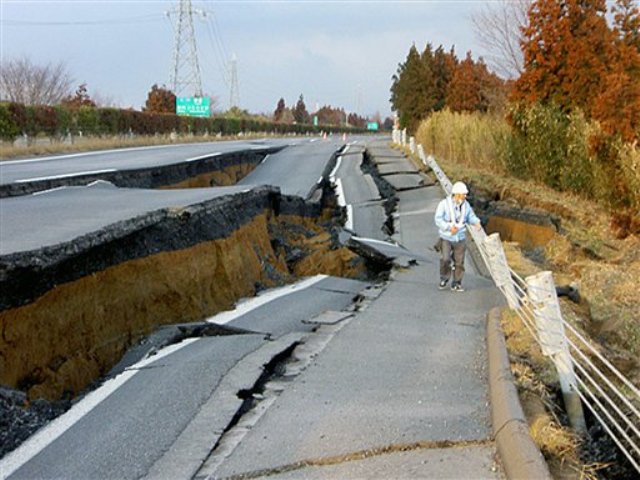
AP Photo/Nexco East Japan via kyodo News
–JK
Employee Benefits Liability
Do you offer employee benefits for your employees? If so, pay close attention to this subject: Employee Benefits Liability.
Picture this scenario:
Busy Betty, office manager for your small business, functions in countless different job capacities ranging from purchasing agent to human resources manager. One day while dealing with other urgent issues, Betty forgets to enroll a new employee on your firm’s medical insurance plan. The error isn’t discovered until the employee is hospitalized with a life threatening cancerous tumor and the bills started to roll in—over $300,000 in all.
What now?!
Well, in a case like this, it’s safe to assume that busy Betty (your business essentially) will be found liable for the damages. This is when you’re hoping you have an endorsement on your commercial general liability insurance policy known as “Employee Benefits Liability” coverage.
Carrying Employee Benefits Liability coverage means your commercial general liability insurance carrier will pay those sums that the you become legally obligated to pay as damages because of any negligent act, error, or omission committed in the “administration” of your employee benefit program, barring any exclusions. The amount of insurance paid is limited to the amount of liability coverage you carry on your general liability insurance policy.
“Administration” of employee benefit programs is defined as:
- Counseling employees, including their dependents and beneficiaries, with respect to your employee benefit program;
- Handling records in connection with your employee benefit program;
- or, effecting or terminating any employee’s participation in a plan included in the employee benefit program.
Employee benefit programs typically entail group life insurance, group accident or health insurance, profit-sharing plans, and pension plans.
Employee Benefits Liability coverage does not apply to losses arising out of any dishonest, fraudulent, criminal or malicious act or omission, committed by any insured; or claims or suits based upon failure of any investment to perform as represented by any insured; or advice given to any person to participate or not to participate in any plan included in the employee benefit program. Other exclusions apply, so keep a close eye on your policy forms. Here’s an example of a typical Employee Benefits Liability coverage form.
In most cases, minimal premium charges apply for this important endorsement (as low as $50 to $100 annually). This is a no brainer if you have an employee benefit program in force. Don’t waste time digging up a copy of your policy to confirm. Call your insurance agent today. Also keep in mind that this coverage is written on a claims made basis.
–JK
Gas Prices Up- Reduce Your Fuel Costs, NOW!
I don’t know about you, but as I have making my daily 40 minute commute to work, I’m seeing these gas prices skyrocketing by the hour it seems! I can’t help but notice the local gas station signs and their prices increasing over .07 cents a day! Whoever’s job it is to bring the pole out and update those numbers is working overtime. Here in LA, we’re above the $4 mark per gallon at some stations. In fact, I filled up my tank on Monday and my receipt came out to $62.70 and I’m not even driving a truck or an SUV. As if it isn’t frustrating enough for individuals, businesses with auto fleets are feeling more pain at the pump and it’s cutting into their bottom line.
Here are 10 Ways to Reduce Your Fuel Costs, NOW!
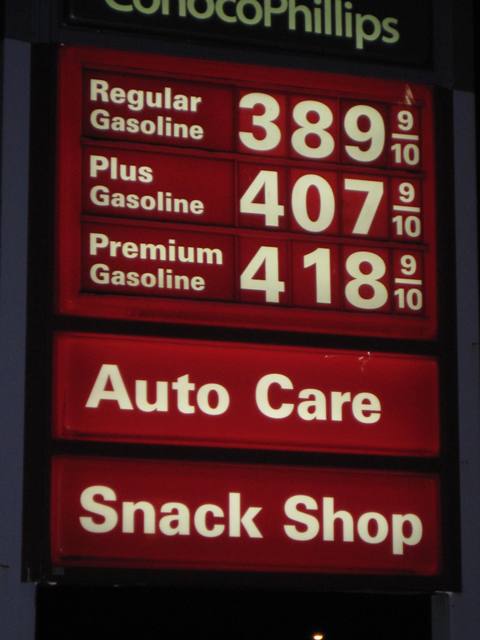
Here's a picture I took last night, 3/02, of a gas station sign in my neighborhood in Long Beach
Purchase Fuel Wisely – Save up to 20%
- Use the right grade of gasoline/ Don’t top off: most cars run fine on regular. Check your vehicle owner’s manual to find out what’s right for your car. (See regular vs. premium.) Don’t “top off” at the pump and make sure your fuel fill cap is on tight and working right. Regular grade fuel cost about 20-cents per gallon less than premium grade.
- Look for the Best Price / Limit Purchases When gas prices are High: Today’s gasolines provide very similar engine performance (although some brands have different gasoline blends that provide other benefits), so choose stations in your area with the lowest prices. Fuel prices can vary 10% within a few blocks. Avoid filling the tank during high-price periods.
Alter Travel Practices – Save up to 30%
- Use Carpooling/ Public Transit/ Non-Motorized Options: Ride the bus, carpool, bicycle or walk instead of driving alone. Sharing a ride to work with a friend or two effectively doubles your fuel economy for the trip and may allow you to use the diamond lane.
- Take Advantage of Telecommuting/ Telecommunications Technology: Many employers offer telecommuting as an option. Use the computer and telephone to replace vehicle trips for business, shopping and services when possible.
Drive More Efficiently – Save up to 20%
- Don’t Drive Aggressively/ Drive at the Speed Limit: Avoid aggressive driving and aggressive starts. All vehicles lose fuel economy at speeds above 55 mph. Driving 65 instead of 75 mph reduces fuel cost 13%. Driving 55 would save 25%.
- Reduce Air Conditioner Use/ Close Windows: Using the air conditioner increases fuel cost from 13% up to 21%. If it’s cool enough, use the flow-through ventilation instead of rolling down the windows or using the AC.
- Eliminate Extra Wind Resistance and Weight: Using a loaded roof rack increases fuel consumption. Carry the load inside your vehicle if you can. Removing unnecessary weight is better still.
- Minimize Vehicle Idling: Today’s vehicles are designed to warm up fast. Avoid idling when you can; idling is 0 miles per gallon.
Improve the Efficiency of the Vehicle You Drive – save up to 50%
- Maintain Vehicle Efficiency: Regular maintenance as prescribed by the vehicle owner’s manual will help your vehicle achieve its best fuel economy. Some overlooked maintenance items, such as a dirty air filter and under-inflated tires, can increase your fuel cost up to 13%. When replacing your tires, replace them with the same make and model as the tires that were on your vehicle when it was new. It’s been estimated that if all Californians properly inflated and aligned their tires, we’d save 300 million gallons of gasoline a year!
- Drive or Purchase a Fuel-Efficient Vehicle: Drive your most fuel-efficient vehicle whenever possible. When purchasing, consider the most fuel-efficient vehicle and save up to 50%. Consider a hybrid-electric, a diesel vehicle, or even a motorcycle. The next best option is to purchase the most fuel-efficient vehicle within the class of vehicles you are considering.
Final Word on Gasoline-Saving Devices
Please also be aware that many companies will try to sell you mileage improving devices. Some claim that they will save you 10 to 50%. Buyers Beware! The U.S. EPA and Federal Trade Commission have both said that there are no devices that will boost your mileage any appreciable amount. See web page for Energy Myths on Gasoline-Saving Products.
Source: California Energy Commission
-JK
California Business Owner Convicted of Insurance Fraud
Here’s a word of advice for you: If you’re a business owner, make sure you’re accurately reporting your payroll on your workers compensation insurance policy. If you are using subcontractors/ independent contractors to perform services for your clients, you must obtain a certificate of insurance from these contractors confirming they carry their own workers compensation insurance coverage. If not, you may be liable for any losses that occur as a result of the services they are performing for your business.
Here’s a friendly reminder that it doesn’t pay to cheat the system:
California insurance commissioner, Dave Jones, announced in a press release on 2/23 the conviction of a California business owner for insurance fraud and perjury. The case involves a $1.6 Million penalty for failure to pay premiums and failure to accurately report payroll.
Ronald J. Haas Sr., 69, has been convicted on 10 counts of insurance fraud for failing to accurately report payroll and for failing to pay insurance premiums to his workers’ compensation insurance carriers. Haas was sentenced to one year in the county jail and restitution to the entities involved, and three years probation.
“Workers’ compensation insurance fraud is an egregious offense and it will be fully investigated by my Department,” said Commissioner Dave Jones. “Those who would seek to cheat a fund to help workers who were legitimately injured will be prosecuted to the fullest extent of the law.”
On January 12, 2007, State Compensation Insurance Fund Special (SCIF) reported a suspected fraudulent claim to the California Department of Insurance Fraud Division for investigation of suspected workers’ compensation insurance premium fraud. The report alleged that Haas, President of R J Haas Construction Corporation, et al., Saratoga, CA, failed to accurately report employee payroll to his workers’ compensation insurance carrier, SCIF. From July 1, 1998 to June 1, 2005, Haas claimed that he had no employees and that sub-contractors did all the work for his company. However, during this period, four workers’ compensation claims were filed by injured employees. Haas reported payroll to SCIF only after an injury was discovered and then payroll reporting stopped shortly thereafter, with the cancellation of his policy. Subsequently, Haas obtained workers compensation insurance policies through First Comp and again reported minimal to no employees.
An investigation by the Silicon Valley Regional Office of the California Department of Insurance, Fraud Division and the California Employment Development Department (EDD) revealed that Haas misrepresented office staff, project superintendents, foremen, and even some of his own family members as subcontractors. A forensic audit was conducted and revealed that Haas owed $594,293.22 in insurance premiums to SCIF, $229,167.71 in insurance premiums to First Comp and $813,328.27 to EDD for failing to accurately report employee payroll for the purpose of determining employment tax liabilities.
On April 29, 2009, Haas was arrested for felony violations of Insurance Code. Haas is eligible to apply for a home electronic monitoring program in lieu of county jail time. At time of sentencing Haas had already paid the full amount of restitution owed to insurance carriers SCIF and First Comp and to EDD.
Source: California Department of Insurance
-JK
Insurance Topics In the News (2/20-2/26)
- Need an Employee Handbook? Download one here for free and customize.
- Employee Romances and Sexual Harassment – Double the Trouble When It Originates from the Top: Read
- New Zealand’s Earthquake May Become Costliest Insured Disaster Since 2008

A powerful earthquake struck one of New Zealand's biggest cities, Christchurch, Tuesday at the height of a busy workday, toppling tall buildings and churches, crushing buses and killing dozens of people in one of the country's worst natural disasters.
- Earthquake Safety – Prepare Your Workplace
- Caught on Tape: Slip and Fall Scams. Fraudulent claims drive up costs for everyone: ABC News
- Earthquake Early Warning System a Reality in California?
- California Workers’ Compensation Website To Verify Employers’ Insurance: Insurance Journal
- REPORT: Architects, Engineers Liability Rates to Go Up
- CA insurance commissioner announces conviction of s business owner for insurance fraud and perjury
–JK
Has An Earthquake Detection System Become Reality??
Plain and simple, natural disasters are horrendous! To put it politely, they S-U-C-K! Floods, tornado’s, hurricane’s, volcanic eruption’s, landslide’s, and notoriously here in California…earthquakes! All these natural disasters lead to some kind of loss, whether it be financial, environmental, or human loss. In most cases, there’s actually some degree of advanced warning as to when a natural disaster might strike. Take hurricane’s for example. We are able to pinpoint powerful storms in advance and prepare accordingly. If nothing else, this allows us to reduce the probability of human loss.
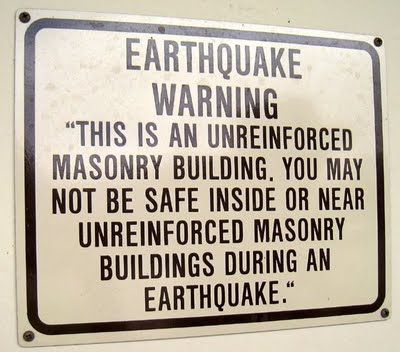 Unfortunately, advanced warning does not apply when it comes to the earth shifting, otherwise known as EARTHQUAKES! ………Or does it??
In an article published by Fox News, there is now “a state-of-the-art, first-in-the-world earthquake detection system in now installed and operational” in southern California, near Palm Springs, in the Coachella Valley. In fact, twelve locations are now in place with 120 sites planned, all meant to detect an earthquake and give people a chance to duck and cover, or brace themselves before the shaking begins.
This earthquake detection system was created by a company called QuakeGuard. The system works by way of sensors which are designed to detect the initial, or “P” energy waves given off by every quake, even though it’s only the later, or “S” waves that do all the damage. The time in-between the two waves varies depending on the proximity to the epicenter and as the first sensor closest to the quake goes off, it can offer advance notice — from a few seconds to a full minute– to other locations farther away.
The system can also be set to automatically open fire station doors, and water and gas valves for municipalities could be shut off. Back-up generators for hospitals could be turned on and, most importantly, warn school kids to duck and take cover.
Of the 12 sets of sensors currently set in place throughout the Coachella Valley in Southern California, all are tied to fire stations. Soon, they will be networked to every school in the area. Down the road, they can possibly be linked to hospitals, private businesses and even people’s homes.
A mobile system is also in development and would help rescue crews detect aftershocks. A few seconds could get rescuers out from under the rubble and thus out of harm’s way.
How great would this be for California or for any other regions affected by the earth moving?? It’ll be interesting to see how technology progresses. In this case, not soon enough! We can’t stop an earthquake, but it would be nice to be warned if one is on the way . The sudden jolt of the earth shifting is the probably the scariest part of an earthquake in my opinion. Let alone the damage and destruction that comes with it.
Would an earthquake detection system ease your fear of earthquakes?
–JK
Distracted Driving- Auto Accidents Don’t Announce Themselves
Have you seen this comical Lexus commercial on the air pertaining to distracted driving? This one really applies to everyone on the road. Auto accidents don’t announce themselves.
After watching the video, check out the tips below to avoid distracted driving. Be safe out there.
Tips to avoid distracted driving
- Be well rested and alert before driving.
- Keep safe driving as your first priority when driving.
- Consider taking a defensive driving course.
- Park to eat.
- Drink with a lid on your cup, only going slow and straight or stopped.
- Don’t hold a cup between your knees while driving.
- Pull to the curb to read a map or directions.
- Find out what landmarks are near your destination before arriving.
- Tell your passengers you need to keep your eyes on the road.
- Keep sun glasses within reach.
- Check rearview mirror BEFORE you enter a curve or turn.
- Keep both hands on the steering wheel in a curve or turn.
- Use restraints for your pet when you drive with them in the car.
–JK
Valentine’s Day: Big Love or Big Business?
Valentine’s Day. The day of love and romance? Or an excuse for consumerism and business opportunity? Everyone has their own take on the “holiday”. What’s yours?
To go along with the theme of the day, check out these Valentine’s Day statistics:
- 85% of all Valentine cards are bought by women.

- Chocolate and candy sales reach profits of $1,011 billion during Valentines
- 73% of flowers are bought by men, and only 27% are by women.
- Over 1 billion Valentine cards are exchanged in the U.S each year. It’s the largest seasonal card-sending occasion of the year, next to Christmas.
- About 3% of pet owners will give Valentine’s Day gifts to their pets.
- California produces 60% of American roses, but the vast number sold on Valentine’s Day in the United States are imported mostly from South America. Approximately 110 million roses, the majority of which are red, will be sold and delivered within a three-day time period.
- $72 is the average amount women spend on gifts on Valentine’s Day; $135 is the average amount men spend.
- 25% of people treat their significant others to an evening out.
- The main consumers of Valentine’s Day merchandise are between 25 and 34, with each spending an average of 164 dollars.
- Consumers are expected to purchase more than $345 million in chocolate candy during Valentine’s week, accounting for 5.1% of annual sales in the chocolate candy category. Consumers will purchase more than $448 million worth of total candy during Valentine’s week.
- Valentine’s week is one of the top weeks for sparkling wine sales, with more than $8.6 million in sales. More than 881,000 bottles of sparkling wine will be sold during the holiday week. Only Thanksgiving, Christmas and New Year’s have higher sales.
- Seventy million Americans will celebrate Valentine’s Day at a restaurant this year, according to the National Restaurant Association.

–JK
Back From A Break
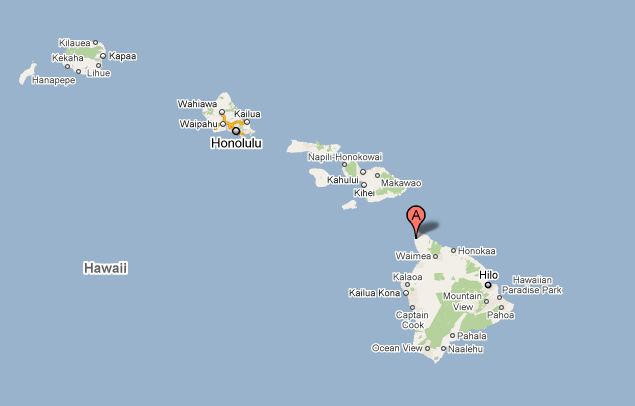
I was fortunate enough to have been in Hawaii for four days and have been away from the computer. It was a great little retreat. The weather was awesome and there was a lot of time to relax and take it all in. I have a ton of great pictures, but here’s a little video clip I took of the waves crashing on the rocks at Kapa’a Beach Park in Kamuela, HI which is about an hour drive from Kona:
Kapa’a Beach Park Kamuela, HI on the big map
Who has been to Hawaii? What’s your favorite island?
–JK
About Me

I grew up in Fullerton, CA and graduated from Servite High School in Anaheim. I have my Bachelors degree from Loyola Marymount University in Los Angeles. I currently live in Tustin, CA.
Please contact me if you need help with any of the following lines of insurance for your business:
-Cyber / Data Breach
-Commercial Property
-Commercial General Liability
-Products Liability
-Workers Compensation
-Commercial Auto
-Umbrella/Excess Liability
-Errors & Omissions/ Professional Liability
-Employment Practices Liability
-Directors & Officers
-Life & Disability Insurance

